
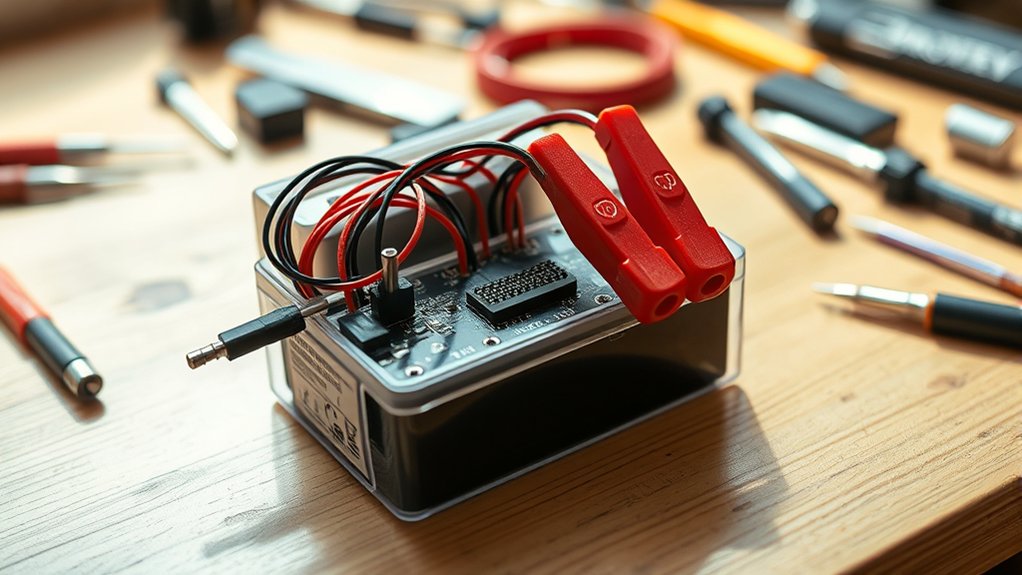
How to Make a Battery Charger
To make a battery charger, first select a stable power source with enough current capacity for your battery type. Use voltage regulators and current-limiting components to maintain safe charging parameters and prevent damage. Assemble the circuit with proper polarity, sturdy connections, and insulation.
Test the output with a multimeter before use, employing dummy loads and monitoring for heat or faults. Incorporate safety features like reverse polarity and overcurrent protection. With these basics, you’re set to explore advanced designs and troubleshooting tips.
Key Takeaways
- Use a stable power source with appropriate voltage and current for your battery type to ensure safe and accurate charging.
- Incorporate a voltage regulator and current limiting resistor to maintain consistent output and prevent battery damage.
- Add a diode to prevent reverse current flow and protect both the battery and charger circuitry.
- Test the charger output with a multimeter and a dummy load before connecting an actual battery to ensure correct operation.
- Prioritize safety by insulating all connections, using fuses or current limiters, and housing the charger in a durable enclosure.
Essential Components for a DIY Battery Charger
To build an effective DIY battery charger, you’ll need several essential components that assure safe and efficient charging. Start with a reliable power source, such as a transformer or DC power supply, to provide stable voltage and current.
Incorporate a voltage regulator to maintain consistent output, critical for protecting the battery from overcharging. Use a current limiting resistor or a dedicated current control circuit to prevent excessive current flow.
A diode is necessary to prevent reverse current, safeguarding both the battery and charger circuitry. Integrate a simple indicator, like an LED, to signal charging status. This keeps the design beginner friendly.
Selecting these components carefully not only enhances safety but also delivers significant cost saving compared to commercial chargers, making your DIY project both economical and effective.
Understanding Battery Types and Their Charging Needs
You need to identify the battery type—such as lead-acid, NiMH, or lithium-ion—since each demands specific charging protocols. Understanding their voltage, current limits, and charging phases ensures safe and efficient energy transfer. This knowledge forms the foundation for designing a reliable battery charger.
Common Battery Types
Batteries come in various chemistries and configurations, each with distinct charging requirements that directly impact charger design. You’ll commonly encounter lead-acid, nickel-cadmium (NiCd), nickel-metal hydride (NiMH), and lithium-ion (Li-ion) types.
Lead-acid batteries demand controlled voltage and current to prevent overcharging, essential for battery safety. NiCd and NiMH batteries tolerate higher charge rates but require careful termination to avoid memory effects and capacity loss.
Li-ion batteries are sensitive to voltage and temperature, necessitating precise voltage regulation and thermal management to ensure both battery safety and charger efficiency. Understanding these types helps you optimize your charger’s circuitry to match the battery’s chemistry, enhancing performance and lifespan.
Selecting the proper charging method directly influences energy transfer efficiency and minimizes risks associated with improper charging.
Charging Requirements Overview
How do different battery chemistries dictate the specific charging protocols required for safe and efficient energy transfer? Each battery type, whether lead-acid, NiMH, Li-ion, or others, has unique voltage thresholds, charge rates, and termination methods. You must tailor the charger design to these parameters to ensure charging safety, preventing overcharging, overheating, or capacity loss.
For instance, lithium-ion batteries require precise voltage regulation and current limiting, while lead-acid batteries benefit from multi-stage charging. Ignoring these needs risks reducing battery lifespan or causing hazardous failures.
Additionally, understanding battery disposal practices is critical; improperly charged or damaged batteries can leak toxins or explode. By aligning your charger’s output with the battery’s chemical profile and integrating safety mechanisms, you optimize performance and mitigate risks associated with charging and end-of-life disposal.
Choosing the Right Power Source for Your Charger
Where should you draw power to guarantee efficient and safe charging? Selecting the right power source is critical, as unstable sourcing can cause inconsistent current, potentially damaging your battery or charger circuit.
Additionally, you must consider regulatory hurdles, ensuring compliance with local electrical standards.
Focus on these factors when choosing a power source:
- Voltage Stability: Choose sources with minimal fluctuations to prevent overcharging or undercharging.
- Current Capacity: Ensure the source can deliver sufficient current without overheating.
- Regulatory Compliance: Verify certifications to avoid legal and safety issues.
- Availability and Reliability: Opt for widely available, dependable power sources to maintain consistent operation.
How to Assemble a Simple Battery Charger Circuit
Assembling a simple battery charger circuit requires careful attention to component selection and layout to ensure safe and efficient operation. Start by identifying components compatible with your battery chemistry, as voltage and current requirements vary significantly between lead-acid, NiMH, or lithium-ion cells.
Use resistors and diodes that can handle expected loads without overheating. When connecting the transformer, rectifier, and voltage regulator, maintain proper polarity and secure solder joints to prevent shorts.
Prioritize DIY safety by insulating exposed wires and incorporating fuses or current limiters to mitigate risks of overcurrent or reverse polarity. Arrange components on a non-conductive base, keeping spacing adequate for heat dissipation.
Following these precise assembly steps will help create a reliable charger tailored to your battery type while adhering to essential safety protocols.
Testing Your Homemade Battery Charger Safely
After completing the assembly of your battery charger circuit, verifying its functionality under controlled conditions is essential to guarantee safety and performance. Prioritize safe handling to prevent electrical hazards and component damage.
Before testing, review legal considerations related to electrical device compliance in your region. Follow these steps:
- Use a multimeter to measure output voltage and current without a battery connected.
- Connect a dummy load that matches the battery’s specifications to simulate charging conditions.
- Monitor the circuit for overheating or abnormal sounds during operation.
- Ensure all connections are insulated, and test in a well-ventilated area away from flammable materials.
Adjusting Voltage and Current for Safe Charging
Voltage and current adjustments are critical parameters that determine the safety and efficiency of your battery charger. You need to set the voltage precisely to match the battery’s rated voltage, avoiding overvoltage that can damage cells.
Current limits must be configured to prevent excessive charging rates, which compromise battery life and safety. Use proper charging cables with adequate gauge and insulation safety ratings to handle expected currents without overheating.
Incorporate thermal management strategies like heat sinks or fans to dissipate heat generated during operation. When designing for portable power applications, balance compactness with effective heat dissipation and current control.
Accurate voltage and current adjustment ensures stable charging profiles, protects battery integrity, and enhances overall charger reliability.
Adding Safety Features to Your Battery Charger
How can you guarantee your battery charger operates reliably under all conditions? Incorporating essential safety features is key to preventing damage and ensuring longevity. Start by integrating overcurrent and overvoltage protection circuits to avoid electrical faults.
Next, include temperature sensors that trigger shutdown if overheating occurs, aligning with safe handling protocols. Additionally, implement reverse polarity protection to prevent damage from incorrect connections.
Finally, design your charger enclosure following strict storage guidelines to protect components from dust and moisture. These measures will create a robust system capable of safe operation. Here’s a concise checklist:
- Overcurrent and overvoltage protection circuits
- Temperature sensors with automatic shutdown
- Reverse polarity protection mechanisms
- Durable enclosure adhering to storage guidelines
Troubleshooting Common DIY Battery Charger Issues
Encountering issues with your DIY battery charger is common, but diagnosing them systematically ensures efficient resolution. First, verify the lighting design indicators; if LEDs fail to illuminate correctly, check for loose connections or incorrect resistor values affecting current flow.
Next, inspect the battery housing for corrosion or improper contact points, which can disrupt charging cycles. Measure output voltage with a multimeter to confirm it matches your design specifications.
If you detect voltage irregularities, reassess your circuit components, especially the voltage regulator and transformer. Additionally, ensure the wiring adheres to your schematic to prevent shorts or open circuits.
Upgrading Your Charger for Different Battery Types
You’ll need to understand the specific chemistry of each battery type to adjust your charger’s voltage and current settings accurately. Modifying these parameters ensures efficient charging while preventing damage. Incorporate safety features that detect battery compatibility to protect both the charger and the battery during operation.
Understanding Battery Chemistry Differences
Understanding the fundamental differences in battery chemistry is essential when upgrading your charger to accommodate various battery types. Each battery operates based on distinct battery theory principles, driven by unique chemical reactions that affect charging behavior.
Recognizing these differences ensures your charger delivers appropriate energy, preventing damage and optimizing performance.
Key battery chemistry distinctions include:
Lead-Acid: Uses lead dioxide and sponge lead plates; slow chemical reactions require controlled charging.
Nickel-Cadmium (NiCd): Involves nickel oxide hydroxide and cadmium; tolerates higher charge rates but suffers memory effects.
Nickel-Metal Hydride (NiMH): Similar to NiCd but with different hydrogen storage chemistry; demands precise current control.
Lithium-Ion: Utilizes lithium cobalt oxide and graphite; sensitive to voltage and temperature due to complex electrochemical processes.
Understanding these chemical reactions guides effective charger modifications.
Adjusting Voltage and Current
How do you guarantee your charger delivers the correct voltage and current for different battery chemistries? Precise voltage regulation is essential, as each battery type requires a specific charging voltage to avoid damage or undercharging.
You need a reliable feedback mechanism, such as a voltage reference and comparator circuit, to maintain stable output voltage under varying load conditions. Current control is equally critical; implementing a constant current stage prevents excessive current that can overheat or degrade batteries.
Using adjustable current limiters or programmable current sources allows you to tailor the charging profile precisely. By integrating these two control aspects, voltage regulation and current control, you can upgrade your charger to accommodate diverse chemistries like Li-ion, NiMH, or lead-acid, ensuring optimal performance without compromising battery health.
Safety Features for Compatibility
Balancing voltage and current control alone doesn’t guarantee safe charging across various battery chemistries. To upgrade your charger for compatibility, you need to incorporate specific safety features rigorously validated through safety testing.
Start by ensuring accurate detection of battery type to adjust charging protocols dynamically. Prioritize component sourcing from reliable manufacturers to maintain consistent performance and reduce failure risks.
Implement these critical features:
- Overcharge and over-discharge protection circuits tailored to each chemistry
- Temperature sensors for real-time thermal management
- Reverse polarity and short-circuit protection
- Adaptive charging algorithms based on battery state and type
These elements, combined with thorough safety testing, enable your charger to handle different batteries safely and efficiently while minimizing hazards or damage.
Affordable Sources for DIY Battery Charger Parts
Where can you find reliable components without overspending? Start by sourcing inexpensive parts from reputable electronic surplus stores and online marketplaces specializing in DIY electronics. These platforms often provide essential components like resistors, capacitors, and voltage regulators at competitive prices.
When crafting marketing terms, focus on “bulk purchasing” and “second-hand electronics” to identify cost-effective options. Additionally, consider local maker spaces or electronics clubs where members share or trade parts, reducing your expenditure further.
Pay close attention to component specifications to ensure compatibility with your battery charger design, avoiding costly replacements. By combining analytical evaluation of part quality with strategic sourcing, you can maintain both performance and affordability in your project, optimizing your investment without compromising reliability or safety.
Frequently Asked Questions
How Do I Recycle Old Batteries Safely?
You should follow strict disposal guidelines by taking old batteries to designated recycling centers. Ensuring recycling safety involves avoiding damage or leakage and never discarding them with regular waste. This prevents environmental contamination and hazards.
Can I Use Solar Panels to Power My Charger?
You can harness the sun’s golden arrows by using solar panels to power your charger, but ensure solar efficiency aligns with your battery’s needs. Prioritize charge safety with proper voltage regulation and protective circuitry to avoid damage.
What Are the Environmental Impacts of Battery Chargers?
You’ll reduce environmental impacts by prioritizing solar charging and ensuring proper recycling safety for batteries and chargers. Improper disposal releases toxins, so focus on efficient energy use and responsible end-of-life handling to minimize ecological harm.
How Long Does a Typical Battery Charger Last?
You can expect a typical battery charger to last around 3 to 5 years with proper use.
Avoid longer charging times than necessary, as they can reduce battery longevity and charger efficiency over time.
Are There Any Smartphone Apps to Monitor Charging?
Yes, you’ll find numerous charging apps that provide detailed battery monitoring. These apps analyze charging speed, temperature, and health, helping you optimize charging cycles and extend battery lifespan through precise, real-time data and alerts.
Conclusion
By following these steps, you’ll build a battery charger that’s as reliable as a Swiss watch, tailored precisely to your battery’s needs. Understanding components, power sources, and safety ensures efficiency and longevity. Testing and troubleshooting sharpen your skills, while upgrades expand versatility.
Sourcing affordable parts keeps the project budget-friendly. With this methodical approach, you’ll confidently create a charger that performs flawlessly. This battery charger will meet the exacting demands of your DIY projects every time.