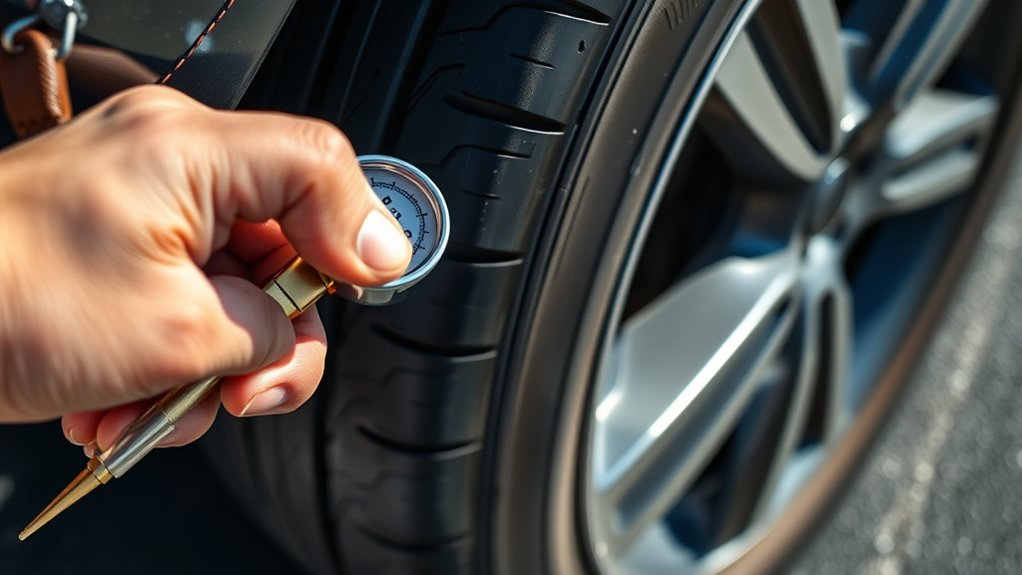
How to Check Tire Pressure
To check your tire pressure, start by parking your vehicle on a flat surface and making sure the tires are cold, ideally after at least three hours of inactivity. This ensures an accurate reading.
Next, remove each valve cap and firmly press a reliable tire pressure gauge onto the valve stem. Note the PSI reading and compare it to the manufacturer’s recommended range, which can be found on your vehicle’s door jamb.
If needed, adjust the air pressure using an air compressor. Repeat this process for all tires, then tighten the valve caps securely.
Properly managing tire pressure boosts both safety and performance. Understanding how to check tire pressure regularly will help you maintain optimal tire health.
Key Takeaways
- Park your vehicle on a flat surface and let tires cool for at least three hours before checking pressure.
- Remove the valve cap and firmly press a reliable tire pressure gauge onto the valve stem to get a reading.
- Compare the measured tire pressure to the manufacturer’s recommended PSI found on the driver’s door jamb.
- Repeat the process for all four tires and note any pressure discrepancies.
- Adjust tire pressure by adding or releasing air to match the recommended PSI for optimal safety and performance.
Benefits of Proper Tire Pressure for Safety and Performance
Maintaining the correct tire pressure considerably enhances both your vehicle’s safety and performance. When you keep your tires properly inflated, you ensure optimal contact between the tire tread and the road surface, reducing tire tread wear and improving handling.
Incorrect tire materials can exacerbate wear if combined with improper pressure, so it’s crucial to maintain the recommended psi to avoid premature degradation. Underinflated tires increase rolling resistance, which compromises fuel efficiency and causes uneven tire tread wear, while overinflated tires reduce traction and heighten the risk of blowouts.
Proper tire pressure also stabilizes your vehicle during braking and cornering, reducing stopping distances and increasing control. By regularly maintaining correct tire pressure, you extend tire life, optimize safety, and enhance your vehicle’s overall performance.
How to Check Your Tire Pressure Step by Step
How do you accurately check your tire pressure to ensure optimal vehicle performance and safety? Begin by brainstorming ideas to approach the task systematically. Follow these precise steps:
- Park your vehicle on a flat surface and let the tires cool down for at least three hours.
- Remove the valve cap from the tire and press a tire pressure gauge firmly onto the valve stem.
- Read the pressure measurement displayed and compare it against the manufacturer’s recommended PSI found in the owner’s manual or door jamb.
- Repeat for all four tires, noting any discrepancies and adjusting pressure as needed.
This step-by-step method eliminates guesswork, ensuring your tire pressures stay within ideal ranges. These ideas provide a clear framework for maintaining proper tire inflation efficiently.
Essential Tools for Checking Tire Pressure at Home
After understanding the proper procedure to check your tire pressure, gathering the right tools makes the process efficient and accurate. Essential tools help maintain optimal tire performance, improve safety, and adapt tire maintenance to varying road conditions.
| Tool | Purpose |
|---|---|
| Tire Pressure Gauge | Measures psi accurately to prevent over/under inflation |
| Air Compressor | Adds air precisely to meet recommended pressure |
| Valve Stem Caps | Protect valve from dirt and moisture |
| Tire Tread Depth Gauge | Assesses tire wear impacting road grip |
Using these tools regularly ensures your tires perform reliably, extending lifespan and improving fuel efficiency. Proper tire maintenance tailored to road conditions reduces risks, enhances handling, and promotes even tire wear. Keep these tools accessible for routine checks to stay safe and efficient on the road.
Understanding Tire Pressure Numbers Made Easy
Why do tire pressure numbers matter, and how can you interpret them correctly? Accurate interpretation ensures optimal vehicle performance and safety. Tire pressure is measured in PSI (pounds per square inch), and the ideal range is found on your vehicle’s placard, not the tire sidewall.
Here’s how to read them:
- Identify the recommended PSI on the driver’s door jamb.
- Compare it with the tire sidewall’s maximum PSI. Don’t exceed this.
- Use a reliable gauge to measure current pressure.
- Adjust to the recommended PSI, considering load and temperature.
Just as you wouldn’t ignore cooking recipes or skip planning travel destinations, don’t overlook tire pressure data. Proper understanding prevents wear, improves fuel efficiency, and keeps your ride safe.
When and How Often Should You Check Tire Pressure?
When should you check your tire pressure to maintain optimal performance and safety? You should check it at least once a month and before long trips or when carrying heavy loads. Tire pressure naturally decreases over time and with temperature changes, so regular checks prevent unsafe driving conditions.
Avoid treating this as an irrelevant topic or ignored concept; consistent monitoring ensures proper tire wear, fuel efficiency, and handling. Always check pressure when tires are cold, as driving heats them and skews readings.
Use a reliable gauge and compare results to the manufacturer’s recommended PSI, found on the driver’s door jamb or manual. Staying disciplined with these intervals will keep you safe and extend tire life without confusion or guesswork.
What to Do If Your Tire Pressure Is Too Low or Too High
Regularly checking your tire pressure helps you spot deviations before they cause problems, but knowing how to respond if the pressure is too low or too high is equally important. Low pressure can cause uneven tire tread wear and reduce fuel efficiency, while overinflation risks damaging low profile tires and compromising ride comfort.
Here’s what to do:
- If pressure is too low, inflate tires to the manufacturer’s recommended PSI using a reliable air compressor.
- For high pressure, release air slowly until you reach the optimal level.
- Inspect the tire tread for abnormal wear patterns that may indicate ongoing pressure issues.
- Avoid driving long distances on improperly inflated tires, especially low profile ones, to prevent structural damage.
Act promptly to maintain safety and extend tire lifespan.
How Temperature Changes Affect Your Tire Pressure and What to Do
You should know that tire pressure decreases as temperature drops and increases when it rises, affecting your vehicle’s performance. Adjust your tire pressure seasonally to maintain optimal levels based on manufacturer recommendations. Regularly monitor your tire pressure, especially during temperature fluctuations, to ensure safety and efficiency.
Temperature Impact On Pressure
How does temperature affect your tire pressure? Temperature directly influences tire inflation by causing pressure fluctuations. As temperature increases, air molecules inside your tires move faster, increasing pressure.
Conversely, colder temperatures slow molecular movement, decreasing pressure.
To manage this effectively:
- Check tire pressure when tires are cold for accurate readings.
- Use a reliable gauge to detect subtle pressure fluctuations.
- Adjust tire inflation promptly if you notice significant pressure changes.
- Monitor pressure regularly during temperature shifts to maintain optimal performance.
Understanding these principles helps you maintain proper tire inflation, ensuring safety and efficiency. Remember, pressure variations caused by temperature are normal, but consistent monitoring prevents under- or over-inflation, preserving tire integrity.
Seasonal Pressure Adjustments
Why do tire pressures fluctuate with the seasons? Air contracts in cold weather and expands in heat, causing pressure changes inside your tires. To maintain optimal tire calibration, you must perform seasonal adjustments as temperatures shift.
Here’s a quick guide:
| Season | Avg. Temp Change | Pressure Adjustment (psi) |
|---|---|---|
| Winter | -20°F to 32°F | Increase by 2-4 psi |
| Spring | 32°F to 68°F | Return to manufacturer’s recommended pressure |
| Summer | 68°F to 95°F | Decrease by 2-3 psi |
Adjust tire pressure when the temperature changes by 10°F or more. Use a reliable gauge and adjust when tires are cold. This ensures safety, efficiency, and prolongs tire life through precise seasonal adjustments.
Monitoring Tire Pressure Regularly
Regularly monitoring tire pressure is essential to maintain optimal performance and safety, especially as temperatures fluctuate. Changes in temperature directly affect tire pressure: for every 10°F drop, pressure decreases about 1 psi.
To stay ahead, follow these steps:
- Check tire pressure weekly, ideally in the morning when tires are cold.
- Use a reliable tire pressure gauge to avoid inaccurate readings.
- Adjust pressure according to your vehicle’s recommended psi, compensating for temperature shifts.
- Record pressure readings to identify trends and prevent an unrelated topic, like a random discussion, from distracting you during checks.
Ignoring temperature effects can lead to underinflation or overinflation, reducing tire lifespan and compromising safety. Consistent monitoring ensures your tires perform efficiently under all conditions.
Tips for Maintaining Proper Tire Pressure on the Go
Carry a portable pressure gauge to quickly measure your tire pressure anywhere. Check your tires when they’re cold for the most accurate readings. Use quick pressure check techniques to spot underinflation before it affects your safety or performance.
Portable Pressure Gauge Use
How can you guarantee your tires stay properly inflated when you’re away from home? Using a portable pressure gauge ensures tire safety by letting you monitor pressure anytime. Here’s how to maintain accuracy and effectiveness:
- Check gauge calibration regularly to ensure precise readings.
- Remove valve caps and press the gauge firmly onto the valve stem without air leaks.
- Read pressure immediately to avoid inaccurate measurements due to air loss.
- Store the gauge properly in a clean, dry place to prevent damage and maintain calibration.
Quick Pressure Check Tips
Where should you focus your attention when performing quick tire pressure checks on the go? Prioritize measuring each tire’s pressure with a reliable portable gauge before driving. This ensures a quick balance and prevents uneven wear.
Listen for unusual road noise. This often signals improper tire pressure or imbalance. Always check when tires are cold for accurate readings.
| Tip | Purpose |
|---|---|
| Check pressure cold | Accurate measurement |
| Use portable gauge | Immediate, precise readings |
| Monitor road noise | Detect pressure or balance issues |
Frequently Asked Questions
Can Incorrect Tire Pressure Affect Fuel Efficiency Significantly?
Yes, incorrect airflow from improper tire pressure causes increased rolling resistance, lowering fuel efficiency substantially. You’ll also risk tire fines for unsafe conditions.
Regularly check and adjust pressure precisely to optimize performance and avoid penalties.
How Does Tire Pressure Impact Tire Wear Patterns?
Imagine uneven tire wear patterns as a jagged mountain range. When your tire pressure’s off, tread depth wears unevenly. Overinflation causes center wear, and underinflation wears edges.
You must maintain proper pressure for even, lasting tread depth.
Are Tire Pressure Monitoring Systems Reliable for All Vehicles?
You shouldn’t assume tire pressure monitoring systems offer reliability across ecosystems; their monitoring technology limitations vary by vehicle model, sensor type, and environmental conditions. Always verify system compatibility and calibrate regularly for accurate readings.
Can Overinflated Tires Cause Damage to Suspension Components?
Yes, overinflated tires increase suspension wear by transmitting harsher impacts, compromising tire integrity and causing premature damage.
You should maintain recommended pressure to protect suspension components and guarantee balanced tire performance and longevity.
What Are the Signs of a Slow Tire Leak Besides Pressure Loss?
Think of slow leak clues as whispers from your tire: subtle vibrations, uneven tread wear, or faint hissing sounds.
Maintain a strict inspection cadence to catch these signs early and prevent sudden pressure loss or damage.
Conclusion
Maintaining proper tire pressure is like keeping your vehicle’s heartbeat steady—essential for safety and peak performance. By regularly checking and adjusting pressure, you ensure your tires grip the road firmly, avoid premature wear, and optimize fuel efficiency.
Use your gauge as a trusted compass, guiding you through varying temperatures and driving conditions. Stay vigilant, and your tires will reward you with smooth, reliable journeys every time.
Remember, knowing how to check tire pressure is key to keeping your vehicle safe and running efficiently. Make it a regular habit for the best results.