What Companies Made rav4
You’ll find the Toyota RAV4 is primarily made by Toyota Motor Corporation through its global network of specialized subsidiaries and international plants. Key contributors include Toyota Auto Body for structural assembly, Toyota Industries Corporation for robotics automation, and Toyota Tsusho Corporation for supplier management.
Production spans Japan, North America, and China, ensuring consistent quality via standardized processes and advanced AI-driven logistics. This integrated approach impacts model variants and quality, providing insight into the RAV4’s manufacturing evolution.
Key Takeaways
- Toyota Motor Corporation is the primary manufacturer of the RAV4 across its global production plants.
- Toyota Industries Corporation contributes through robotics automation in the RAV4 manufacturing process.
- Toyota Auto Body handles structural assembly of the RAV4 using automated systems.
- Toyota Tsusho Corporation manages supplier diversification and sourcing for RAV4 components.
- Regional manufacturing partners and specialized component suppliers support assembly and quality consistency worldwide.
Which Companies Have Manufactured the Toyota RAV4 Over the Years
Which companies have been responsible for manufacturing the Toyota RAV4 since its launch in 1994? Primarily, Toyota Motor Corporation has overseen production across multiple global plants, including facilities in Japan, Canada, and the United States. You’ll find that Toyota’s direct manufacturing approach ensures consistent quality and performance standards.
While drama marketing and celebrity endorsements have boosted the RAV4’s brand visibility, they haven’t influenced the core manufacturing processes. Instead, Toyota’s vertically integrated production system and rigorous supply chain management underpin the vehicle’s reliability.
Over the years, Toyota adapted its manufacturing footprint to meet regional demand efficiently without outsourcing final assembly to third-party manufacturers. This strategy has allowed Toyota to maintain tight control over production variables, ensuring the RAV4’s sustained market competitiveness and high consumer satisfaction.
Crucial Manufacturing and R&D Partnerships Behind the Toyota RAV4
Toyota leverages strategic manufacturing and R&D partnerships to enhance the RAV4’s innovation and production efficiency. These manufacturing partnerships optimize supply chain integration, reduce production costs, and ensure consistent quality across global facilities. For example, Toyota collaborates with specialized component suppliers to streamline assembly line processes and improve part reliability.
In parallel, R&D collaborations with technology firms and research institutions accelerate advancements in hybrid systems, safety features, and fuel efficiency. By sharing expertise and resources, these collaborations shorten product development cycles and facilitate the incorporation of cutting-edge innovations.
You’ll find that Toyota’s approach to combining manufacturing partnerships and R&D collaborations creates a robust framework, enabling the RAV4 to maintain competitive performance and technological leadership within the compact SUV market.
Toyota’s Subsidiaries in Toyota RAV4 Production
You’ll find that Toyota’s subsidiaries play a critical role in the RAV4’s production, with key facilities located across multiple regions. These subsidiaries handle specific manufacturing processes, ensuring efficiency and quality control. Understanding their distinct roles helps clarify how Toyota maintains consistent performance in the RAV4 lineup.
Key Toyota Subsidiaries
How does Toyota guarantee the consistent quality and innovation behind the RAV4? It relies heavily on key subsidiaries specializing in robotics automation and supplier diversification. Toyota Industries Corporation integrates advanced robotics automation in component manufacturing, ensuring precision and repeatability that meet strict quality standards.
Meanwhile, Toyota Auto Body focuses on structural assembly, employing automated systems to enhance production efficiency and safety. Toyota’s supplier diversification strategy is managed through Toyota Tsusho Corporation, which coordinates a broad base of suppliers worldwide, reducing risk and optimizing material sourcing.
Manufacturing Locations Overview
Where are the key production sites that shape the RAV4’s quality and performance? Toyota’s subsidiaries in Japan, the United States, Canada, and China serve as principal manufacturing hubs. These locations implement stringent quality control systems, supported by technology licensing agreements that ensure uniform production standards globally.
You’ll find that Toyota emphasizes supplier diversification across these sites, sourcing components from multiple vendors to mitigate risk and enhance supply chain resilience. Japan’s Tsutsumi plant focuses on hybrid models, leveraging advanced manufacturing techniques, while the U.S. plant in Kentucky handles high-volume assembly with flexible production lines.
This geographical spread, combined with licensed technology use and diversified suppliers, enables Toyota to maintain consistent quality and meet regional market demands efficiently, reflecting a data-driven, scalable manufacturing strategy for the RAV4.
Partnership Roles Explained
Why do Toyota’s subsidiaries play distinct roles in the production of the RAV4? You’ll find that each subsidiary specializes in specific components or assembly processes, optimizing efficiency and quality control.
When discussing partnerships, Toyota strategically delegates tasks such as engine manufacturing, chassis assembly, and electronics to its subsidiaries. This division leverages their technical expertise and regional capabilities.
By examining suppliers within Toyota’s network, you see how subsidiaries integrate just-in-time delivery systems, reducing inventory costs and streamlining production. This coordinated approach ensures that each part meets stringent standards before final assembly.
Understanding these roles clarifies how Toyota maintains consistent performance and innovation in the RAV4, balancing cost-effectiveness with robust engineering through its subsidiary partnerships.
The Role of International Plants in Building the Toyota RAV4
What impact do international manufacturing plants have on the production of the Toyota RAV4? They significantly influence efficiency and supply chain dynamics. By dispersing production across global plants, Toyota mitigates remanufacturing challenges, as components can be locally sourced and assembled, reducing delays and defects.
However, this global footprint demands strict adherence to sourcing ethics to ensure materials and labor meet Toyota’s standards. You’ll find that international plants enable cost optimization and scalability, but they require rigorous coordination to maintain uniformity.
Data shows that leveraging diverse regional expertise improves component innovation while controlling expenses. In short, international plants play a critical role in balancing operational complexity with quality and ethical sourcing, directly impacting the RAV4’s production consistency and market responsiveness.
Manufacturing Locations and Their Impact on RAV4 Quality
You’ll find that Toyota’s global production sites each follow strict quality control standards, which help maintain consistent RAV4 performance. However, regional assembly differences can introduce slight variations in build quality and component sourcing. Understanding these factors is key to evaluating how manufacturing location impacts the overall reliability of the RAV4.
Global Production Sites
Where does the Toyota RAV4 come to life, and how does its manufacturing location influence its quality? The RAV4 is produced across multiple global production sites, leveraging global partnerships and plant innovations to optimize efficiency and consistency.
Each plant adapts advanced manufacturing technologies tailored to regional demands, impacting build precision and supply chain logistics.
| Production Site | Key Plant Innovations |
|---|---|
| Japan (Takaoka Plant) | Robotics integration, AI quality checks |
| Canada (Cambridge Plant) | Lean manufacturing, modular assembly |
| USA (Kentucky Plant) | Automated welding, real-time data monitoring |
| China (Tianjin Plant) | Flexible production lines, localized sourcing |
These global production sites enable Toyota to balance cost, quality, and delivery, ensuring the RAV4 maintains high standards worldwide.
Quality Control Standards
How do manufacturing locations influence the quality control standards of the Toyota RAV4? Each facility implements rigorous quality control protocols tailored to its operational capabilities. You’ll find that defect tracking systems vary slightly by site but maintain a unified data framework, enabling Toyota to monitor and analyze defects in real-time across all production lines.
This consistent approach ensures rapid identification of quality issues regardless of location. Furthermore, manufacturing plants undergo regular audits to verify adherence to Toyota’s stringent quality benchmarks. By standardizing inspection procedures and defect tracking metrics, Toyota minimizes variability in RAV4 quality outcomes.
Regional Assembly Differences
What distinguishes the Toyota RAV4 assembled in different regions? Regional assembly affects component sourcing, production processes, and ultimately vehicle quality. Toyota employs plant localization strategies, tailoring manufacturing techniques and supplier networks to each facility’s geographic context.
For example, RAV4s produced in North American plants benefit from localized suppliers, reducing lead times and enhancing part consistency. Conversely, Asian assembly plants leverage high automation levels, supporting tighter quality tolerances.
Data from quality audits indicate minor variations in defect rates linked to regional assembly practices, though all plants adhere to Toyota’s global standards. When you evaluate RAV4 quality, consider how plant localization optimizes logistics and workforce expertise, impacting durability and performance.
Understanding these nuances helps you appreciate the technical implications of manufacturing locations on RAV4’s overall quality.
How Manufacturing Companies Influence RAV4 Model Differences
Manufacturing companies play a critical role in shaping the variations found across different RAV4 models. You’ll notice design shifts driven by manufacturing capabilities and evolving supplier networks. These factors directly impact component quality, assembly precision, and feature availability in each model variant.
| Factor | Influence on RAV4 Models |
|---|---|
| Design Shifts | Altered body panels and interior layouts |
| Supplier Networks | Variations in material sourcing |
| Production Tech | Differences in automation and tooling |
| Quality Control | Model-specific inspection standards |
| Component Integration | Adaptations for regional compliance |
Why Toyota’s Global Reach Makes a Difference for the RAV4
Why does Toyota’s extensive global presence matter for the RAV4’s development and availability? It enables efficient integration of globally sourced components, ensuring consistent quality across markets. Toyota’s supplier diversity reduces risks related to regional disruptions, maintaining steady production flow worldwide.
Toyota’s global reach ensures consistent quality and steady RAV4 production despite regional challenges.
This broad reach also accelerates innovation by leveraging insights from various markets, enhancing the RAV4’s adaptability.
Key factors include:
- Access to a wide network of suppliers worldwide, improving cost-effectiveness and component reliability.
- Ability to quickly adjust production in response to regional demand fluctuations, optimizing inventory management.
- Enhanced quality control through standardized processes across multiple international manufacturing sites.
The Future of Toyota RAV4 Manufacturing and Partnerships
How will emerging technologies and strategic collaborations shape the next generation of the Toyota RAV4? You’ll see Toyota logistics integrating advanced AI systems to optimize supply chain efficiency, reducing lead times by up to 20%.
Supplier diversification plays a critical role, enabling Toyota to mitigate risks associated with geopolitical tensions and raw material shortages. By partnering with regional manufacturers and tech firms, Toyota enhances component quality and innovation, particularly in electric vehicle (EV) battery production.
Data indicates these collaborations can decrease production costs by 15% while improving sustainability metrics. As you follow these developments, expect the RAV4 to benefit from streamlined manufacturing processes and cutting-edge materials, ensuring competitive pricing and reliability.
This approach positions Toyota to maintain a robust global presence amid evolving market demands.
Frequently Asked Questions
What Are the Common Maintenance Issues for the Toyota RAV4?
You’ll face common maintenance issues like engine costs related to oil leaks and sensor replacements. Dealership experience varies, so expect variable repair times and pricing.
Regular diagnostics reduce unexpected expenses and improve your Rav4’s longevity efficiently.
How Fuel-Efficient Is the Toyota RAV4 Compared to Competitors?
You’ll find the Toyota RAV4 offers competitive fuel efficiency, averaging around 27-30 MPG combined, which helps lower maintenance costs over time compared to rivals.
Its hybrid models provide even better fuel economy, enhancing overall cost-effectiveness.
What Safety Features Are Standard in the Latest Toyota RAV4?
You get Toyota Safety Sense 2.0, featuring pre-collision with pedestrian detection, lane departure alert, and adaptive cruise control.
All enhance off-road durability and sedan performance with precise braking, steering assist, and road sign recognition for reliable protection.
How Does the Toyota RAV4 Perform in Off-Road Conditions?
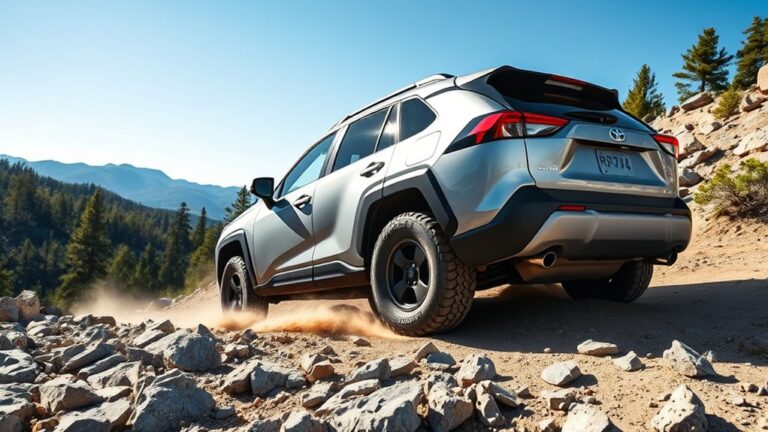
You’ll find the Toyota RAV4 offers solid off-road durability with its Dynamic Torque Vectoring AWD and Multi-Terrain Select.
Don’t fall for maintenance myths; regular checks keep its system reliable in rugged conditions.
What Are the Warranty Options Available for the Toyota RAV4?
Don’t worry about limited warranty coverage; Toyota offers a 3-year/36,000-mile basic and 5-year/60,000-mile powertrain warranty on the RAV4. Brand collaborations ensure quality parts, extending reliability and thorough coverage for your vehicle.
Conclusion
You might assume the Toyota RAV4 is made by a single company, but it’s actually the product of a complex network of manufacturers and global plants. While Toyota’s subsidiaries handle core production, international partnerships and regional facilities shape model variations and quality.
This global collaboration contrasts with the precision and consistency Toyota demands. Understanding this interplay helps you appreciate how manufacturing diversity drives the RAV4’s innovation and reliability in different markets worldwide. Ultimately, the companies that made the RAV4 collectively contribute to its success on a global scale.