Where Are Honda Crvs Made
You’ll find Honda CR-Vs made across Asia, Europe, Latin America, and North America, with key plants in Japan, China, Thailand, Turkey, Ohio, Ontario, and Indiana. These locations help Honda balance labor costs, supply chains, and regional demand while tailoring features to local markets.
Production hubs use advanced automation and skilled labor for quality output. Understanding these global sites reveals how Honda ensures efficient delivery and adapts designs to meet diverse customer needs worldwide.
Key Takeaways
- Honda CR-Vs are manufactured in Asia, Europe, Latin America, and North America to optimize supply chains and meet regional demand.
- Key Asian production hubs include Japan, China, and Thailand, focusing on advanced manufacturing, scalable production, and export support.
- North American CR-V production occurs in East Liberty (Ohio), Alliston (Ontario), and Greensburg (Indiana) with advanced automation and skilled labor.
- Regional plants tailor CR-V features and models to local regulations, customer preferences, and trade rules.
- Global production diversification enhances supply chain flexibility, reduces shipping costs, and supports timely delivery worldwide.
Global Locations Where Honda CR-Vs Are Manufactured
Where exactly are Honda CR-Vs built around the world? You’ll find production facilities strategically located across Asia, Europe, and Latin America. Honda carefully selects these sites to optimize global supply chains and manage labor costs effectively.
For instance, manufacturing plants in Japan, China, Thailand, and Turkey each play a critical role in meeting regional demand. These locations help Honda reduce shipping times and tariffs, while balancing labor costs against quality standards.
Where Are Honda CR-Vs Made in North America?
You’ll find Honda CR-Vs in North America are produced at several key plants across the region. These manufacturing locations each play a specific role in assembling and distributing the vehicles. Understanding where these plants operate helps clarify how Honda meets the demand in the North American market.
Production Plants Overview
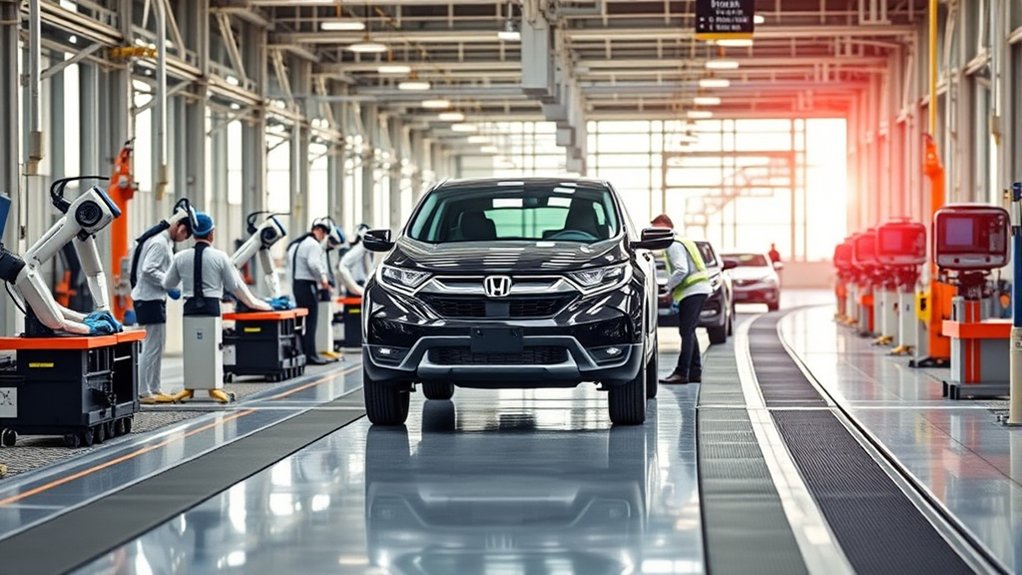
How does Honda guarantee the quality and availability of CR-Vs across North America? They rely on strategically located production plants equipped with advanced labor automation to streamline manufacturing processes.
This approach not only enhances precision but also boosts efficiency, allowing Honda to meet growing demand without compromising quality. Additionally, Honda integrates a robust global logistics system that coordinates parts and materials from various suppliers worldwide, ensuring seamless supply chain management.
Manufacturing Locations Details
Which facilities produce the Honda CR-V models you see on North American roads? Honda manufactures these vehicles primarily in three key locations, leveraging global supplier networks to ensure consistent quality and efficiency. These plants navigate complex labor union dynamics to maintain smooth production.
1. East Liberty, Ohio
A major hub focusing on CR-V assembly with advanced automation.
2. Alliston, Ontario
Canada’s primary CR-V plant, balancing high output with skilled labor.
3. Greensburg, Indiana
Supports regional demand while integrating parts from global suppliers.
Each facility plays a vital role in supplying the North American market while managing workforce relations carefully. Understanding these manufacturing locations gives you insight into how Honda maintains its CR-V production standards across the continent.
North America Plant Roles
Where exactly do the Honda CR-Vs you see on North American roads come from? Honda’s plants in the U.S., Canada, and Mexico play key roles in production timing and capacity, balancing labor costs and union dynamics effectively.
These facilities emphasize plant automation, workforce training, and environmental compliance to meet emission standards and safety regulations. They leverage supplier networks, parts standardization, and supplier consolidation to optimize logistics efficiency and port strategy, reducing currency risk and capital expenditure.
Vehicle localization aligns with regional trade rules and marketing alignment, supporting regional branding and dealer networks. Plant modernization includes IT systems for data transparency, demand forecasting, and quality assurance.
Shift scheduling and infrastructure maintenance ensure smooth production, while warranty coverage and aftersales support enhance the product lifecycle, all within strict regulatory labeling and energy sourcing frameworks.
Honda CR-V Production Sites in Asia
Wondering why the Honda CR-V has such a strong presence in Asian markets? The answer lies in strategic production sites that enhance global supply and labor diversification. Honda operates multiple key plants across Asia, which allows it to efficiently meet regional demand while optimizing manufacturing costs.
Here are three notable sites:
- Japan – The birthplace of Honda, this plant focuses on advanced manufacturing techniques ensuring high-quality output.
- Thailand – Serving as a major hub, it supports both domestic and export markets, benefiting from skilled labor and logistic advantages.
- China – Catering to the largest automotive market, this site emphasizes scalable production and localization.
These locations collectively strengthen Honda’s global supply network and underscore its commitment to labor diversification, enabling a resilient and flexible production system.
Why Honda Makes CR-Vs in Multiple Countries
You’ll find that Honda makes CR-Vs in multiple countries to support its global production strategy and meet regional demand efficiently. By manufacturing vehicles closer to key markets, Honda reduces shipping costs and adapts to local preferences. This approach helps the company stay competitive and responsive worldwide.
Global Production Strategy
Why does Honda manufacture CR-Vs in several countries instead of concentrating production in one location? You’ll find Honda’s global production strategy aims to optimize efficiency and responsiveness. By spreading manufacturing geographically, Honda leverages:
- Global logistics: Reducing shipping costs and delivery times by producing closer to key markets.
- Supplier networks: Accessing diverse suppliers worldwide ensures steady parts availability and cost control.
- Risk management: Minimizing disruptions from regional issues like natural disasters or trade restrictions.
This strategy lets Honda balance cost, quality, and speed, ensuring the CR-V meets demand globally without relying on a single production hub. It’s a calculated approach that enhances flexibility and strengthens Honda’s supply chain resilience while supporting local economies.
Market-Specific Manufacturing
Expanding on Honda’s global production strategy, market-specific manufacturing plays a key role in tailoring CR-V production to meet local demands and regulations. You’ll find that Honda produces CR-Vs in multiple countries to efficiently address regional preferences, emission standards, and safety requirements.
This approach helps minimize manufacturing logistics challenges by positioning assembly plants closer to end consumers, reducing shipping costs and delivery times. Additionally, Honda leverages localized supplier networks, ensuring parts availability and fostering stronger collaboration with regional vendors.
How Regional Plants Affect Honda CR-V Design and Features
How do regional manufacturing plants influence the design and features of the Honda CR-V? You’ll find that these plants impact the vehicle through factors like regional logistics and plant specialization. Each facility adapts production to meet local demands efficiently, which affects design elements and feature availability.
Here’s how regional plants shape the CR-V:
- Regional logistics streamline parts supply and assembly, ensuring timely incorporation of features tailored to local preferences.
- Plant specialization allows each facility to focus on specific CR-V variants or technologies, enhancing quality and innovation.
- Local regulations and customer expectations drive minor design tweaks and feature sets unique to the plant’s market.
Understanding these influences helps you appreciate why CR-Vs may vary subtly depending on where they’re made.
Unique Features of Each Honda CR-V Factory
What sets each Honda CR-V factory apart goes beyond location and capacity. You’ll find that factory logistics play a crucial role in shaping production efficiency and output quality at every plant.
For instance, factories in North America emphasize streamlined supply chains to meet high demand swiftly, while Asian plants might integrate advanced automation tailored to local market preferences.
Labor dynamics also vary significantly; you’ll notice that some factories benefit from highly skilled, unionized workforces, enhancing precision, whereas others leverage flexible staffing to adapt quickly to production changes.
These unique characteristics not only influence how each factory operates but also subtly affect the final product’s features and availability. Understanding these differences helps you appreciate the complexity behind where and how your Honda CR-V is made.
Frequently Asked Questions
What Is the Fuel Efficiency of the Honda CR-V?
You’ll find the Honda CR-V’s fuel efficiency varies slightly due to displacement differences across models, typically around 28-34 mpg.
Staying on top of maintenance intervals ensures optimal performance and fuel economy throughout its lifespan.
How Often Should I Service My Honda CR-V?
You should service your Honda CR-V every 7,500 miles or six months, like clockwork! This keeps driving ergonomics smooth and prevents aftermarket accessories from wearing out prematurely.
Regular servicing ensures your vehicle stays reliable and comfortable on every trip.
What Safety Features Come Standard on the Honda CR-V?
You’ll find standard safety features like Honda Sensing, collision mitigation, and lane-keeping assist.
Plus, comfort considerations include adaptive cruise control and a multi-angle rearview camera, ensuring a secure and pleasant driving experience every time.
Are There Hybrid Versions of the Honda CR-V Available?
Yes, you’ll find hybrid availability in the Honda CR-V lineup, combining efficiency with performance. These hybrids are produced in multiple locations, including the U.S. and Japan, ensuring global access to eco-friendly options.
What Is the Warranty Coverage for a New Honda CR-V?
You get a 3-year/36,000-mile basic warranty and a 5-year/60,000-mile powertrain warranty with your Honda CR-V.
Honda manufacturing ensures quality, and this warranty coverage protects you against defects during those periods.
Conclusion
Now that you know where Honda CR-Vs are made, you see how Honda’s global strategy weaves a tapestry of innovation and efficiency. By manufacturing in North America and Asia, Honda meets regional demands while maintaining quality.
Each plant adds unique touches, ensuring the CR-V suits local tastes and needs. This worldwide production network isn’t just about making cars—it’s about crafting a vehicle that drives seamlessly across the globe, no matter where you are.
Ultimately, understanding where Honda CR-Vs are made highlights the brand’s commitment to producing reliable, high-quality vehicles tailored for diverse markets.