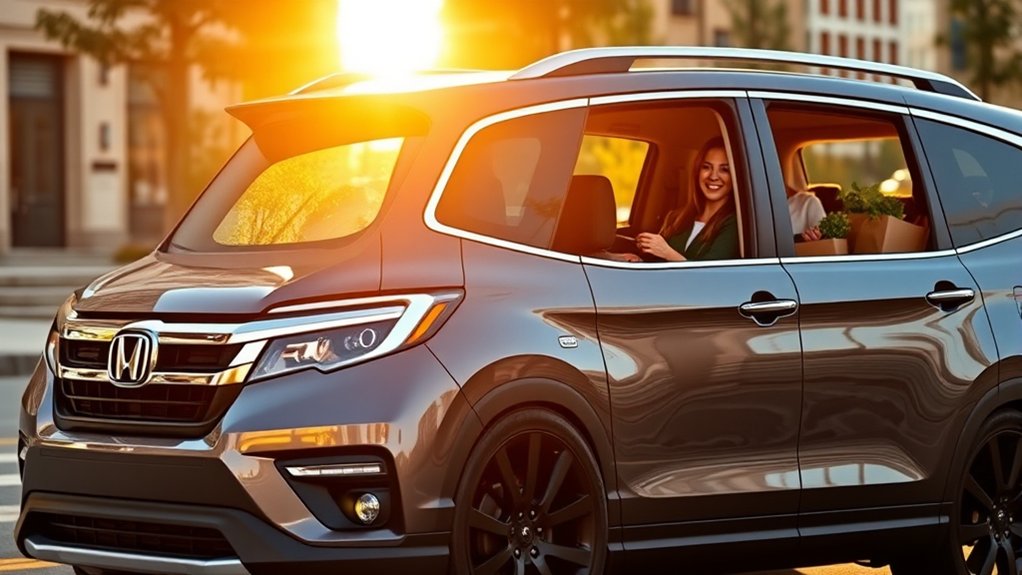
Is Honda Pilot a Good Car
You’ll find the Honda Pilot is a good car that delivers a spacious interior with flexible seating for up to eight and advanced safety tech like collision mitigation braking and lane-keeping assist.
Its 3.5-liter V6 engine offers smooth acceleration and responsive handling, while the suspension ensures comfortable rides.
Fuel economy is moderate but consistent.
Though it favors comfort over sporty performance and towing, it balances quality, safety, and family-friendly features well.
Explore further to see how it stacks up and fits your needs.
Key Takeaways
- The Honda Pilot offers a spacious, versatile interior suitable for families with seating for up to eight passengers.
- It features a reliable 3.5-liter V6 engine delivering smooth performance and decent fuel economy near 20/27 mpg city/highway.
- Advanced safety technologies like Honda Sensing, collision mitigation braking, and lane-keeping assist come standard for enhanced driver confidence.
- The suspension provides a comfortable ride by absorbing road imperfections, prioritizing comfort over sporty handling or towing power.
- While it lacks turbocharged power and aggressive handling, the Pilot balances practicality, safety, and moderate maintenance costs well against competitors.
What Makes the Honda Pilot a Popular Midsize SUV?
What draws drivers to the Honda Pilot as a midsize SUV? You’ll find its blend of spacious design, reliability, and advanced features compelling.
The Pilot’s production logistics ensure a streamlined manufacturing process, maintaining high-quality standards while meeting demand efficiently. This consistency translates to dependable vehicles that drivers trust.
You’ll also appreciate the range of color options, allowing a degree of personalization without compromising the SUV’s classic appeal. The interior layout emphasizes functionality, with configurable seating and ample cargo space, meeting practical needs.
Safety features integrate seamlessly, enhancing driver confidence. Overall, the Pilot’s appeal stems from its thoughtful engineering and production precision, positioning it as a competitive choice for those seeking a midsize SUV that balances utility and dependability effectively.
Honda Pilot’s Real-World Driving Performance: Power and Handling
How does the Honda Pilot perform when you’re behind the wheel? Its power output comes from a 3.5-liter V6 engine delivering 280 horsepower, providing smooth acceleration and confident merging.
You’ll notice the balance between power and fuel efficiency, with EPA ratings around 20 mpg city and 27 mpg highway, helping you manage fuel costs effectively. Handling-wise, the Pilot offers:
- Responsive steering with minimal body roll, enhancing stability in curves.
- A suspension tuned to absorb road imperfections, ensuring a comfortable ride.
- Available all-wheel drive that improves traction on varied terrain without sacrificing fuel efficiency significantly.
Why Families Choose the Honda Pilot: Space, Safety, and Comfort
You’ll appreciate the Honda Pilot’s spacious interior design, which offers flexible seating configurations and ample cargo capacity to accommodate your family’s needs. The vehicle integrates advanced safety features, like collision mitigation braking and lane-keeping assist, to enhance occupant protection. Together, these elements create a balanced environment focused on space, safety, and comfort.
Spacious Interior Design
The Honda Pilot’s interior maximizes space through a thoughtful layout that accommodates up to eight passengers comfortably. It aligns well with spacious trends seen in modern SUVs, focusing on both volume and usability.
The interior styling balances functionality with a clean, ergonomic design, enhancing comfort without sacrificing space.
- Flexible Seating Configuration: The second-row seats slide and recline, while the third row easily folds flat, offering versatile cargo and passenger arrangements.
- Generous Headroom and Legroom: Across all three rows, the Pilot provides above-average dimensions, ensuring comfort on long drives.
- Optimized Storage Solutions: Multiple compartments and underfloor storage maximize utility without cluttering the cabin.
This precise approach to interior design ensures you experience both practicality and comfort in every journey.
Advanced Safety Features
What makes the Honda Pilot a top choice for families beyond its spacious interior? It’s the advanced safety features designed to protect you and your passengers. The Pilot comes standard with Honda Sensing®, a suite of driver-assist technologies including collision mitigation braking, lane keeping assist, and adaptive cruise control.
Automated braking activates when sensors detect an imminent collision, helping you avoid or reduce impact severity. Additionally, the Pilot incorporates a multi-angle rearview camera and blind spot information system, enhancing situational awareness.
These systems work cohesively to provide real-time responses that support safe driving. When you choose the Honda Pilot, you’re investing in a vehicle equipped with comprehensive, technically advanced safety measures that prioritize your family’s well-being on every trip.
Honda Pilot vs. Competitors: Where It Excels and Falls Short
When comparing the Honda Pilot to its competitors, you’ll notice differences in performance and handling that impact driving dynamics. The Pilot offers a balanced ride but may lack the sportiness or towing capacity found in some rivals. Interior space and features vary as well, with the Pilot excelling in passenger comfort but sometimes falling short on advanced tech options.
Performance and Handling
Exploring the performance and handling of the Honda Pilot reveals a balanced approach tailored for family SUVs rather than sporty driving. While some reviews stray into unrelated topics or tangential ideas, focusing strictly on driving dynamics shows where the Pilot stands compared to competitors.
You’ll notice:
- The Pilot’s V6 engine delivers smooth acceleration and sufficient power for daily driving but lacks the punch of rivals with turbocharged options.
- Its suspension prioritizes comfort, absorbing road imperfections well, though it sacrifices some cornering sharpness.
- Steering is precise but not particularly engaging, reflecting a design aimed at stability over spirited handling.
Interior Space and Features
While the Honda Pilot provides a comfortable and stable ride, its interior space and features present a more mixed picture compared to competitors. You’ll find the Pilot offers ample third-row seating with decent legroom, but it’s not as spacious as some rivals, which may affect passenger comfort on longer trips.
The cabin lighting uses LED technology, enhancing visibility and creating a modern ambiance, though it lacks customizable ambient lighting found in premium competitors. Interior acoustics are well-managed, with effective noise insulation that minimizes road and wind noise, contributing to a quieter cabin environment.
Storage solutions are practical but not exceptional, and the infotainment system, while user-friendly, doesn’t always match the responsiveness or feature set of rivals. Overall, the Pilot balances functionality with some limitations in space and tech.
Honda Pilot Fuel Economy and Maintenance Costs Explained
How efficient is the Honda Pilot regarding fuel consumption, and what should you expect concerning maintenance expenses? The Pilot offers moderate fuel economy for its class, typically around 20-22 mpg combined, depending on the drivetrain and model year. Maintenance costs remain reasonable compared to other midsize SUVs, thanks to Honda’s reputation for reliability.
Consider these key points:
- Fuel Economy: The V6 engine balances power and efficiency, but expect slightly higher consumption in AWD versions.
- Scheduled Maintenance: Regular oil changes, brake inspections, and fluid replacements follow Honda’s standard intervals, averaging $400-$600 annually.
- Long-Term Costs: Components like tires and brakes wear predictably, with parts and labor costs remaining competitive.
Is the Honda Pilot the Right SUV for You?
What makes the Honda Pilot a suitable choice for your needs? If you value quiet styling and practical features, the Pilot delivers a refined cabin and smooth ride.
However, consider budget tradeoffs: its price point and fuel economy may be higher than some competitors. You should evaluate your priorities in space, tech, and cost.
| Feature | Consideration |
|---|---|
| Interior Noise | Well-insulated, minimal road noise |
| Seating Capacity | Up to 8 passengers |
| Cost Efficiency | Moderate fuel economy, maintenance costs |
Frequently Asked Questions
What Are Common Reliability Issues With the Honda Pilot?
You’ll encounter common maintenance issues like transmission problems and faulty fuel injectors. Engine durability concerns include timing chain wear.
Staying proactive with regular oil changes helps maintain your Honda Pilot’s engine performance and longevity.
Does the Honda Pilot Offer Advanced Infotainment Features?
Yes, the Honda Pilot offers advanced infotainment features, including a touchscreen with Apple CarPlay and Android Auto integration.
You’ll find intuitive dashboard controls that provide easy access to navigation, audio, and connectivity options for seamless operation.
How Does the Honda Pilot Perform in Off-Road Conditions?
You’ll find the Honda Pilot offers moderate off-road traction, suitable for light trails. Its terrain durability handles dirt and gravel well, but it’s not designed for extreme off-road conditions or rugged, technical terrains.
What Warranty Coverage Comes With the Honda Pilot?
You get a 3-year/36,000-mile basic warranty and a 5-year/60,000-mile powertrain warranty with the Honda Pilot, addressing reliability concerns by covering major components and ensuring solid warranty coverage for peace of mind.
Are There Hybrid or Electric Versions of the Honda Pilot?
You’ll find no hybrid viability or electric prospects for the current Honda Pilot model. Honda focuses on traditional gasoline engines here, while their hybrid technology appears mainly in other models like the CR-V Hybrid or Accord Hybrid.
Conclusion
So, you’re wondering if the Honda Pilot is a good car? Well, if you enjoy a midsize SUV that balances decent power, spacious comfort, and reliable safety without redefining fuel efficiency or turning maintenance into a budget buster, it might just fit your needs.
Ironically, its strengths and flaws make it less about perfection and more about practical, everyday driving—a reminder that sometimes “good” simply means “good enough” for your family’s ride.
When considering all factors, the Honda Pilot is a good car for those prioritizing comfort, reliability, and space over cutting-edge features or top fuel economy.