Which Is Better rav4 or Crv
If you want sharper handling and a rugged look, the Toyota RAV4 offers slightly more power and lower long-term repair costs.
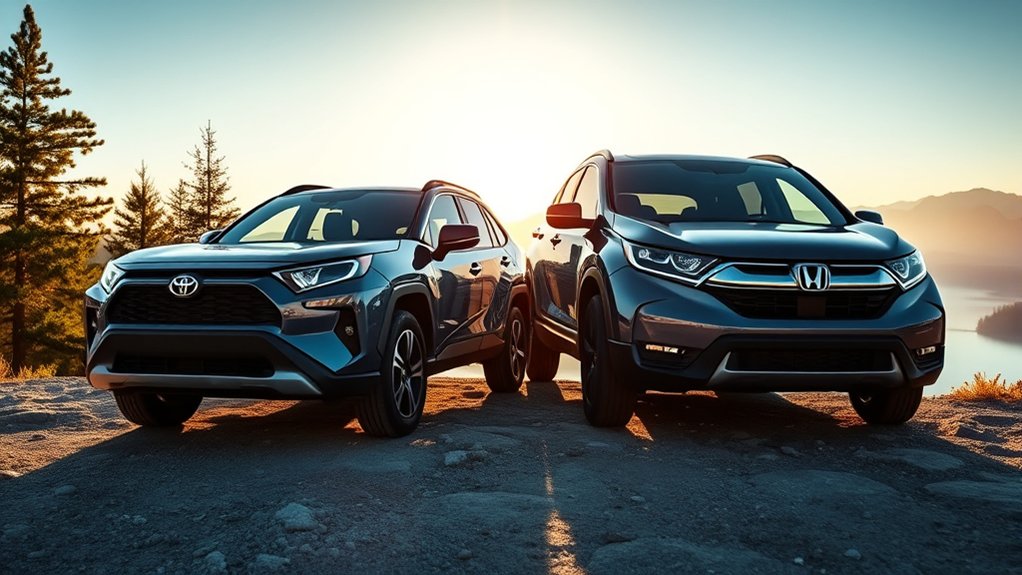
When comparing the RAV4 vs CR-V, the Honda CR-V provides a softer ride, a roomier cargo area, and marginally lower upfront pricing.
Both offer strong reliability, competitive fuel efficiency, and advanced safety systems.
Your choice depends on whether you value sporty driving or interior comfort more.
Keep exploring to understand how each SUV fits different lifestyles and priorities.
Key Takeaways
- Toyota RAV4 offers slightly more power and sportier handling, ideal for drivers seeking a responsive ride.
- Honda CR-V provides a softer ride and more spacious cargo area, enhancing comfort and practicality for families.
- Both SUVs have strong reliability reputations, but RAV4 tends to have lower repair costs and better long-term durability.
- RAV4’s infotainment features a larger, wireless-enabled display, while CR-V offers a digital instrument cluster in higher trims.
- Pricing is similar, with RAV4 often higher in top trims but includes more standard driver assistance features.
How to Choose Between the Toyota RAV4 and Honda CR-V
When deciding between the Toyota RAV4 and Honda CR-V, you’ll want to contemplate several key factors that align with your specific needs and preferences. Start by examining reliability myths surrounding both models; while each has a strong reputation, it’s important to look at real-world data rather than assumptions.
Next, consider cargo versatility, as both SUVs offer flexible storage solutions, but their configurations differ slightly. The CR-V tends to provide a more spacious cargo area with easy-folding rear seats, whereas the RAV4 offers practical compartments and a flat load floor. Assess how you plan to use the space, whether for daily errands or weekend adventures.
RAV4 vs CR-V Performance and Powertrain Options
When comparing the Toyota RAV4 and Honda CR-V, you’ll want to contemplate their engine specifications and powertrain options, including available hybrids. Each model offers different fuel efficiency ratings that impact overall running costs. Understanding these details will help you choose the best fit for your driving needs.
Engine Specifications Comparison
How do the Toyota RAV4 and Honda CR-V stack up in terms of engine performance and powertrain options? Both offer reliable engines with efficient designs, but there are key differences to consider.
The RAV4 features a 2.5-liter four-cylinder engine producing around 203 horsepower, while the CR-V’s 1.5-liter turbocharged engine delivers approximately 190 horsepower. When comparing:
- Engine reliability: Both models are known for dependable engines, though the RAV4 slightly edges out in long-term durability.
- Service costs: The CR-V may have marginally lower maintenance expenses due to fewer complex components.
- Powertrain choices: Each offers front-wheel and all-wheel drive, but the RAV4’s engine provides a bit more power for spirited driving.
Understanding these specs helps you weigh performance against upkeep when choosing between the two.
Hybrid Powertrain Availability
Why weigh a hybrid powertrain in your next compact SUV? Both the Toyota RAV4 and Honda CR-V offer hybrid availability, catering to drivers seeking a blend of performance and eco-friendliness.
The RAV4’s hybrid system combines a 2.5-liter four-cylinder engine with electric motors, delivering robust power and smooth acceleration. Similarly, the CR-V Hybrid pairs a 2.0-liter engine with electric motors, emphasizing balanced performance.
When comparing these models, keep in mind that the RAV4 tends to offer more aggressive power output, while the CR-V focuses on refined driving dynamics. Additionally, aftermarket upgrades for hybrid systems are limited compared to traditional engines, so you’ll want to weigh how important customization is to you.
Fuel Efficiency Ratings
Which compact SUV offers better fuel efficiency: the Toyota RAV4 or the Honda CR-V? Both models have seen new model updates that enhance their performance and off road capability, but fuel economy remains a key deciding factor.
- The RAV4’s hybrid variant delivers an EPA-estimated 41 mpg city and 38 mpg highway, making it highly efficient for off road adventures and daily commutes.
- The CR-V hybrid offers slightly lower fuel efficiency, with 40 mpg city and 35 mpg highway ratings, still impressive for its class.
- Gasoline-only versions of both SUVs provide solid mileage, but hybrids clearly lead in conserving fuel.
When choosing, consider how the new model updates affect fuel economy and off road capability in your driving routine.
RAV4 vs CR-V Fuel Efficiency: Which Is Better?
When comparing the RAV4 and CR-V, you’ll want to contemplate their city and highway fuel economy ratings closely. Both models offer competitive mileage, but differences in engine options and hybrid availability can impact your fuel costs. Understanding these details will help you choose which SUV fits your driving habits best.
City Fuel Economy
How do the Toyota RAV4 and Honda CR-V compare when it comes to city fuel economy? Both models are designed with urban driving in mind, but there are key differences affecting your daily fuel costs and overall efficiency. Here’s what you should consider:
- The Honda CR-V typically achieves around 28 mpg in city driving, slightly edging out the RAV4’s average of 27 mpg.
- Toyota’s hybrid RAV4 variant offers better fuel efficiency in stop-and-go traffic, which aligns well with urban planning focused on reducing emissions.
- When factoring in resale dynamics, hybrids tend to retain value better in markets prioritizing eco-friendly vehicles.
If you drive mostly in the city, the RAV4 hybrid might save you more on fuel, while the conventional CR-V offers solid efficiency and reliability.
Highway Fuel Performance
Want to know which SUV delivers better fuel efficiency on the highway? When comparing the RAV4 and CR-V, you’ll find the two word highway fuel performance differs slightly based on engine options.
The CR-V generally achieves around 34 mpg on highways, while the RAV4 averages about 30-33 mpg, depending on the trim. These two word fuel efficiency figures highlight the CR-V’s edge in optimizing fuel use during long drives.
However, if you opt for hybrid models, both SUVs improve substantially, often reaching 38 mpg or more on highways. Ultimately, your choice depends on whether you prioritize slightly better highway mileage or other features.
Understanding these two word highway fuel performance metrics helps you make a more informed decision for your driving needs.
Cargo Space and Interior Comfort Comparison
Where will you find more room for your gear and passengers, the Toyota RAV4 or the Honda CR-V? When comparing cargo space and interior comfort, both excel but in slightly different ways.
- Cargo Space: The CR-V offers about 39.2 cubic feet behind the rear seats, while the RAV4 provides roughly 37.6 cubic feet, giving the CR-V a slight edge for hauling larger loads.
- Interior Comfort: Both vehicles feature supportive seating, but the RAV4’s cabin has a more rugged feel with durable materials, whereas the CR-V emphasizes a smoother, quieter ride.
- Versatility: Both SUVs fold rear seats flat, but the CR-V’s lower cargo floor makes loading bulky items easier.
Ultimately, your choice depends on whether you prioritize maximum cargo space or a refined interior comfort experience.
Safety Features and Crash Ratings Compared
You’ll want to look closely at how the RAV4 and CR-V perform in crash tests to understand their safety levels. Both models offer advanced safety technologies, but their features and effectiveness can differ. Let’s compare their crash ratings and key safety systems to help you make an informed choice.
Crash Test Performance
How do the Toyota RAV4 and Honda CR-V stack up when it comes to crash test performance? Both vehicles perform well in independent crash tests, but subtle differences can influence your choice, especially regarding insurance factors.
- The RAV4 earns top marks from the IIHS, including “Good” ratings in front, side, and rollover tests, which often lead to lower insurance premiums.
- The CR-V also scores highly, with strong results in NHTSA crash tests, emphasizing occupant protection in frontal crashes.
- Both models feature robust safety cages and effective airbags, but the RAV4’s slightly better crash test ratings may give it an edge in insurance considerations.
Understanding these crash test results helps you evaluate risk and potential costs, making your decision more informed.
Advanced Safety Technologies
What safety technologies do the Toyota RAV4 and Honda CR-V offer to protect you on the road? Both vehicles come equipped with advanced safety systems designed to enhance driver awareness and reduce accident risks.
The RAV4 features Toyota Safety Sense, which includes adaptive cruise control, lane departure alert with steering assist, and automatic high beams. Meanwhile, the CR-V offers Honda Sensing, incorporating collision mitigation braking, road departure mitigation, and traffic sign recognition.
Each system uses cameras and radar to monitor your surroundings actively. Crash ratings from IIHS and NHTSA confirm strong protection in both SUVs.
While their technologies differ slightly, both prioritize alerting you to hazards and intervening when necessary, ensuring a safer driving experience. Your choice depends on which suite aligns better with your preferences for advanced safety features.
Infotainment and Technology in RAV4 and CR-V
When comparing the infotainment and technology features of the RAV4 and CR-V, it’s important to contemplate how each system enhances your driving experience. Unlike an unrelated topic or miscellaneous comparison, this evaluation focuses on practical usability and connectivity.
Both SUVs offer user-friendly touchscreens, but you’ll find these key differences:
- Screen size and responsiveness: The RAV4 boasts a larger, more responsive 9-inch display, while the CR-V features a slightly smaller 7-inch screen.
- Smartphone integration: Both support Apple CarPlay and Android Auto, but the RAV4’s system integrates wireless connections, providing more convenience.
- Additional tech: The CR-V offers a digital instrument cluster in higher trims, whereas the RAV4 emphasizes customizable multi-information displays.
These distinctions help you decide which vehicle’s tech fits your daily needs better.
Pricing Comparison and Value for Money
Exploring the pricing structures of the RAV4 and CR-V reveals important insights into their value for money. When you weigh the pricing comparison, you’ll see both offer competitive base prices, but trim levels and features affect overall costs and value perception.
| Model | Base Price (USD) | Mid Trim Price (USD) | Top Trim Price (USD) |
|---|---|---|---|
| Toyota RAV4 | $27,700 | $33,000 | $38,400 |
| Honda CR-V | $28,000 | $32,800 | $37,800 |
The RAV4 generally commands a slightly higher price at top trims but includes more standard driver aids. The CR-V’s pricing is marginally lower, appealing if you prioritize upfront cost, influencing your value perception significantly.
Reliability and Maintenance Costs Over Time
How reliably a vehicle performs over time can greatly influence your ownership experience and overall costs. When comparing the Rav4 and CRV, consider these key factors:
- Reliability Pricing: Both models have competitive reliability pricing, but the Rav4 often has lower reported repair costs, reducing unexpected expenses.
- Maintenance Convenience: Toyota’s widespread service network makes maintaining a Rav4 more convenient in many areas, though Honda’s CRV also benefits from solid dealership coverage.
- Long-Term Durability: Both vehicles score well in reliability ratings, but the Rav4 tends to hold up slightly better over extended periods, potentially lowering lifetime maintenance costs.
Handling and Ride Comfort Differences
What sets the Rav4 and CRV apart in daily driving is their handling and ride comfort. The Rav4 offers a more responsive handling tuning, allowing you to feel confident during cornering and quick maneuvers. Its suspension is tuned for a slightly firmer ride, which enhances stability but can transmit more road imperfections.
On the other hand, the CRV prioritizes ride quality with softer suspension settings, delivering a smoother and more cushioned experience over rough surfaces. While the CRV’s handling is competent, it leans towards comfort rather than sporty agility. Ultimately, if you prefer sharper handling, the Rav4’s tuning might suit you better. If you value a plush ride quality for daily commutes, the CRV provides a gentler, more relaxed drive.
Which SUV Is Best for Your Lifestyle?
Where does your lifestyle demand the most from an SUV? Choosing between the Rav4 and CRV depends on your priorities. Consider these factors:
- Daily Use: If you need solid exterior styling and reliability for commuting, the Rav4 shines with its rugged look and strong resale value. The CRV’s smoother design suits urban settings but may suffer from unreliable resale in some markets.
- Family Needs: The CRV offers spacious interiors and comfort, ideal for families prioritizing passenger space over edgy exterior styling.
- Outdoor Activities: The Rav4’s off-road capability and durable build make it better for adventure seekers, though its exterior styling might not appeal to everyone.
Evaluate these points to pick the SUV that best fits your lifestyle without compromise.
Frequently Asked Questions
What Are the Color Options for the RAV4 and CR-V?
You’ll find the RAV4 offers vibrant color options like Ruby Flare Pearl, while the CR-V features sleek shades such as Radiant Red. Both provide stylish interior styling, focusing on comfort and modern design to suit your taste.
Do the RAV4 and CR-V Offer Hybrid or Electric Variants?
Both the RAV4 and CR-V offer hybrid variants, boosting hybrid performance efficiently. However, only the RAV4 provides a plug-in hybrid, benefiting from better charging infrastructure.
The CR-V lacks a fully electric option.
How Do the RAV4 and CR-V Compare in Terms of Resale Value?
You’ll find the RAV4 generally holds a higher resale value than the CR-V, partly due to its popularity. Both offer diverse color options, but choosing a popular color can boost resale value for either model.
Are There Significant Differences in Warranty Coverage Between the Two?
You’ll find both offer similar basic warranties, but Toyota often provides more flexible warranty extensions and maintenance plans.
Check each dealer’s offers closely, as these extras can vary, impacting your long-term ownership costs.
Which Model Has Better Off-Road Capabilities?
Imagine tackling a muddy trail; the RAV4’s superior off-road traction and higher ground clearance give you confidence. Its advanced AWD system handles rough terrain better, making it the stronger choice for off-road adventures compared to the CR-V.
Conclusion
When choosing between the Toyota RAV4 and Honda CR-V, you’re really weighing two solid companions with their unique charms. The RAV4 might feel like the adventurous path, while the CR-V offers a more relaxed journey. Both deliver dependable performance, comfort, and efficiency.
So, it’s less about finding a “better” SUV and more about which one quietly fits your lifestyle’s rhythm. Trust your instincts—they’ll guide you to the right choice. Ultimately, deciding which is better, RAV4 or CR-V, depends on what suits you best.