Where Are the Honda Accords Made
You’ll find Honda Accords made in several countries, including the U.S., Japan, China, Thailand, and other parts of Asia.
Where are the Honda Accords made? Honda strategically locates plants near key markets to balance cost, quality, and demand.
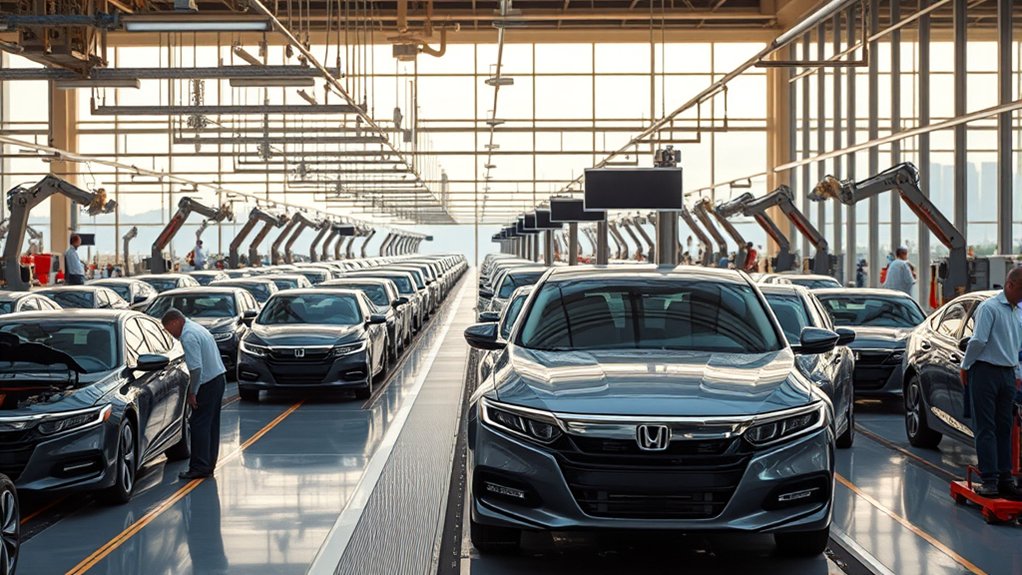
U.S. sites like Ohio’s Marysville plant combine advanced robotics with skilled labor, while Asian hubs focus on cost-efficient production and local market needs.
This global approach guarantees consistent quality and responsive supply chains.
Exploring further reveals how Honda fine-tunes production and innovates worldwide.
Key Takeaways
- Honda Accords are manufactured in Japan, China, Thailand, and multiple North American locations.
- The Marysville Auto Plant in Ohio is the flagship U.S. production site for the Accord.
- Japan focuses on advanced technology and quality in Accord production.
- Asian plants like Thailand and China emphasize cost-effective and volume production for regional markets.
- Regional parts sourcing supports efficient and localized Accord manufacturing worldwide.
Where Honda Accords Are Made Worldwide
Where exactly are Honda Accords made worldwide? You’ll find that Honda uses a strategy of global sourcing to optimize production efficiency and cost-effectiveness. The Accords are manufactured in multiple countries, including Japan, China, Thailand, and several locations across North America.
This distribution allows Honda to balance labor costs and supply chain logistics effectively. By producing in regions with competitive labor costs, Honda ensures it remains price-competitive without sacrificing quality.
Global sourcing also helps Honda adapt to regional market demands and regulations swiftly. When you consider where these vehicles come from, it’s clear that Honda’s worldwide manufacturing network is designed to maximize efficiency and responsiveness, leveraging labor cost variations while maintaining consistent quality standards across all plants.
U.S. Plants Producing the Honda Accord
Which facilities in the United States produce the Honda Accord? Honda’s production strategy centers mainly on two key plants. These facilities play essential roles in maintaining an efficient supply chain and meeting high demand.
- Marysville Auto Plant, Ohio. This plant is Honda’s flagship U.S. production site for the Accord, combining advanced robotics with skilled labor.
- Anna Engine Plant, Ohio. While primarily an engine plant, it supports Accord production by supplying powertrains essential for assembly.
- Lincoln, Alabama Plant. Though primarily for other models, it occasionally supports Accord components, enhancing supply chain flexibility.
Honda Accord Production in Japan and Asia
How does Honda maintain its global production network for the Accord? In Japan and Asia, Honda balances production currency fluctuations and dealer incentives to optimize output and market reach.
Japan serves as a key production hub, leveraging advanced manufacturing technologies. Meanwhile, plants in Asia focus on cost-effective production to meet local demand, adjusting for currency variations that impact overall profitability.
| Country | Production Focus | Dealer Incentives Impact |
|---|---|---|
| Japan | Technology & Quality | Moderate |
| Thailand | Cost-effective Models | High |
| China | Volume Production | Variable |
| Indonesia | Local Market Demand | Moderate |
| Malaysia | Regional Supply | High |
This diversified approach ensures Honda adapts to regional market conditions while maintaining Accord’s global standards.
How Honda Picks Accord Manufacturing Sites
When Honda selects Accord manufacturing sites, it focuses on strategic location factors like proximity to key markets and supply chains. You’ll find that production efficiency, including labor availability and infrastructure, also plays a pivotal role. These considerations help Honda optimize costs and meet regional demand effectively.
Strategic Location Factors
Why does Honda choose certain locations to manufacture the Accord? You’ll find that Honda carefully weighs strategic factors to optimize costs and market access. They focus on:
- Global labor costs: Honda targets regions where skilled labor is affordable, balancing quality with expense to keep prices competitive.
- Trade tariffs: Manufacturing in countries with favorable trade agreements helps Honda avoid costly import tariffs, reducing vehicle prices for consumers.
- Proximity to key markets: Building plants near major buyers cuts shipping costs and delivery times, enhancing customer satisfaction.
Production Efficiency Considerations
Beyond strategic location factors, Honda also prioritizes production efficiency to keep the Accord competitive in the global market. You’ll find that Honda’s offshoring strategies carefully balance labor cost dynamics with advanced manufacturing technology.
By selecting sites with skilled labor and modern infrastructure, they reduce costs without sacrificing quality. This method boosts productivity and streamlines supply chains.
Here’s a snapshot of key production efficiency considerations:
| Factor | Description | Impact on Site Selection |
|---|---|---|
| Labor Cost Dynamics | Competitive wages with skilled labor | Controls manufacturing expenses |
| Automation Level | Use of robotics and AI | Increases precision and speed |
| Supply Chain Access | Proximity to parts suppliers | Reduces delays and costs |
| Regulatory Environment | Favorable policies and incentives | Enhances operational efficiency |
Why Honda’s U.S. Plants Are Great for Building Accords
How do Honda’s U.S. plants maintain such high standards in building Accords? You’ll find it’s a combination of advanced strategies and local expertise. Honda leverages global procurement to source top-quality materials worldwide, ensuring each Accord meets strict specifications. They also use labor analytics to optimize workforce efficiency and maintain consistent production quality.
Here’s why you can trust U.S. plants for Accords:
Here’s why Honda’s U.S. plants deliver exceptional quality in every Accord.
- Precision in sourcing components globally, ensuring durability and performance.
- Data-driven labor management that maximizes skill utilization and reduces errors.
- Continuous improvement programs that adapt to market demands and technology advances.
Differences Between Accord Models From Different Countries
You’ll notice that Accord models from different countries often show variations in manufacturing quality and regional design features. These differences reflect local market preferences and production standards. Understanding these distinctions helps you appreciate how Honda tailors the Accord to meet diverse customer needs worldwide.
Manufacturing Quality Variations
What differences should you expect when comparing Honda Accords manufactured in various countries? While Honda maintains strict quality standards worldwide, subtle manufacturing quality variations can arise due to factors like production delays and labor unions’ influence.
- Consistency: Plants with strong labor unions might experience production delays, impacting assembly line flow and sometimes leading to minor variations in build quality.
- Materials: Local sourcing policies affect parts and materials, so Accords from some countries may use slightly different suppliers, influencing durability.
- Inspection Rigor: Quality control processes vary; some factories implement more rigorous inspections, which can enhance overall vehicle reliability.
Understanding these nuances helps you appreciate that although overall quality is high, slight differences reflect regional operational realities rather than a drop in Honda’s commitment to excellence.
Regional Design Differences
Where do the design differences between Honda Accord models from various countries come into play? These variations arise primarily from the need to adapt to regional preferences, regulations, and driving conditions.
When you compare Accords made in the U.S. with those produced in Japan or China, you’ll notice distinctions in exterior styling, interior features, and even engine options. Honda manages a complex global supply network, ensuring parts meet specific regional requirements through efficient regional logistics.
This approach allows Honda to tailor each model while maintaining overall quality standards. For instance, North American Accords often emphasize larger cabin space and more powerful engines, while Asian models might focus on fuel efficiency and compact design.
Understanding these regional design differences helps you appreciate how Honda balances global consistency with local customization.
How Global Production Affects Honda Accord Quality
How does producing the Honda Accord across multiple countries influence its overall quality? You might expect variations, but Honda’s global logistics system ensures consistency despite geographic spread. Managing production worldwide helps balance labor costs without compromising standards.
Here’s how global production impacts Accord quality:
- Streamlined global logistics keep parts and materials consistent, reducing defects.
- Diverse manufacturing sites allow Honda to optimize labor costs while maintaining strict quality controls.
- Cross-country production fosters innovation by integrating best practices from different regions.
How Local Supply Chains Support Honda Accord Production
You’ll find that Honda relies heavily on regional parts sourcing to keep Accord production running smoothly. By working with local suppliers, they reduce transportation time and costs, which directly boosts production efficiency. This tight-knit supply chain helps maintain consistent quality while speeding up assembly processes.
Regional Parts Sourcing
Why does regional parts sourcing play a pivotal role in Honda Accord production? It strengthens the supply chain by ensuring components are readily available, reducing delays and transportation costs. When you rely on regional sourcing, you support local economies and enhance production resilience.
Here’s why regional parts sourcing matters:
- It minimizes lead times, so you get faster assembly without interruptions.
- It reduces environmental impact by cutting down long-haul shipping.
- It fosters strong relationships with local suppliers, improving quality control and innovation.
Impact on Production Efficiency
Where exactly do local supply chains make the biggest difference in Honda Accord production? They streamline supply logistics by reducing transportation time and costs, which directly boosts production efficiency.
By tailoring the sourcing strategy to regional differentiation, Honda adapts components to meet specific market needs, ensuring faster assembly and fewer delays. This approach supports responding quickly to global demand fluctuations, maintaining steady output across various manufacturing sites.
When parts come from nearby suppliers, you see less inventory buildup and smoother workflow on the production line. Ultimately, leveraging local supply chains allows Honda to optimize resource allocation, minimize disruptions, and enhance overall manufacturing speed.
This precise coordination between suppliers and factories is key to meeting the high standards and volume requirements of Accord production worldwide.
How Honda Matches Accord Production With Regional Demand
How does Honda guarantee that the Accord production aligns with the specific demands of different markets? They use precise production logistics and real-time data analysis to balance supply with regional demand. This approach helps prevent shortages or surpluses, ensuring customers get the right models when they need them.
Honda achieves this by:
- Continuously monitoring sales trends and customer preferences across regions to adjust production schedules promptly.
- Strategically locating manufacturing plants close to key markets, reducing delivery times and adapting quickly to demand shifts.
- Employing flexible manufacturing systems that allow quick changes in production volume or model variants based on updated market data.
Future Changes in Honda Accord Manufacturing
What innovations will shape the future of Honda Accord manufacturing? You’ll see an increased emphasis on integrating global design principles with regional logistics strategies. Honda plans to streamline production by leveraging advanced digital tools that enable real-time coordination between design teams worldwide and local manufacturing plants.
This approach ensures that the Accord meets diverse market needs while maintaining consistent quality. Additionally, adopting smarter supply chain management will optimize parts availability, reducing delays and costs tied to regional logistics challenges. You can also expect a greater focus on sustainable manufacturing processes, including energy-efficient factories and eco-friendly materials.
These future changes will allow Honda to respond swiftly to market shifts, improve efficiency, and sustain the Accord’s reputation as a globally recognized, reliable vehicle.
Frequently Asked Questions
What Are the Most Popular Honda Accord Trim Levels?
You’ll find the most popular Honda Accord trim levels are the LX, Sport, and EX-L. When discussing ideas, keep trends in pricing in mind. They balance features and cost, making them top picks for many buyers.
How Often Should I Service My Honda Accord?
Think of your Honda Accord as a clock. How often should you service it? Typically, every 7,500 miles or six months.
Regular maintenance keeps your Accord reliable, no matter where it’s made, ensuring smooth, safe driving always.
What Is the Fuel Efficiency of the Latest Honda Accord?
You’ll find the latest Honda Accord delivers about 30-38 MPG, depending on the engine. Factory specific models vary slightly, reflecting made in country trivia that influences fuel efficiency standards and design tweaks globally.
Are Honda Accords Good for Long Road Trips?
You’ll find Honda Accords excellent for long road trips thanks to their Honda reliability, comfortable interiors, and smooth handling. They combine fuel efficiency with spacious cabins, making extended drives both economical and enjoyable for you.
What Safety Features Come Standard on the Honda Accord?
Imagine touring a factory where every assembly line safety measure guarantees precision. The Honda Accord comes with standard features like Collision Mitigation Braking System, Lane Keeping Assist, and Adaptive Cruise Control, enhancing your driving safety comprehensively.
Conclusion
You’ve seen how Honda carefully chooses Accord manufacturing sites across the globe, from U.S. plants to Asia, ensuring quality and efficiency. By aligning production with local demand and supply chains, Honda keeps the wheels turning smoothly.
As changes loom on the horizon, the company’s strategic approach means you can expect consistent, reliable Accords. In short, Honda’s global production is the backbone that keeps this popular model ahead of the curve.
Where are the Honda Accords made? Their diverse manufacturing locations play a key role in maintaining the model’s reputation for excellence.