How Do You Charge a Portable Battery Charger
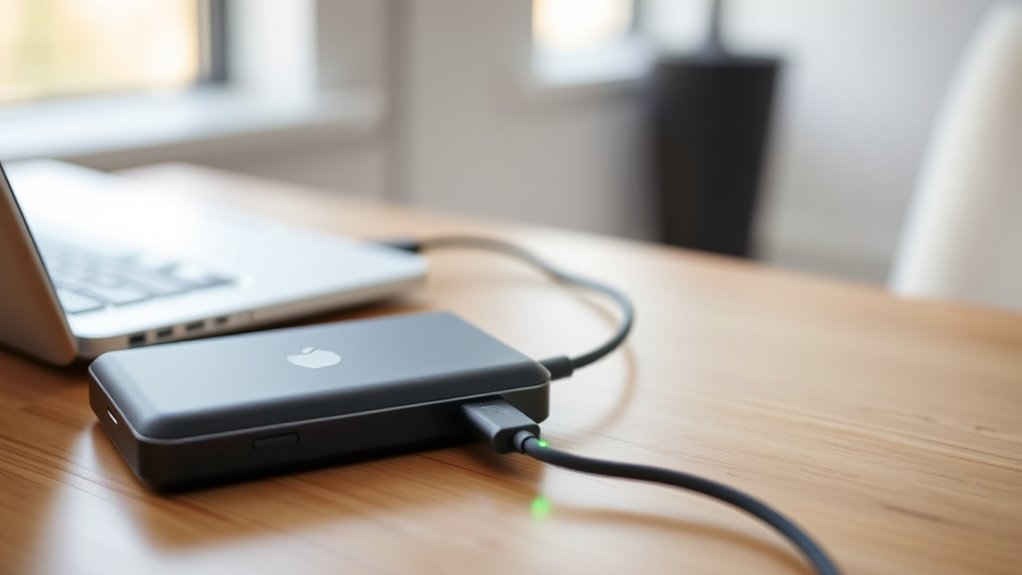
You charge a portable battery charger by connecting it to a compatible power source such as a USB wall outlet, car adapter, or solar panel.
Using a reputable cable that matches the charger’s input voltage and current specifications ensures efficient energy transfer.
Monitor the charger’s indicators to avoid overcharging and to confirm full replenishment.
Charging speed can vary depending on the power source wattage, cable quality, and battery capacity.
Proper charging methods are important for the longevity and performance of your portable battery charger.
Further details on these methods are available ahead.
Key Takeaways
- Connect the portable charger to a power source using a reputable USB cable and plug it into the charger’s input port.
- Use a wall outlet for the fastest charging, typically taking 2-6 hours depending on capacity and cable quality.
- For solar charging, place a compatible panel in direct sunlight between 10 a.m. and 2 p.m., connecting it securely to the charger.
- In a car, plug the charger into a 12V outlet or USB port with the engine running for consistent power supply.
- Monitor the charger’s indicator lights and disconnect once fully charged to prevent overcharging and maintain battery health.
How Does a Portable Battery Charger Work?
How exactly does a portable battery charger work to power your devices on the go? It stores electrical energy in an internal lithium-ion or lithium-polymer battery, which you can then use for off grid charging. When you connect your device, the charger converts its stored DC power to a regulated voltage compatible with your device’s requirements.
This controlled energy transfer ensures efficient charging without damaging your device’s battery. Proper battery maintenance is crucial for optimal performance and longevity. You should avoid deep discharges and keep the charger between 20% and 80% charge when possible.
Additionally, avoid extreme temperatures during storage and use, as they degrade battery capacity. Understanding this mechanism helps you maximize the functionality and lifespan of your portable charger.
Types of Portable Battery Chargers You Should Know
You’ll encounter several common types of portable battery chargers, each designed with specific battery capacities and charging capabilities. Understanding these variations helps you select a charger that matches your device’s power requirements and usage patterns. Let’s analyze the key categories and their capacity differences to optimize your charging strategy.
Common Charger Types
Portable battery chargers come in various types, each designed to meet specific charging needs and device compatibilities. Understanding these common charger types helps you select the right one without confusing irrelevant topics or unrelated concepts.
- USB-A Chargers: Standard and widely compatible, ideal for most devices but limited in fast-charging capabilities.
- USB-C Chargers: Support faster data transfer and higher power output, becoming the industry standard for modern devices.
- Wireless Chargers: Use inductive charging, eliminating cables but requiring compatible devices and slower charging speeds.
- Solar Chargers: Harness solar energy for off-grid charging, excellent for outdoor use though dependent on sunlight conditions.
Battery Capacity Variations
Why does battery capacity matter when choosing a portable charger? Capacity determines how many times you can recharge your device before the charger itself needs recharging. Ignoring capacity leads to outdated considerations or focusing on unrelated topics like brand prestige rather than functionality.
You must analyze capacity to match your usage needs.
| Capacity (mAh) | Typical Use Case |
|---|---|
| 5,000 | Single smartphone charge |
| 10,000 | Multiple charges, small tablets |
| 20,000 | Extended outings, multiple devices |
| 30,000+ | Power-hungry devices, long trips |
Selecting the right capacity avoids inefficiency and bulkiness. Always prioritize capacity over unrelated features for optimal performance.
How to Charge a Portable Battery Charger With USB
How exactly do you charge a portable battery charger using a USB connection? Charging via USB is straightforward but requires attention to detail for efficiency and safety. Follow this precise process:
- Choose a reputable USB cable compatible with your charger to ensure brand reliability.
- Connect the USB cable to a power source, such as a wall adapter or computer USB port, adhering to proper charging etiquette. Avoid unreliable or low-power sources.
- Plug the cable into the portable charger’s input port, confirming a secure connection.
- Monitor the charging indicator lights; disconnect once fully charged to prevent overcharging and prolong battery lifespan.
How to Charge a Portable Battery Charger Using Solar Power
To charge your portable battery charger using solar power, you need to select a solar panel with compatible voltage and sufficient wattage. Position the panel in direct sunlight to maximize energy absorption and efficiency. Finally, ensure you connect the solar charger correctly, matching connectors and voltage requirements to avoid damage.
Choosing The Right Panel
Which solar panel suits your portable battery charger best depends on several critical factors. You need to evaluate these parameters carefully to maximize charging efficiency while adhering to recycling ethics.
- Power Density: Select panels with high power density to maximize energy output relative to size and weight.
- Compatibility: Ensure voltage and current specifications match your battery charger’s input requirements.
- Durability and Materials: Prioritize panels made from recyclable or sustainably sourced materials to align with recycling ethics.
- Efficiency Ratings: Higher efficiency panels convert more sunlight to electricity, reducing charge times.
Balancing these factors will help you choose a solar panel that not only delivers optimal performance but also supports environmental responsibility in your portable battery charging setup.
Optimal Sunlight Conditions
When can you expect the fastest charge for your portable battery charger using solar power? The optimal sunlight conditions occur during peak solar irradiance, typically between 10 a.m. and 2 p.m., when the sun is at its highest angle.
To maximize sunlight optimization, position your solar panel perpendicular to the sun’s rays, minimizing the angle of incidence. Avoid shading and reflections that reduce energy absorption.
Consistent exposure to strong, direct sunlight not only speeds up charging but also maintains battery health by preventing undercharging and overcharging cycles. Cloud cover, dust, and temperature fluctuations can impede efficiency and degrade battery longevity.
Connecting Solar Charger Properly
Maximizing sunlight exposure only sets the stage for efficient solar charging; proper connection between the solar charger and your portable battery determines the actual energy transfer. Avoid confusing this process with an irrelevant topic or unrelated concept like general battery maintenance. Focus precisely on these steps:
- Verify compatibility between the solar charger’s output voltage and your portable battery’s input specifications.
- Use the correct connector cables, ensuring secure, corrosion-free contacts to minimize resistance.
- Connect the solar charger’s positive lead to the battery’s positive terminal and the negative lead accordingly.
- Monitor the charging status via any built-in indicators or a multimeter to confirm energy flow.
How to Charge a Portable Battery Charger in Your Car
How can you efficiently charge a portable battery charger using your car’s electrical system? Begin by connecting the charger’s input cable to your vehicle’s 12V power outlet or USB port, depending on compatibility.
Ensure your car’s engine is running to provide a stable power supply, preventing battery drain. Unlike solar charging, which depends on environmental variables, car charging offers consistent voltage, typically around 12-14 volts, facilitating predictable charging rates.
Use a high-quality, compatible cable to minimize power loss and ensure efficient energy transfer. Monitor the charger’s indicators to confirm active charging and avoid overcharging.
This method leverages your car’s electrical system for reliable, on-the-go charging, complementing solar charging by providing a dependable alternative when sunlight is unavailable.
How Long Does It Take to Fully Charge a Portable Battery Charger?
You’ll find that the time it takes to fully charge your portable battery charger depends on several factors, including its battery capacity and the charging method you use. Larger capacity batteries naturally require longer charging times, while fast chargers can substantially reduce this duration. Comparing USB, wall outlet, and car charger inputs will help you understand the efficiency differences and plan your charging accordingly.
Charging Time Factors
When can you expect your portable battery charger to reach full capacity? Charging time depends on several key factors you should consider:
- Input Power Source: Higher wattage adapters reduce charging duration, but ensure compatibility to follow proper charging etiquette and avoid voiding warranty considerations.
- Cable Quality: Using certified, high-gauge cables improves current flow, accelerating charge time.
- Charger Circuitry: Advanced chargers manage current efficiently, affecting how quickly the battery reaches full charge.
- Environmental Conditions: Charging in optimal temperature ranges prevents thermal throttling, maintaining consistent charging rates.
Battery Capacity Impact
Beyond external factors like input power and cable quality, the battery capacity itself directly determines charging duration. Larger capacity batteries naturally require more time to reach full charge because they store more energy.
When you select a portable battery charger, consider that models with higher capacity often emphasize handheld durability, as they need robust casing to protect heavier internal cells. However, increased capacity typically shifts pricing trends upward, reflecting the cost of advanced materials and engineering.
You’ll find that chargers with moderate capacity strike a balance between reasonable charging times and portability. Understanding this relationship helps you estimate how long a full recharge will take, allowing you to plan usage effectively.
Ultimately, battery capacity remains the primary variable you control to optimize charging time without compromising device longevity.
Charging Methods Compared
How long does it take to fully charge a portable battery charger? Charging time varies based on the method and device specifications. Here’s a clear comparison:
- Wall Outlet: Fastest method; typically 2-6 hours depending on charger capacity and cable durability.
- USB Port on Computer: Slower due to limited current; expect 6-12 hours.
- Car Charger: Moderate speed, about 4-8 hours, influenced by vehicle power output stability.
- Solar Charging: Depends heavily on solar efficiency and weather conditions; can take 8-20+ hours.
Cable durability impacts charging consistency and speed, especially with high-current methods. Solar efficiency varies widely, so expect fluctuations. Selecting a method depends on your time constraints and available power sources.
Tips to Prolong Your Portable Battery Charger’s Battery Life
Why does your portable battery charger’s lifespan often fall short of expectations? One primary reason is improper usage and charging habits. To prolong its battery life, avoid fully draining or constantly keeping it at 100%.
Instead, maintain a charge between 20% and 80% to reduce stress on lithium-ion cells. Also, steer clear of exposing it to extreme temperatures, as heat accelerates chemical degradation while cold reduces efficiency.
Using chargers with appropriate voltage and current ratings prevents electrical strain. Ignore any unrelated topic or random idea suggesting frequent full discharges; this practice actually harms battery longevity.
Regularly update your charger’s firmware if applicable, ensuring optimal power management. By applying these targeted strategies, you’ll enhance your portable battery charger’s effective lifespan and maintain reliable performance over time.
What to Do If Your Portable Battery Charger Isn’t Charging
If your portable battery charger isn’t charging, start by examining the charging cable and port for damage or debris that might block the connection. Avoid jumping to conclusions based on unrelated topics or irrelevant concepts like software glitches unrelated to power transfer. Instead, systematically troubleshoot:
- Verify the power source is active and compatible; a faulty outlet can impede charging.
- Test with a different, known-good cable to rule out cable failure.
- Inspect the charger’s input port for bent pins or corrosion that could disrupt current flow.
- Reset the charger if it has a reset function, as internal circuitry may need recalibration.
Safety Tips for Charging Portable Battery Chargers
When charging your portable battery charger, what safety measures should you prioritize to prevent damage or hazards? First, follow all safety reminders in the user manual to avoid voiding warranty considerations. Use only the manufacturer-recommended charger and cable, as incompatible accessories may cause overheating or short circuits.
Charge the device on a non-flammable surface, away from direct sunlight or moisture, to minimize risk. Avoid charging unattended or overnight to promptly address any irregularities. Inspect the charger and cable regularly for damage; do not use if exposed wires or cracks appear.
Ensure proper ventilation to dissipate heat effectively. By adhering to these safety reminders and respecting warranty considerations, you’ll maintain device integrity and avoid potential safety risks during charging.
How to Store Your Portable Battery Charger When Not in Use
Although portable battery chargers are designed for durability, proper storage considerably extends their lifespan and maintains performance. To ensure optimal functionality when not in use, avoid irrelevant topic distractions or off topic ideas that could lead to neglecting these key storage principles:
- Store the charger in a cool, dry place to prevent moisture damage and reduce battery degradation.
- Keep the battery charge between 40-60% to avoid deep discharge or overcharging, which shortens battery life.
- Disconnect all cables and remove protective cases that may trap heat or cause physical stress.
- Avoid extreme temperatures; both heat and cold can irreversibly impair battery cells and internal circuitry.
Following these precise steps minimizes performance loss and safeguards your portable battery charger efficiently.
Frequently Asked Questions
Can I Use My Portable Charger to Jump-Start a Car?
You can jump-start a car with some portable chargers, but bypassing safety features risks damage or injury. Analyze your device’s specifications carefully to avoid jump-start risks and ensure it’s designed specifically for automotive use.
Are Portable Battery Chargers Compatible With All Phone Brands?
You won’t find portable battery chargers universally compatible due to varying charging protocols and compatibility considerations. Always verify your phone’s charging standards and ensure the charger supports them to guarantee efficient, safe power delivery without damaging your device.
Do Portable Chargers Work in Extreme Weather Conditions?
You’ll find portable chargers face challenges in extreme temps, as weather impact can reduce battery efficiency and lifespan.
To ensure optimal performance, avoid exposing them to harsh cold or heat, and store them within recommended temperature ranges.
Can I Carry a Portable Battery Charger on an Airplane?
You can carry a portable battery charger on an airplane if it meets power tolerance limits and canister safety regulations.
Ensure its watt-hour rating complies with airline policies to avoid restrictions or the need for special approval during security checks.
How Do I Recycle or Dispose of an Old Portable Battery Charger?
Don’t just toss that old portable battery charger into a black hole! Follow strict disposal guidelines by exploring recycling options at e-waste centers or retail drop-offs. This ensures hazardous materials are handled safely and recycled properly.
Conclusion
Charging your portable battery charger is like fueling a reliable engine—each method, from USB to solar, ensures it’s ready to power your devices. By understanding the technical nuances and following safety tips, you maintain its efficiency and longevity.
Treat your charger with precision, store it properly, and troubleshoot promptly to keep it performing optimally. With these strategies, your portable power source will stay as dependable as a well-oiled machine.
By mastering how to charge a portable battery charger correctly, you ensure it remains a reliable energy companion, always ready when you need it most.