
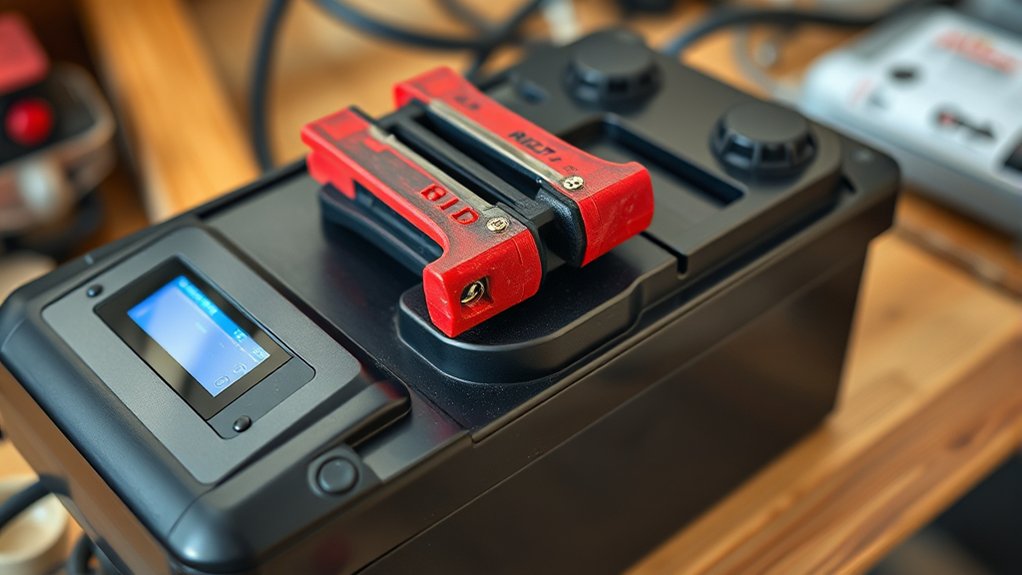
What Does Battery Recondition Mean on a Battery Charger
Battery recondition on your charger means it uses controlled voltage and current cycles to actively reverse chemical changes inside the battery, like sulfation. This process breaks down lead sulfate crystals that reduce capacity and increase internal resistance, restoring balance between cells and revitalizing performance.
It’s not just recharging but carefully managing the battery’s chemical state to extend usable life safely. Understanding how this works helps you know when and why to activate reconditioning mode.
Key Takeaways
- Battery recondition mode reverses chemical changes like sulfation, not just recharges, to restore battery capacity and performance.
- It applies controlled voltage pulses and discharge cycles to break down lead sulfate crystals on battery plates.
- This process reduces internal resistance and balances cell voltages, extending the battery’s usable life safely.
- Reconditioning is mainly effective on lead-acid batteries prone to sulfation, such as flooded and AGM types.
- The charger carefully manages voltage and current to avoid overheating or damage during the reconditioning cycle.
What Battery Reconditioning Means on Your Charger
What exactly does the battery reconditioning mode on your charger do? It revitalizes the battery’s capacity by reversing certain chemical changes that reduce performance, rather than just providing a simple recharge.
This process targets issues like internal resistance and voltage imbalance that standard charging overlooks. You should understand that this function dispels common recycling myths: it’s not about disposing of batteries prematurely but extending their usable life safely.
Safety concerns are addressed by controlled voltage and current adjustments to prevent overheating or damage. By using reconditioning mode, you avoid hazardous practices linked to improper battery handling.
This mode’s precise cycle manages the battery’s chemical state, ensuring it regains functionality without compromising safety. It’s a technical solution designed to optimize battery longevity and performance effectively.
Why Batteries Sulfate and How Reconditioning Helps
Batteries sulfate when lead sulfate crystals accumulate on their plates during discharge or prolonged inactivity, impairing the chemical reactions necessary for efficient energy storage and delivery. This batteries sulfation process decreases battery capacity and increases internal resistance, resulting in diminished performance.
When you use a charger with a recondition function, it applies controlled pulses or higher voltage to reverse sulfation by breaking down these lead sulfate crystals. This restores the plates’ active surface area, improving chemical reaction efficiency.
The reconditioning benefits include extended battery life and recovered capacity, reducing the need for replacement. By addressing the root cause of sulfation, reconditioning helps maintain optimal battery function, ensuring reliable energy output over time.
Which Batteries Benefit Most From Reconditioning
Which types of rechargeable cells respond best to reconditioning? Lead-acid batteries, including flooded and AGM (Absorbent Glass Mat) types, show the most significant improvements. These batteries often suffer from sulfation, a primary cause of capacity loss, and reconditioning targets this by breaking down sulfate crystals to restore battery health.
NiMH and NiCd batteries can benefit too, especially when memory effects reduce their effective charge cycle capacity. However, lithium-ion batteries generally don’t respond well to traditional reconditioning since their degradation involves chemical and structural changes not reversible by this process.
When you focus on batteries with sulfation or crystallization issues, reconditioning can extend their usable life and optimize charge cycle efficiency. Prioritizing these types ensures you get the most effective restoration from your battery charger’s recondition mode.
Signs Your Battery Needs Reconditioning
You’ll notice your battery’s performance drops when it can’t hold a charge as long as before. If it drains quickly or takes unusually long to recharge, these are clear indicators it may need reconditioning. Monitoring these signs helps you decide when to restore your battery’s efficiency.
Diminished Battery Performance
How can you tell when a battery’s performance has declined to the point that reconditioning is necessary? Diminished battery performance manifests as a measurable reduction in capacity and voltage stability under load.
If you notice your battery holds a charge significantly shorter than its rated capacity or its voltage drops rapidly during use, these are clear indicators. The reconditioning rationale hinges on reversing sulfation and restoring the battery’s chemical balance, which standard charging cannot achieve.
By initiating a recondition cycle, you target the internal degradation mechanisms causing the diminished performance. Monitoring these performance metrics lets you determine when reconditioning will effectively extend battery life, ensuring reliable operation and avoiding premature replacement.
Recognizing diminished battery performance early optimizes maintenance and cost-efficiency.
Frequent Battery Drain
Beyond diminished performance, frequent battery drain offers another clear sign that reconditioning is needed. When your battery discharges rapidly despite recent charging, internal sulfation or capacity loss is likely progressing. Identifying this early helps prevent complete failure.
| Symptom | Possible Cause |
|---|---|
| Rapid voltage drop | Sulfation buildup |
| Short runtime | Reduced active material |
| Unexpected shutdowns | Internal resistance rise |
| Inconsistent charge | Electrolyte imbalance |
Both topic idea one and topic idea two emphasize how these symptoms correlate with chemical degradation inside the battery. By reconditioning, you reverse sulfation and restore chemical balance, extending battery life and reliability. Monitoring frequent battery drain precisely signals when reconditioning is essential to maintain optimal battery function.
Slow Charging Times
Why does your battery take substantially longer to reach a full charge? Slow charging often signals internal degradation or sulfation, which impedes efficient energy transfer. When you notice extended charging times, it’s a clear indicator that your battery requires reconditioning to restore optimal performance.
Effective battery maintenance includes identifying such issues early to prevent permanent capacity loss. Key factors contributing to slow charging include:
- Accumulated lead sulfate crystals reducing active surface area
- Electrolyte stratification causing uneven charge distribution
- Increased internal resistance from aging components
Addressing slow charging through reconditioning can break down sulfation and balance electrolyte composition, improving charge acceptance and battery life. Monitoring charging speed offers a precise diagnostic tool for timely battery maintenance interventions.
When to Use Battery Reconditioning Mode
When should you activate the battery reconditioning mode on your charger? Use it primarily when you notice significant capacity loss or inability to hold charge, often due to sulfation in lead-acid batteries. Understanding your battery chemistry is crucial. Reconditioning suits lead-acid types but may damage lithium-ion or NiMH cells.
Before engaging this mode, review manufacturer guidelines to confirm compatibility and ensure safety considerations are met. Avoid reconditioning if the battery shows physical damage or leakage, as this poses hazards. Employ reconditioning only as a remedial step after standard charging fails to restore performance.
Proper timing maximizes battery life extension while minimizing risks related to overheating or chemical instability inherent to the battery’s electrochemical processes.
What Happens During Battery Reconditioning
After deciding to use the reconditioning mode, it helps to understand the processes occurring inside the battery. During reconditioning, the charger applies controlled voltage pulses to reverse sulfation, a common cause of capacity loss in lead-acid batteries. This process restores the active material, improving battery efficiency and extending life.
You should recognize that reconditioning contributes to battery recycling by reducing the need for premature disposal.
Specifically, reconditioning involves:
- Dissolving lead sulfate crystals that degrade performance
- Balancing cell voltages to prevent uneven wear
- Reestablishing optimal chemical reactions for charge retention
Understanding these mechanisms underscores reconditioning’s role in long term maintenance, helping you maintain battery health and delay replacement cycles effectively.
Step-by-Step Guide to Battery Reconditioning
How exactly do you recondition a battery using your charger’s reconditioning mode? First, ensure you follow strict battery safety protocols: wear protective gear and work in a well-ventilated area.
Begin by connecting the battery to the charger, selecting the “recondition” setting. The charger will apply a controlled discharge and recharge cycle to remove sulfation.
Monitor the process closely, as improper handling can damage the battery or pose risks. Once complete, disconnect the battery and allow it to rest in a cool, dry storage location to stabilize.
Check the battery’s voltage and capacity to confirm successful reconditioning. Always store batteries away from extreme temperatures and moisture to maintain longevity.
This systematic approach helps restore battery performance while prioritizing safety and proper storage conditions.
Common Mistakes to Avoid When Reconditioning
Following the step-by-step procedure for battery reconditioning increases your chances of success, but overlooking common errors can still compromise results or damage the battery. Understanding and avoiding these common mistakes are critical to preserve battery integrity and extend its service life.
One frequent error is neglecting charger recalibration, which can result in improper voltage delivery and ineffective reconditioning cycles. Additionally, failing to monitor the battery’s temperature during the process can lead to overheating and permanent damage.
Neglecting charger recalibration and temperature monitoring risks voltage errors and battery overheating during reconditioning.
Lastly, using incorrect electrolyte concentrations or contaminated fluids compromises chemical balance and battery performance.
- Skip charger recalibration, causing inaccurate charging parameters
- Ignore temperature monitoring, risking thermal damage
- Use improper or contaminated electrolyte solutions
Frequently Asked Questions
Can Reconditioning Extend Battery Life Beyond Original Capacity?
You can’t extend battery lifespan beyond its original capacity with reconditioning; it only restores some lost performance.
Understanding reconditioning limits helps you manage expectations and maintain optimal battery function without expecting permanent capacity improvements.
Is Battery Reconditioning Safe for Electric Vehicle Batteries?
You should guarantee battery safety by using manufacturer-approved reconditioning methods, as improper techniques can reduce charging efficiency and degrade electric vehicle batteries. Proper reconditioning maintains performance but requires precise control to avoid risks.
How Long Does a Typical Battery Reconditioning Cycle Take?
Back in the days of dial-up, you’d find battery reconditioning cycles typically last between 6 to 12 hours. You’ll want longer cycles for deeper restoration, but always factor in safety considerations to avoid damage or hazards.
Are There Specific Brands Better Suited for Reconditioning?
Yes, you’ll want chargers from brands prioritizing battery compatibility and charger efficiency.
Opt for models with advanced reconditioning modes and smart detection to ensure effective restoration across various battery chemistries without risking damage.
Can Reconditioning Fix Physically Damaged Batteries?
You can’t fix physically damaged batteries through reconditioning, as reconditioning limitations prevent restoring structural integrity. Attempting it risks worsening battery damage, so you should avoid reconditioning if the battery has cracks, leaks, or other physical defects.
Conclusion
Now that you understand what battery reconditioning means and how it works, don’t you want to maximize your battery’s lifespan and performance?
By using the reconditioning mode correctly, you can reverse sulfation damage and restore capacity in many lead-acid batteries. Just remember to identify when your battery needs it and follow the proper steps carefully.
Avoid common mistakes, and you’ll save money while keeping your batteries reliable and efficient. Using the battery recondition mode on a battery charger is a smart way to extend your battery’s life.