How Long to Leave Battery Charger on Car
You should typically leave a battery charger on your car for no more than 24 hours to avoid overcharging, which can damage the battery’s electrolyte balance and lead to corrosion.
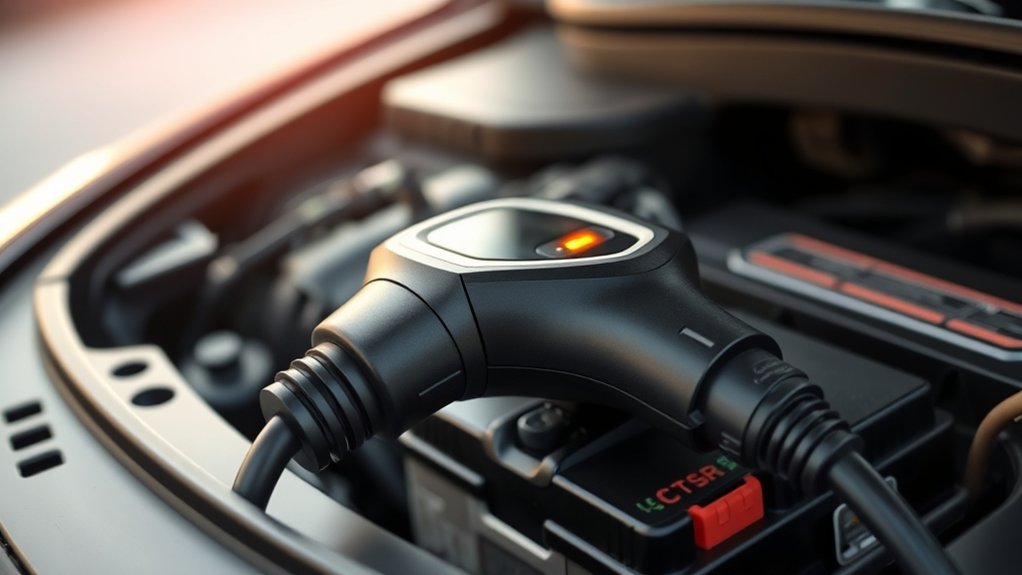
Using a smart charger with automatic shutoff or float mode helps maintain the charge safely without risking battery damage.
Monitor the voltage and current to know when the battery is full—around 12.6–12.8 volts and near zero amps.
Understanding the different charger types, the effects of weather, and the overall battery health will help you optimize charging and extend the battery’s lifespan.
Key Takeaways
- Typically, do not leave a car battery charger connected for more than 24 hours to avoid overcharging and battery damage.
- Use smart chargers with automatic shutoff or float mode to safely maintain charge without risk of overcharging.
- Monitor charging current; when current nears zero amps or indicator shows full charge, it’s time to disconnect if no auto mode.
- For chargers without maintenance mode, disconnect immediately after reaching full capacity to prevent electrolyte depletion and corrosion.
- Cold weather can extend charging time, so adjust or monitor charging carefully to avoid prolonged overcharge and battery stress.
How Long Should You Leave a Battery Charger on Your Car?
How long should you leave a battery charger on your car? It depends on the battery’s state and charger type, but you typically shouldn’t exceed 24 hours.
Car batteries experience self discharge, a natural process where they lose charge over time even when unused. A charger compensates by restoring voltage, but overcharging can disrupt electrolyte recombination, the chemical reaction essential for maintaining battery health.
Car batteries naturally lose charge over time, and chargers restore voltage but must avoid overcharging to protect battery health.
Extended charging risks excessive gassing and plate corrosion, reducing battery lifespan. Modern smart chargers mitigate this by switching to maintenance mode, preventing overcharge while countering self discharge.
If your charger lacks this feature, monitor charging closely and disconnect after the battery reaches full capacity. In sum, balance recharging time to avoid damaging the battery while offsetting self discharge effectively.
Trickle vs. Fast Chargers: What’s the Difference?
Why choose between trickle and fast chargers? Understanding their differences helps you optimize charging safety and battery maintenance. Trickle chargers deliver a low, steady current, ideal for long-term maintenance without overcharging. Fast chargers supply a high current to rapidly replenish a depleted battery but risk overheating if not monitored.
Consider these distinctions:
- Charging Speed: Trickle chargers work slowly over hours or days; fast chargers complete charging in under an hour.
- Battery Impact: Trickle chargers preserve battery health by preventing overcharge; fast chargers can stress the battery if used excessively.
- Usage Scenario: Use trickle chargers for storage or infrequent use; fast chargers for quick recovery during emergencies.
Choosing the right charger ensures safe, efficient battery care tailored to your vehicle’s needs.
Factors That Affect Car Battery Charging Time
When determining how long to leave your car battery charger connected, several key factors influence the charging time. First, battery design plays a critical role; different chemistries and capacities require varied charging durations. For instance, lead-acid batteries generally charge slower than lithium-ion types due to their internal structure.
Second, charging standards your charger adheres to, such as IUoU, CCCV, or multi-stage protocols, impact how quickly and safely the battery reaches full capacity. These standards regulate voltage and current flow, preventing overcharging and extending battery life.
Additionally, the battery’s state of charge at the start affects timing; a deeply discharged battery demands longer charging. Environmental conditions like temperature also matter, but battery design and charging standards remain the primary determinants for accurate charging time estimation.
How to Know When Your Battery Is Fully Charged
Understanding the factors that influence charging time helps you anticipate how long the process might take, but knowing exactly when your battery reaches full charge requires monitoring specific indicators. Avoid focusing on irrelevant topics or unrelated concepts, like guessing based on time alone. Instead, rely on measurable signs:
- Charger Indicator Light: Most smart chargers display a green light or show “fully charged” when the battery’s voltage stabilizes at the correct level.
- Voltage Measurement: Use a multimeter to check the battery voltage; a fully charged 12V battery reads about 12.6 to 12.8 volts at rest.
- Charging Current: When charging current drops to near zero amps, the battery is close to full charge, indicating the charger has tapered off.
Monitoring these factors ensures you know precisely when the battery is ready without guesswork.
Risks of Overcharging Your Car Battery and How to Avoid Them
How can overcharging harm your car battery? Excessive charging causes electrolyte depletion and internal corrosion, reducing battery capacity and lifespan. It generates heat, which can warp plates and risk thermal runaway.
To maintain charger safety, use a smart charger with automatic shutoff or float mode to prevent continuous current flow once fully charged. Avoid leaving a conventional charger connected indefinitely, as it lacks overcharge protection.
Regularly inspect your battery and charger connections for corrosion or damage as part of your maintenance tips. Ensure proper ventilation during charging to dissipate gases safely.
Step-by-Step: Safely Charge Your Car Battery
Why is following a precise charging procedure critical for your car battery’s health? Proper steps ensure battery safety, prevent damage, and extend battery life.
Following a precise charging procedure safeguards your car battery, prevents damage, and prolongs its lifespan.
To safely charge your car battery, follow this numeric checklist:
- Prepare the Charger and Battery: Inspect the charger for damage and confirm charger maintenance is up to date. Ensure the battery terminals are clean and free of corrosion.
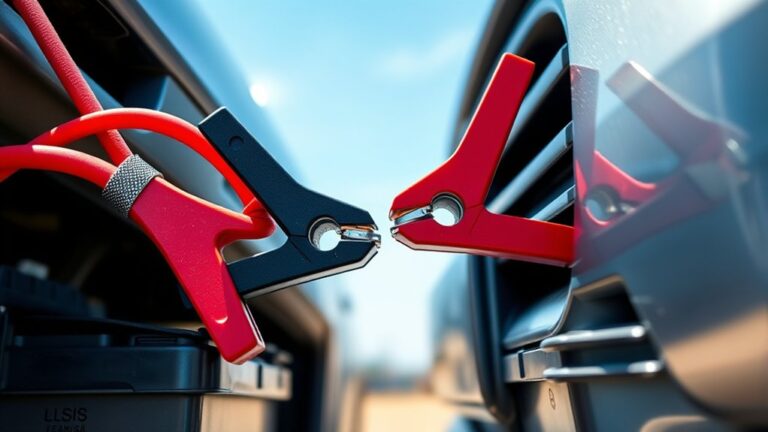
- Connect Correctly: Attach the positive (red) clamp to the positive battery terminal first, then the negative (black) clamp to the negative terminal or vehicle chassis ground. This minimizes sparking hazards.
- Set Charger and Monitor: Select the appropriate charging mode and amperage on your charger. Turn on the charger, monitor charging progress, and disconnect once fully charged to avoid overcharging risks.
Adhering to these steps maintains battery safety and optimizes charger maintenance for effective and secure battery charging.
How Weather and Seasons Affect Car Battery Charging Time
You’ll notice that temperature considerably impacts your car battery’s charging efficiency, with cold weather slowing the chemical reactions inside the battery. Seasonal changes can cause variations in battery performance, often requiring longer charging times during winter months. To optimize charging in cold conditions, you should use chargers with temperature compensation and avoid rapid charging that could damage the battery.
Temperature Impact On Charging
Although battery chargers deliver a consistent current, ambient temperature considerably influences the charging process and duration. You must consider temperature effects to ensure charging safety and optimize battery life.
Cold temperatures slow chemical reactions inside the battery, extending the charging time, while high temperatures accelerate reactions but risk overheating. To manage these effects, follow these guidelines:
- Charge in a temperature-controlled environment (ideally 50°F to 80°F) to maintain optimal efficiency.
- Avoid charging immediately after extreme temperature exposure to prevent thermal stress.
- Use a charger with temperature compensation features to adjust current based on ambient conditions.
Seasonal Battery Performance Variations
How do seasonal changes impact your car battery’s charging time? Seasonal variations directly influence charging efficiency and battery performance.
In warmer months, increased temperatures can enhance chemical reactions inside the battery, improving charging speed and efficiency. However, prolonged heat exposure accelerates seasonal wear, reducing battery lifespan.
Conversely, cooler seasons slow down chemical activity, decreasing charging efficiency and requiring longer charging durations. This seasonal wear manifests as reduced capacity and slower recharge rates, demanding more attention during colder months.
Understanding these effects helps you optimize charging time by adjusting for seasonal fluctuations. Monitoring your battery’s condition regularly during seasonal transitions ensures you maintain optimal performance and prevent premature wear caused by inconsistent charging patterns linked to temperature variations.
Cold Weather Charging Tips
Seasonal temperature shifts directly affect your car battery’s ability to hold and receive charge, with cold weather presenting particular challenges. In cold weather, battery efficiency drops due to slowed chemical reactions, requiring longer charging times. To optimize charging in these conditions, follow these tips:
- Use a charger with a temperature sensor to adjust charging rates and prevent overcharging in cold weather.
- Warm the battery to near room temperature before charging if possible, as cold batteries accept charge less efficiently.
- Monitor the charger’s output and battery voltage closely; extended charging could cause damage if the battery is already fully charged but cold.
When to Replace Your Car Battery Instead of Charging
You should consider replacing your car battery if it’s over three to five years old or shows persistent signs of failure like slow engine crank or warning lights. Testing battery performance with a multimeter or load tester can confirm if charging is insufficient. Relying solely on a charger won’t help if the battery’s internal condition has deteriorated.
Battery Age Considerations
When should you consider replacing your car battery instead of repeatedly charging it? Battery aging reduces its ability to hold a charge, and at some point, no charger can restore full performance. Additionally, battery health can be indirectly affected by coolant compatibility issues, as improper coolant mixtures may impact the engine environment, stressing the battery system.
Here are three key factors to evaluate:
- Battery age exceeds 3-5 years, depending on manufacturer guidelines and environmental conditions.
- Frequent need for charging despite following correct charging protocols indicates diminished capacity.
- Corrosion or damage linked to coolant leaks or incompatibility that may affect battery terminals or housing.
Replacing the battery under these conditions prevents unexpected failures and ensures reliable vehicle operation.
Signs of Battery Failure
Recognizing the signs of battery failure helps determine when replacing your car battery is necessary rather than continuing to charge it. Over time, battery chemistry degrades, reducing capacity and making charging ineffective.
If your battery struggles to hold charge despite using alternating current chargers properly, replacement is likely needed.
| Sign | Explanation |
|---|---|
| Slow engine crank | Indicates diminished battery capacity |
| Swollen or leaking casing | Physical damage from internal chemical stress |
| Frequent need for recharge | Battery chemistry no longer supports retention |
If you observe these signs, recharging won’t restore full function. Replacing the battery prevents unexpected failures and ensures reliable vehicle operation.
Testing Battery Performance
How can you accurately assess whether your car battery still performs adequately or requires replacement? Employing a proper testing methodology is essential to avoid unnecessary charging attempts that waste time and reduce charger efficiency. Here’s what you should do:
- Measure the battery voltage with a multimeter; a fully charged battery reads about 12.6 volts. Below 12.4 volts indicates diminished capacity.
- Conduct a load test using a battery tester to simulate starting conditions. If voltage drops below 9.6 volts during the test, replacement is advisable.
- Check the battery’s age and physical condition. Corrosion, leaks, or swelling signal internal damage beyond what charging can fix.
If your battery fails these tests, charging won’t restore performance, and you should replace it to ensure reliable vehicle operation.
Frequently Asked Questions
Can I Charge a Car Battery With a Solar Charger?
Yes, you can charge a car battery with a solar charger, but don’t buy into non-technical myths. Use quality panels and charge controllers to ensure safety first, protecting your battery and electrical system efficiently.
How Do I Store a Battery Charger When Not in Use?
Think of your charger like a delicate instrument: for storage safety and long term maintenance, unplug it, coil cables loosely, keep it in a dry, cool place, and avoid heavy pressure or moisture to preserve its functionality.
Are Smart Chargers Compatible With All Car Battery Types?
Smart chargers generally support multiple battery types, ensuring charger compatibility with lead-acid, AGM, and gel batteries. You’ll enhance battery safety by selecting a charger matching your battery’s specifications and features designed to prevent overcharging or damage.
Can Charging a Battery Cause Sparks or Explosions?
Worried about sparks during charging? Yes, charging hazards like ignition risks can cause sparks or explosions from batteries if hydrogen gas accumulates.
You must ensure proper ventilation and follow safety guidelines to prevent such dangerous incidents.
Is It Safe to Charge a Battery Inside a Closed Garage?
Charging a battery inside a closed garage isn’t safe unless you guarantee proper ventilation. Charging safety requires dispersing hydrogen gas emitted during charging to prevent explosions.
Always provide airflow or open doors to meet ventilation requirements effectively.
Conclusion
When charging your car battery, remember that over 70% of battery failures stem from improper charging or maintenance. Leaving a charger on too long can damage your battery, while undercharging reduces its lifespan.
Use a smart charger with an automatic shutoff or switch to trickle charging for long-term maintenance. Always monitor charging times based on your charger type and battery condition to ensure optimal performance and longevity.
Charge smart to keep your battery reliable, and know how long to leave the battery charger on your car to maximize its life and effectiveness.