Can You Use Water as Coolant
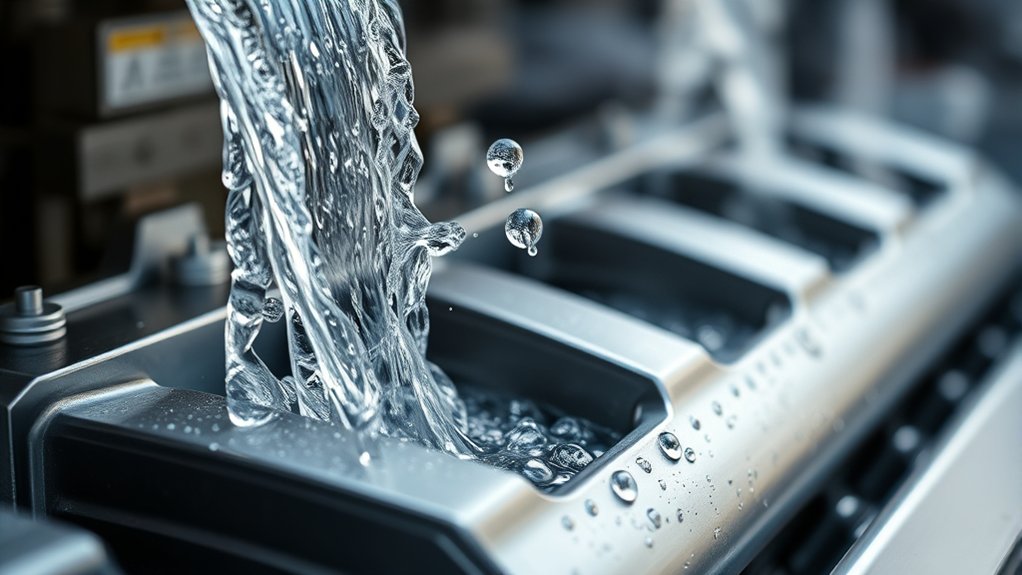
You can use water as a coolant because it efficiently absorbs and transfers heat due to its high specific heat capacity and thermal conductivity. Water as a coolant is widely used in various applications for these reasons. However, you’ll need to carefully manage its purity, corrosion risks, and temperature limits to prevent scaling, metal damage, and boiling issues.
Water suits controlled environments and low-stress systems but isn’t ideal for extreme conditions without additives. Exploring how to optimize water cooling will help you maximize its performance and reliability. Proper maintenance and monitoring are key to ensuring effective and safe water-based cooling systems.
How Does Water Transfer Heat as a Coolant?
How exactly does water transfer heat when used as a coolant? You rely on water’s high specific heat capacity to absorb and transport thermal energy efficiently.
Water’s high specific heat capacity enables efficient absorption and transport of thermal energy when used as a coolant.
As water flows through a system, it removes heat from hot surfaces via conduction and convection, enabling spatial cooling by distributing heat uniformly across the coolant volume. This spatial cooling minimizes thermal hotspots, maintaining system stability.
Additionally, water’s density and thermal conductivity support rapid heat exchange, which enhances acoustic efficiency by reducing vibrations caused by uneven temperature gradients. The turbulence generated in flowing water further improves convective heat transfer rates.
You’ll find that water’s molecular properties make it an effective medium for transferring heat, optimizing both temperature regulation and acoustic performance in cooling applications.
Benefits of Using Water for Cooling
Why choose water as your cooling medium? Water offers exceptional thermal conductivity and specific heat capacity, making it highly efficient for heat transfer applications. Its abundance and low cost simplify procurement, though you’ll need to consider water licensing regulations to ensure compliance with local environmental standards.
Additionally, water’s compatibility with various cooling system materials reduces corrosion risks when properly treated. You can also leverage water’s transparency and clarity to maintain aquatic aesthetics in open cooling systems, which is crucial for installations near natural or recreational water bodies.
Moreover, water’s non-toxic nature minimizes environmental hazards in case of leaks or spills, enhancing operational safety. Overall, water’s unique combination of thermal performance, regulatory considerations, and environmental benefits makes it a compelling choice for cooling applications.
Risks of Using Water Alone as a Coolant
What challenges arise when you rely solely on water as a coolant? Water’s boiling point limits its effectiveness in high-temperature applications, causing vapor formation that disrupts consistent heat transfer. Additionally, water’s inability to inhibit corrosion can degrade system components over time, increasing maintenance costs and risking failure.
| Risk | Impact |
|---|---|
| Boiling Point Limit | Vapor pockets reduce heat transfer efficiency |
| Corrosion | Metal degradation shortens system life |
| Freezing | Expansion can crack cooling systems |
| Microbial Growth | Biofilm formation clogs pathways |
| Electrical Conductivity | Risk of short circuits in electronics |
Understanding these risks helps you weigh water’s limitations carefully when selecting a coolant for your system.
When Is Water a Suitable Coolant Choice?
Despite the risks associated with using water alone as a coolant, there are scenarios where water remains an effective and practical choice. You’ll find water suitable when operating within controlled temperature ranges and environments where freezing or boiling points won’t be exceeded.
Its high specific heat capacity enables efficient thermal transfer, making it ideal for water-specific cooling systems designed to optimize flow and heat dissipation. Additionally, if you prioritize an eco-friendly solution, water’s non-toxic and biodegradable nature reduces environmental impact compared to chemical-based coolants.
However, to maximize effectiveness, you must ensure water purity and possibly integrate corrosion inhibitors. In applications like short-term testing, low-stress engines, or where environmental concerns dominate, water serves as a reliable coolant, provided you manage its inherent limitations carefully.
How Does Water Compare to Traditional Engine Coolants?
You’ll find that water’s thermal conductivity is higher than most traditional coolants, allowing for efficient heat transfer. However, it lacks corrosion inhibitors, which can lead to engine wear over time. Additionally, water’s lower boiling point and higher freezing point pose challenges compared to engineered coolant mixtures.
Thermal Conductivity Differences
How effectively a coolant transfers heat plays a pivotal role in engine performance and durability. Water boasts a thermal conductivity of approximately 0.6 W/m·K, significantly higher than most traditional engine coolants, which average around 0.15 to 0.25 W/m·K. This superior heat transfer capability means water can dissipate engine heat more efficiently, reducing thermal stress.
However, when you consider economic modeling, the cost-effectiveness of water is attractive but must be weighed against potential drawbacks like corrosion. Additionally, political implications arise in regions where access to clean water is limited or prioritized for human consumption, complicating its use as a coolant.
Thus, while water excels thermally, the broader economic and political contexts influence its practical application in engine cooling systems.
Corrosion Protection Capabilities
Why does corrosion protection matter when comparing water to traditional engine coolants? Corrosion directly impacts engine longevity and energy efficiency by causing material degradation and heat transfer inefficiencies.
Unlike specialized coolants, plain water lacks corrosion inhibitors, making metal components vulnerable to rust and scale buildup. Traditional coolants contain additives that form protective layers inside the engine, reducing oxidation and metal wear.
While water is eco friendly and readily available, its inability to protect against corrosion can lead to frequent maintenance and reduced operational efficiency. If you prioritize long-term engine health and consistent performance, relying solely on water compromises corrosion resistance.
Consequently, despite water’s environmental advantages, traditional coolants offer superior corrosion protection critical for maintaining energy-efficient engine operation.
Freezing And Boiling Points
Corrosion protection is just one factor to contemplate when choosing a coolant, but its performance under varying temperatures plays an equally important role. Water’s freezing point (0°C) and boiling point (100°C at atmospheric pressure) are critical benchmarks, but they fall short compared to specialized engine coolants. These coolants often include additives that significantly alter these thermal limits, a feature water alone lacks.
When evaluating water as a coolant, keep in mind:
- Freezing point depression in traditional coolants prevents engine block cracking; water doesn’t provide this.
- Boiling point elevation allows higher operating temperatures, enhancing efficiency; water’s boiling point is relatively low.
- Using water ignores unrelated topics like additive chemistry, which is vital for thermal stability.
- Considering water alone dismisses irrelevant concepts like corrosion inhibitors, crucial in engine longevity.
Thus, relying solely on water is suboptimal for thermal management.
Preparing Water as a Coolant for Your System
When preparing water as a coolant for your system, you must guarantee it meets specific purity and treatment standards to optimize thermal performance and prevent damage. Avoid unrelated topic or off topic discussion about additives here; focus strictly on water quality.
Use deionized or distilled water to minimize mineral deposits and corrosion. Additionally, filter water to remove particulates that could clog your system.
| Parameter | Recommended Standard |
|---|---|
| Purity Level | Resistivity > 1 MΩ·cm |
| Particulate Size | < 5 microns |
| pH Range | 6.5–7.5 |
| Temperature | Ambient, avoid extremes |
Following these parameters ensures reliable heat transfer and longevity. Skipping these steps risks system inefficiency and failure.
Additives That Boost Water’s Cooling Performance
While maintaining high water purity is fundamental, enhancing the coolant’s properties often requires incorporating specific additives. These additives fine-tune thermal conductivity, prevent phase change issues, and improve overall system efficiency. When you optimize water for cooling, consider how it affects irrigation efficiency and steam generation processes, crucial in various industrial applications.
Key additives include:
- Antifreeze agents: Lower freezing points, ensuring consistent flow in cold environments.
- Surfactants: Improve heat transfer by reducing surface tension, boosting irrigation efficiency.
- Phase change stabilizers: Control steam generation, preventing premature vaporization.
- Biocides: Inhibit microbial growth that can degrade cooling performance.
Selecting the right additive blend ensures your water coolant performs reliably under diverse thermal loads and operational conditions.
Preventing Corrosion and Scaling in Water Coolants
Because water-based coolants interact constantly with metal surfaces, you need to address corrosion and scaling proactively to maintain system integrity. Corrosion degrades metal components, increasing engine noise due to vibration and wear, while scaling deposits restrict coolant flow, reducing heat transfer efficiency.
Both factors negatively impact fuel efficiency by forcing the engine to work harder. To prevent these issues, you should use corrosion inhibitors tailored to the metal alloys in your system, such as silicates or phosphates, which form protective layers. Additionally, controlling water pH and hardness minimizes scale formation.
Regular monitoring of coolant chemistry enables early detection of corrosive or scaling tendencies, ensuring optimal thermal performance and prolonging engine life. Proactive management of these factors helps maintain consistent fuel efficiency and reduces unwanted engine noise.
Maintaining a Water-Based Cooling System
You’ll need to perform regular water quality checks to guarantee optimal coolant performance and prevent system degradation. Keep corrosion and scale buildup in check by using appropriate inhibitors and filtration techniques. Additionally, continuously monitor system temperature levels to maintain efficient heat transfer and avoid overheating.
Regular Water Quality Checks
How often should you check the quality of water in a cooling system? Regular monitoring is critical to avoid common refrigeration myths, such as water’s inertness in thermal applications like solar ponds.
You should test water quality at least monthly, focusing on parameters that directly impact system performance:
- pH levels to detect acidity or alkalinity shifts
- Total dissolved solids (TDS) to gauge contamination
- Microbial presence to prevent biofouling
- Conductivity to assess ionic impurities
These metrics help you identify deviations early, ensuring efficient heat transfer and system reliability. Neglecting this can lead to inefficiencies or system failures, undermining water’s viability as a coolant.
Preventing Corrosion and Scale
Why does preventing corrosion and scale matter so much in water-based cooling systems? Corrosion deteriorates metal components, reducing system efficiency and lifespan, while scale buildup impedes heat transfer, causing overheating.
You must address these issues to optimize performance and conserve water, especially amid growing water scarcity. Saltwater effects exacerbate corrosion due to high chloride concentrations, accelerating metal degradation.
To counter this, use corrosion inhibitors and select materials resistant to salt-induced damage. Implement water treatment methods like softening and pH control to minimize scale formation.
Regularly flush the system to remove deposits and prevent buildup. By proactively managing corrosion and scale, you ensure reliable cooling, reduce maintenance costs, and make efficient use of limited water resources in your water-based cooling system.
Monitoring System Temperature Levels
When should you monitor temperature levels in a water-based cooling system to maintain optimal performance? Consistent monitoring is crucial to detect deviations that could signal inefficiencies or system failure. Neglecting this can turn temperature control into an unused topic or an unrelated focus irrelevant to system health.
You should monitor temperature levels:
- Continuously during system operation to catch real-time anomalies
- After maintenance to verify system integrity
- When ambient conditions change significantly
- Periodically during idle phases to prevent unnoticed temperature shifts
Utilize precise sensors and calibrated instruments for accurate readings. Analyzing this data promptly allows you to adjust flow rates or coolant concentration, ensuring the water-based system functions at peak efficiency without overheating or freezing risks.
When Should You Avoid Using Water as a Coolant?
Although water offers excellent thermal conductivity, you should avoid using it as a coolant in systems exposed to freezing temperatures, as it can freeze and cause damage. Freezing expands water, leading to cracks or ruptures in cooling channels.
Additionally, water’s corrosive potential can accelerate wear in metal components without proper additives. Implementing avoidance strategies, such as using antifreeze mixtures or alternative coolants, helps mitigate these risks effectively.
Understanding consumer habits is crucial; many users default to plain water, overlooking environmental conditions and system specifications. If you operate equipment in cold climates or need long-term stability, relying solely on water is imprudent.
Instead, evaluate coolant composition based on operating temperature ranges, corrosion control, and maintenance requirements. This analytical approach ensures optimal system longevity and performance while minimizing downtime.
Frequently Asked Questions
Can Distilled Water Improve Coolant Efficiency Compared to Tap Water?
You’ll find distilled water improves coolant efficiency compared to tap water because it lacks minerals and impurities that cause scale and corrosion.
This distilled water vs. tap water coolant efficiency comparison clearly favors distilled water’s thermal performance.
How Does Water Coolant Impact Engine Warranty Coverage?
Using water as coolant can void your engine warranty due to coolant compatibility issues. Manufacturers require specific coolants, so deviating risks engine warranty implications if damage occurs from improper coolant use or corrosion.
What Is the Environmental Impact of Disposing Used Water Coolant?
When you pour used water coolant down drains, it seeps like toxic ink into soil and waterways. Its coolant toxicity demands careful environmental disposal to prevent harming ecosystems and contaminating groundwater.
This requires strict adherence to disposal regulations.
Can Water-Based Coolants Be Used in Electric Vehicle Cooling Systems?
Yes, you can use water-based coolants in EV cooling systems due to water’s high specific heat capacity and thermal conductivity, which efficiently manage heat.
However, you must address corrosion, freezing, and electrical conductivity challenges for optimum performance.
How Often Should Water Coolant Be Replaced in High-Performance Engines?
You’ll want to replace water coolant in high-performance engines every 12 to 24 months or 15,000 to 30,000 miles. This ensures best water cooling, prevents corrosion, and maintains peak efficiency during intense two-word discussion ideas like heat transfer.