How Do You Measure Wheel Lug Pattern
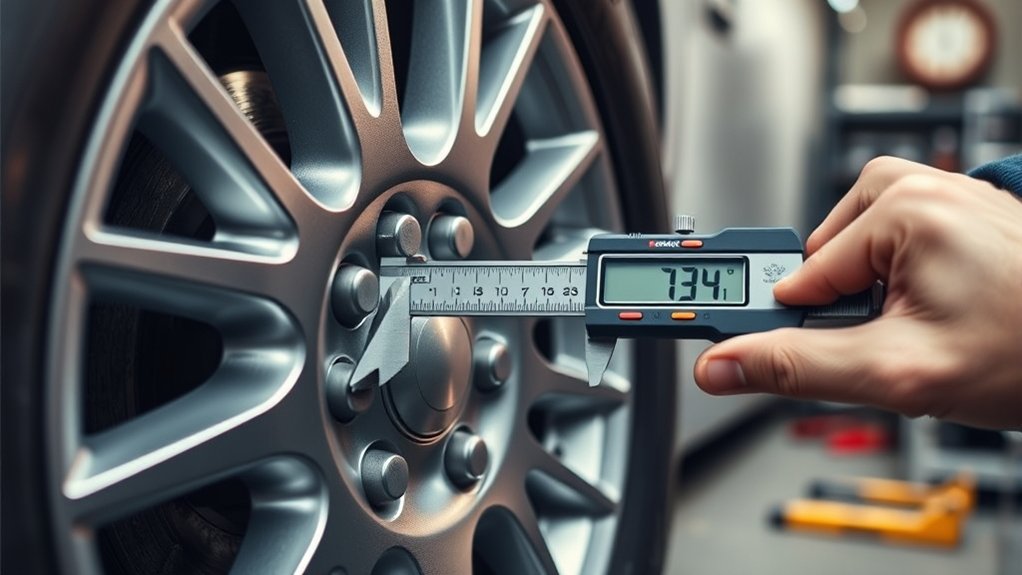
To measure your wheel lug pattern, first count the total number of lug holes on the wheel (e.g., 5 in a 5×114.3 pattern). Using a caliper is recommended for the most accurate measurement.
For wheels with an even number of lug holes, measure directly from the center of one lug hole to the center of the lug hole directly opposite it.
For wheels with an odd number of lug holes, measure from the center of one lug hole to the outer edge of the lug hole across from it.
Be sure to record this bolt circle diameter precisely, avoiding guesses or rounding.
Knowing these details guarantees a proper fit.
There’s more to explore about tools and common pitfalls when measuring your wheel lug pattern.
Figuring Out Your Wheel Lug Pattern Type
How do you determine the exact lug pattern of your wheel? Start by identifying the number of lug holes and measuring the distance between them accurately. Don’t fall for common lug pattern myths, such as assuming all five-lug wheels share the same measurements.
Each vehicle can have subtle differences in spacing, known as bolt circle quirks, which affect compatibility. For four- or five-lug patterns, measure from the center of one lug hole to the center of the opposite hole or the farthest point on the circle.
For even-numbered lug patterns, measure directly across the circle. Avoid guessing or using generic charts; precise measurement ensures you get the correct lug pattern type, essential for wheel fitment and safety.
Essential Tools for Measuring Wheel Lug Patterns
Which tools do you need to measure your wheel lug pattern accurately? To achieve bolt circle precision, you’ll want a reliable caliper or a specialized lug pattern gauge.
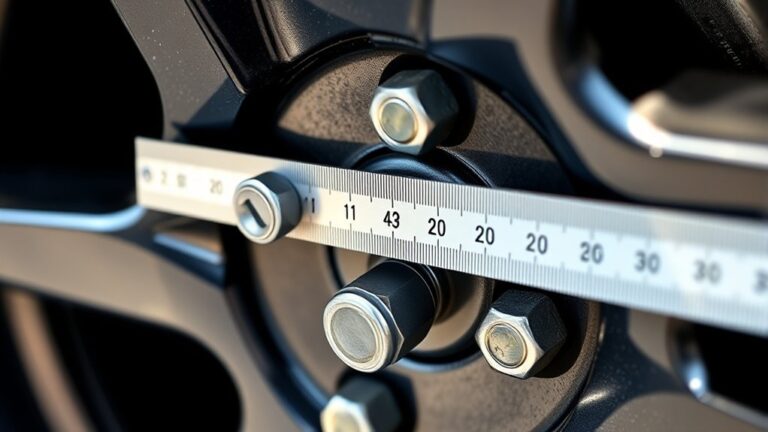
A caliper allows you to measure the distance between lug holes with high accuracy, essential for debunking common lug pattern myths that suggest rough estimates suffice. Additionally, a ruler or tape measure can help, but only if used carefully to avoid errors in spacing.
Avoid relying on assumptions or visual guesses, as these lead to inaccuracies. For multi-lug wheels, consider a protractor or angle finder to confirm hole placement symmetry.
Using these precise tools ensures your measurements reflect the exact bolt circle diameter and lug count, preventing fitment issues down the line.
Measuring Your Wheel Lug Pattern Step-by-Step
When measuring your wheel lug pattern, start by identifying the total number of lug holes on your wheel. This number represents the first part of the pattern terminology, such as “5” in a 5×114.3 pattern.
Next, use a calibrated measuring tool to determine the distance between the centers of two non-adjacent lug holes. For an odd number of lug holes, measure from the center of one lug hole to the outer edge of the lug hole directly across. For an even number, measure center-to-center across the wheel.
Record this distance in millimeters or inches, ensuring measuring accuracy by avoiding parallax errors and maintaining a consistent angle. This distance forms the second part of the pattern terminology, completing the precise definition of your wheel’s lug pattern.
Avoid These Common Lug Pattern Mistakes
Accurately measuring your wheel lug pattern requires attention to detail, but several common mistakes can compromise your results. One major measurement pitfall is assuming all lug patterns follow the same method; lug pattern myths often claim you can measure from center-to-center regardless of the number of lug holes.
In reality, you must measure differently for even and odd lug counts. Measure center-to-center for even lugs and edge-to-center for odd lugs. Another frequent error is using imprecise tools or measuring from the wrong points on the lug holes, which leads to inaccurate results.
Avoid guessing or rounding numbers prematurely; always record measurements to the nearest millimeter or fraction of an inch. By steering clear of these pitfalls and dispelling lug pattern myths, you ensure precise wheel fitment and safety.
Using Your Lug Pattern to Buy the Right Wheels
How do you guarantee the wheels you buy will fit your vehicle perfectly? Start by accurately identifying your lug pattern, the precise number of lug holes and the diameter of the circle they form. This measurement directly determines compatibility.
Avoid common lug pattern myths, such as assuming wheels with the same number of lugs will always fit. Next, verify the wheel’s bolt circle diameter matches your vehicle’s lug pattern exactly.
Be mindful of wheel sizing pitfalls, like ignoring offset or center bore size, which can cause fitment issues even if the lug pattern matches. Use your confirmed lug pattern as a baseline; then cross-reference wheel specifications to ensure proper fitment.
This methodical approach prevents costly mistakes and ensures safe, reliable wheel installation tailored to your vehicle.
Frequently Asked Questions
Can Wheel Lug Patterns Affect Vehicle Safety?
Yes, incorrect lug pattern terminology or poor measurement accuracy can compromise your vehicle’s safety by causing improper wheel fitment. This can lead to instability, uneven wear, or even wheel detachment under stress. Always verify lug specs precisely.
How Do Lug Patterns Differ Between Cars and Trucks?
Think of wheel lugs as puzzle pieces; trucks have larger, more robust wheel lug pattern differences for heavy loads, while cars use smaller, tighter mounting standards.
You’ll need to check wheel compatibility carefully between these distinct designs.
Are Lug Patterns Standardized Internationally?
You won’t find lug patterns standardized internationally, but understanding bolt circle terminology helps you navigate regional differences. Measuring hub spacing precisely guarantees compatibility, as manufacturers often vary bolt circle diameters and lug counts across markets and vehicle types.
Can Changing Lug Patterns Impact Ride Quality?
Yes, changing lug patterns can affect ride quality if you don’t guarantee change compatibility with factory specifications. Incorrect patterns may cause improper wheel fitment, imbalance, or stress on suspension components, leading to vibrations and compromised handling.
What Tools Can Professionals Use for Precise Lug Pattern Measurement?
Imagine a watchmaker’s meticulous hands; professionals use calipers and specialized lug pattern gauges for lug pattern precision. These measurement tools ensure exact bolt circle diameters, preventing fitment issues and guaranteeing optimal wheel alignment and safety.
Conclusion
Measuring your wheel lug pattern precisely might seem straightforward, yet overlooking small details can lead to costly mismatches. While it’s easy to assume all lug patterns are alike, each vehicle demands exact measurements to guarantee safety and performance.
By using the right tools and following methodical steps, you avoid guesswork and errors. This contrast between simplicity and precision highlights why you should never underestimate the importance of accurate lug pattern measurement when selecting wheels.
In conclusion, taking the time to measure your wheel lug pattern correctly ensures compatibility and safety, making it a crucial step in the wheel selection process.