How to Tell if Wheel Bearing Is Bad
You can tell if a wheel bearing is bad by listening for unusual grinding, humming, or rumbling noises that change with speed or when you turn. These sounds often indicate that the bearing is worn or damaged.
Feel for vibrations in the steering wheel or vehicle body, especially at higher speeds. Such vibrations can be a sign of failing wheel bearings affecting the vehicle’s stability.
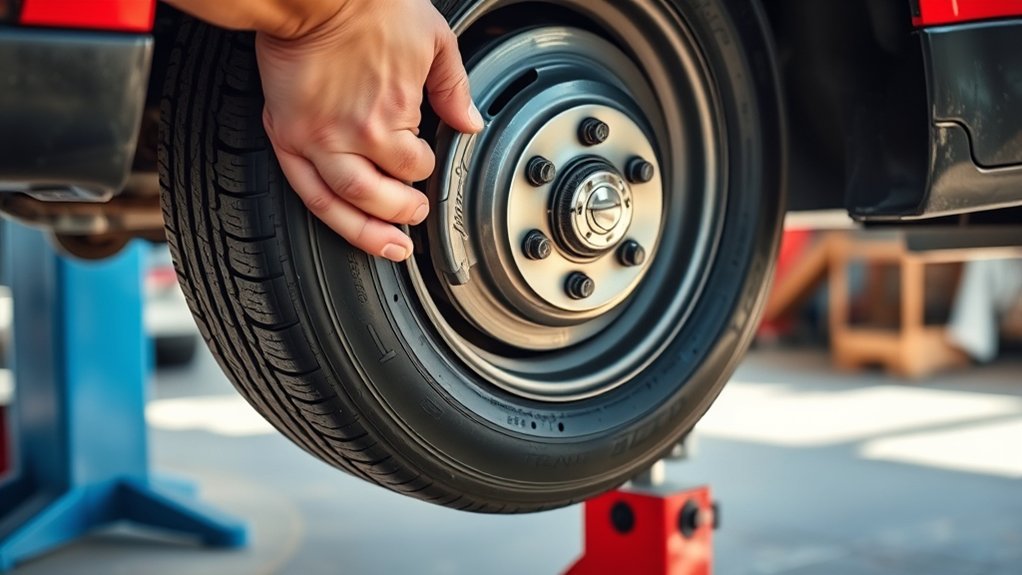
Test for excessive wheel play by checking for lateral or vertical movement at the 12/6 and 3/9 o’clock positions after securely lifting your vehicle. This physical check helps confirm if the bearing has excessive wear.
Not addressing worn bearings risks safety and handling problems. Understanding more about wheel bearing issues can help you spot problems early and avoid costly repairs.
What Does a Wheel Bearing Do in Your Vehicle?
How exactly does a wheel bearing function within your vehicle’s system? It enables the wheel to rotate smoothly by reducing friction between the wheel hub and axle. Wheel bearings support the vehicle’s weight while allowing controlled motion.
When inspecting lubrication, you check the grease that minimizes wear inside the bearing assembly. Proper lubrication prevents metal-on-metal contact, which can cause damage.
Diagnosing noise helps identify bearing issues early; a worn or damaged bearing often produces a grinding or humming sound. You can detect abnormalities by listening and feeling for vibrations while driving.
Maintaining optimal lubrication and promptly diagnosing noise ensures your wheel bearings operate efficiently, preventing potential failure and ensuring safe, stable vehicle performance.
Common Signs of Bad Wheel Bearings to Watch For
You’ll often notice unusual noises, like grinding or humming, coming from your wheels when a bearing starts to fail. Steering wheel vibrations, especially at higher speeds, can also indicate a compromised wheel bearing. Recognizing these signs early helps prevent further damage and ensures your vehicle stays safe to drive.
Unusual Noises While Driving
Why does your car emit strange noises when you drive? Often, bad wheel bearings cause unusual sounds that aren’t just random chatter or an unrelated topic. These noises signal mechanical distress.
To identify if your wheel bearing is the culprit, listen carefully for:
- A consistent humming or growling sound increasing with speed.
- A rhythmic clicking or grinding noise when turning.
- Unusual squeaking or rumbling that varies by road surface.
- Sounds that disappear or change when you shift your weight or steer slightly.
These distinct auditory cues indicate bearing wear or damage. Ignoring them risks further mechanical failure. Recognizing these noises early helps you avoid costly repairs and maintain safe driving conditions.
Steering Wheel Vibrations
When does your steering wheel start to shake or vibrate while driving? Steering wheel vibrations often indicate a failing wheel bearing, especially if the sensation intensifies with speed. A worn bearing causes uneven wheel rotation, disrupting vehicle stability.
You should also consider wheel lubrication status. Lack of proper lubrication accelerates bearing wear, escalating vibrations. Additionally, irregular tire rotation can contribute to uneven tire wear, mimicking bearing-related vibrations, so always rule out tire condition first.
To diagnose, check the wheel for play or roughness when spun. Addressing wheel bearing issues promptly prevents further damage and maintains handling precision. Regular maintenance, including proper wheel lubrication and scheduled tire rotation, helps extend wheel bearing life and ensures safe, vibration-free steering.
How to Diagnose Wheel Bearing Noise While Driving
How can you pinpoint wheel bearing noise while driving? To accurately diagnose it, first ignore alternator and tire patch noises, as they can mimic bearing sounds. Focus on these steps:
- Drive at varying speeds and listen for a consistent humming or grinding noise that changes with speed.
- Slightly turn the steering wheel left and right to check if the noise intensifies on one side, indicating the affected bearing.
- Eliminate other noise sources like brakes or tires by testing on smooth, quiet roads.
- Pay attention to noise that persists regardless of acceleration or braking, since wheel bearing noise usually remains steady.
Following these precise steps helps you isolate wheel bearing issues from other mechanical noises effectively.
What Vibrations and Wheel Play Reveal About Wheel Bearings
What signs do vibrations and wheel play provide about the condition of your wheel bearings? Vibration causes in a failing wheel bearing typically stem from uneven wear or damage to the bearing surfaces, leading to imbalanced wheel rotation. You’ll often feel these vibrations through the steering wheel or floorboard at various speeds.
Play indicators, such as noticeable lateral or vertical movement when you manually manipulate the wheel, suggest excessive bearing clearance or worn components. This wheel play is a critical diagnostic clue, as healthy bearings maintain tight tolerances with minimal movement.
Both vibration causes and play indicators point to compromised bearing integrity, increasing the risk of further damage or failure. Monitoring these symptoms allows you to address bearing issues promptly, ensuring vehicle safety and optimal wheel performance.
Checking Wheel Bearings Without Removing the Wheel
Where should you start if you need to check wheel bearings without removing the wheel? Begin by conducting a thorough auditory and tactile inspection while the vehicle is stationary or moving slowly. Follow these steps:
- Listen for any humming or grinding noises from the wheel area, which may indicate bearing wear.
- Grab the tire at the 12 and 6 o’clock positions; try to rock it to detect any play or looseness.
- Spin the wheel by hand and feel for roughness or resistance, suggesting bearing damage.
- Observe for uneven tire wear or unusual vibrations during a slow drive, as these can signal bearing issues.
While unrelated topic1 and unrelated topic2 might distract, focus solely on these diagnostics to assess bearing health accurately.
Manual Wheel Bearing Inspection Using a Jack
Start by securely lifting the vehicle with a jack and placing it on jack stands to guarantee stability. Once the wheel is off the ground, grip it at the 12 and 6 o’clock positions and check for any play or looseness. Excessive movement here often indicates a worn or damaged wheel bearing.
Lift Vehicle Safely
Before you begin inspecting the wheel bearing manually, ensure you lift the vehicle safely using a suitable jack and secure it with jack stands. Avoid confusing this unrelated topic with a random concept of lifting; safety is critical here. Follow these steps:
- Position the jack under the manufacturer’s recommended lift point near the wheel.
- Pump the jack handle to raise the vehicle until the wheel is off the ground.
- Place jack stands securely under the frame or axle, ensuring they contact solid metal.
- Slowly lower the jack until the vehicle rests firmly on the jack stands.
Never rely solely on the jack to hold the vehicle; this precise procedure prevents accidents and allows accurate wheel bearing inspection.
Check Wheel Play
Once the vehicle is securely supported on jack stands, you can proceed to check the wheel play for signs of a failing wheel bearing. Grasp the tire at the 12 and 6 o’clock positions and attempt to rock it back and forth.
Any noticeable movement or looseness indicates excessive play, a key symptom of bearing wear. Repeat this by holding the tire at 3 and 9 o’clock positions to detect lateral play.
Avoid confusing unrelated topic issues like suspension or steering play, which are off topic ideas in this context. Focus solely on wheel movement relative to the hub.
If you detect abnormal play, further inspection or replacement is necessary. This manual inspection method is a straightforward, effective way to diagnose bearing health without specialized tools.
How Wheel Bearing Damage Affects Safety and Performance
How exactly does a damaged wheel bearing compromise your vehicle’s safety and performance? Understanding this helps you avoid unrelated topics or irrelevant subjects that don’t impact your driving. A faulty bearing directly affects critical vehicle functions:
- Handling Stability: Worn bearings cause wheel wobble, reducing your control during turns and increasing the risk of accidents.
- Brake Efficiency: Damage leads to uneven wheel rotation, impairing your braking response and increasing stopping distances.
- Tire Wear: Excessive play accelerates uneven tire wear, forcing premature replacements and compromising grip.
- Noise and Vibration: Damaged bearings create abnormal noise and vibrations, distracting you and masking other mechanical issues.
Front vs. Rear Wheel Bearing Issues: What’s Different
You’ll notice that front and rear wheel bearing issues produce different noise patterns and affect vehicle vibration and handling in distinct ways. Front bearings often cause louder humming or grinding sounds during turns, while rear bearings tend to generate more consistent droning noises. Additionally, wear patterns vary due to differing load and steering demands on front versus rear wheels.
Noise Differences Explained
Why do front and rear wheel bearing noises sound different? It’s all about load, speed, and design. Front bearings often endure steering forces, while rear ones handle more constant loads. Here’s how noise varies:
- Front bearings usually produce a rhythmic growl or hum, changing with steering angle. Think hot rod humor, where the “squeal” reveals its character.
- Rear bearings emit a steady grinding or rumbling, consistent with tire trivia on constant rotational forces.
- Front noise may intensify during turns due to lateral stress.
- Rear noise remains uniform, often louder at higher speeds.
Understanding these nuances helps you diagnose issues precisely without confusing one for the other. Noise type and behavior provide pivotal clues about bearing condition and location.
Vibration and Handling Variances
Beyond noise, vibration and handling changes offer clear signals about wheel bearing health. When a front wheel bearing degrades, you’ll often feel vibration through the steering wheel, especially at higher speeds, because it directly affects wheel alignment and steering precision. This can cause slight pulling or looseness.
Rear wheel bearing issues, however, tend to produce vibrations felt through the vehicle body rather than the steering, as they impact tire balancing and overall ride stability more than steering control. You might notice subtle handling variances like instability during cornering or uneven tire wear.
Since wheel alignment and tire balancing directly influence these symptoms, it’s essential to rule out alignment or balancing problems before concluding the bearings are at fault. Proper diagnosis ensures targeted repairs and safer handling.
Wear Patterns Comparison
How can you distinguish wheel bearing wear by examining tire wear patterns? Understanding the wear comparison between front and rear wheel bearings helps you pinpoint the source of issues accurately. Front wheel bearing problems often cause uneven wear on the inner or outer edges of the front tires due to misalignment.
Rear wheel bearing wear patterns differ, usually showing more uniform tire wear but accompanied by lateral movement or noise.
Key wear patterns comparison points include:
- Front bearings cause edge tire wear due to steering loads.
- Rear bearings often produce consistent tire wear but affect stability.
- Front wear patterns correlate with steering feedback changes.
- Rear wear patterns align with rear-end vibrations or wandering.
Why You Shouldn’t Ignore Wheel Bearing Problems
Ignoring wheel bearing problems can lead to severe safety risks and costly repairs. You must address symptoms promptly to avoid wheel lockup, uneven tire wear, and compromised steering control. Early detection aligns with two word discussion ideas like “maintenance tips” that emphasize proactive vehicle care.
| Consequence | Explanation |
|---|---|
| Safety Hazard | Increased risk of accidents due to wheel failure |
| Increased Costs | More extensive repairs when issues worsen |
| Performance Decline | Noise, vibration, and poor handling |
| Tire Damage | Uneven wear requiring premature replacement |
When to Repair or Replace a Faulty Wheel Bearing
When should you decide to repair or replace a faulty wheel bearing? Avoid making decisions based on unrelated topic or off topic discussion. Instead, focus on these critical indicators:
- Noise Level: If you hear grinding or humming that worsens with speed, replacement is likely necessary.
- Wheel Play: Excessive side-to-side movement signals severe wear; repair won’t suffice.
- Heat Generation: Overheating near the wheel hub suggests bearing failure requiring immediate replacement.
- Mileage and Age: Bearings beyond manufacturer-recommended service intervals often need replacement, even without symptoms.
Ignoring these signs or entertaining unrelated topic advice risks safety and costly damage. Always rely on precise diagnostics rather than off topic discussion to decide between repair and replacement.
Tips to Maintain Wheel Bearings and Avoid Future Issues
Why should you prioritize regular maintenance of wheel bearings? Proper upkeep prevents premature failure, ensuring safe, smooth vehicle operation. Start by routinely inspecting bearings for wear or damage during wheel servicing.
Prioritize regular wheel bearing maintenance to prevent premature failure and ensure safe, smooth vehicle operation.
Keep bearings lubricated with manufacturer-recommended grease to reduce friction and heat buildup. Avoid incidental factors like overloading or driving through deep water, which accelerate wear.
Unrelated considerations such as poor wheel alignment can also stress bearings, so maintain overall suspension health. When replacing tires or brakes, check bearings to catch early issues.
Regular cleaning prevents dirt and debris contamination, which degrade bearing integrity. By addressing these precise maintenance steps, you minimize repair costs and extend the lifespan of your wheel bearings, ensuring consistent vehicle performance and safety over time.
Frequently Asked Questions
Can Bad Wheel Bearings Cause Uneven Tire Wear?
Yes, bad wheel bearings can cause uneven tire wear by affecting the tangential angle of the wheel. Don’t confuse this with an unrelated topic like alignment issues, though both impact tire performance distinctly.
How Much Does It Cost to Replace a Wheel Bearing?
Replacing a bad bearing is like swapping a worn-out gear in a machine; your replacement cost typically ranges from $150 to $400, depending on your vehicle and labor fees.
You’ll want precision to avoid future damage.
Are Wheel Bearing Noises Louder at Certain Speeds?
Yes, wheel bearing noise patterns are speed related; you’ll notice louder humming or grinding at specific speeds as the bearing’s internal components wear. This helps you pinpoint bearing issues by correlating noise intensity with velocity changes.
Can I Drive With a Bad Wheel Bearing Temporarily?
You can drive temporarily with a bad wheel bearing, but driveability concerns like noise and instability increase. Prioritize maintenance timelines to avoid failure or accidents.
Schedule repairs promptly to guarantee safety and vehicle performance.
Do Wheel Bearings Require Lubrication, and How Often?
If you neglect lubrication frequency, like a fleet driver who skipped greasing every 30,000 miles, wheel bearings can seize prematurely. You must follow manufacturer specs closely. Proper lubrication prevents failure and minimizes costly maintenance implications.
Conclusion
Think of your wheel bearings as the silent guardians of your vehicle’s smooth journey. When they falter, it’s like a subtle crack in the foundation—ignoring it risks greater damage and safety.
By recognizing signs early and maintaining them properly, you preserve not just parts, but the harmony of motion itself. Stay vigilant, act promptly, and guarantee your wheels keep turning seamlessly.
Understanding how to tell if a wheel bearing is bad helps you safeguard every mile and moment on the road ahead.