
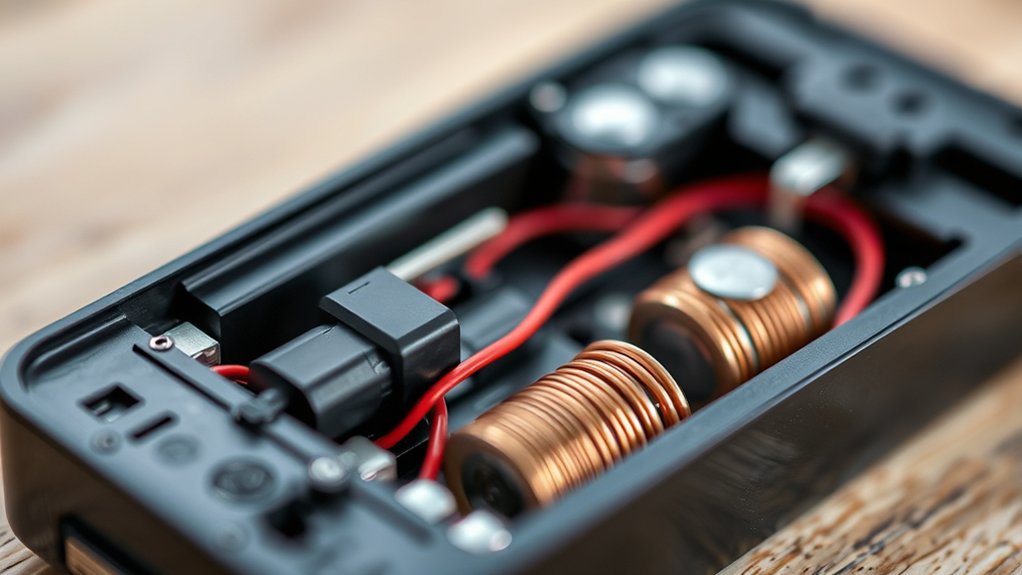
What Is in a Battery Charger
Inside a battery charger, you’ll find components that convert and control electricity to charge batteries safely and efficiently. Battery chargers use transformers to step down high-voltage AC and isolate your device from mains power. Rectifiers then turn AC into DC, which is required for charging.
Circuit boards execute precise charging algorithms to prevent overcharge and manage thermal conditions. Regulators maintain stable voltage throughout the process. Safety circuits detect faults and can stop charging if needed.
Together, these parts optimize charging performance and extend battery life. Explore further to understand how each element works seamlessly within a battery charger.
What Are the Main Parts Inside a Battery Charger?
How does a battery charger convert electrical energy to replenish your device’s power storage? Inside, the main components work together efficiently. You’ll find battery terminals that securely connect the charger to your device, ensuring stable current flow.
Indicator LEDs provide essential feedback, signaling charging status and completion. These LEDs help you monitor the process without opening the charger.
The charger’s internal circuitry controls voltage and current, adapting to battery type and condition. You rely on these components to maintain ideal charging, prevent overcharging, and extend battery life.
How Do Transformers and Rectifiers Convert Electricity in Battery Chargers?
Beyond the physical connections and status indicators, the charger must convert the incoming electrical energy into a form suitable for your battery. Transformers provide essential transformer isolation, stepping down high-voltage AC mains to a safer, lower voltage level while isolating you from potentially dangerous currents.
This isolation enhances safety and prevents electrical noise from affecting the battery. Following the transformer, rectifiers convert the AC output into DC voltage needed by your battery. The rectified DC sizing is critical; it must match your battery’s specifications to prevent damage or inefficient charging.
How Do Circuit Boards Control the Charging Process?
Why does the circuit board play an essential role in your battery charger? It precisely manages the charging process by executing control loops and applying charge algorithms tailored to battery chemistry. This ensures efficient energy transfer while preventing overcharge or deep discharge.
You’ll find safety interlocks integrated to halt charging if unsafe conditions arise, maintaining device integrity. Thermal management is another critical function, preventing overheating by modulating current based on temperature feedback.
| Function | Description | Importance |
|---|---|---|
| Control Loops | Continuously adjust voltage/current | Maintains optimal charge |
| Charge Algorithms | Define charging stages and rates | Maximizes battery lifespan |
| Safety Interlocks | Interrupt charging on faults | Ensures user/device safety |
Together, these components optimize performance and reliability during the charging cycle.
Why Are Regulators and Safety Circuits Important in Battery Chargers?
Although circuit boards manage the charging process, regulators and safety circuits play an essential role in maintaining voltage stability and protecting both the battery and user. The regulator importance lies in its ability to control and limit voltage and current, preventing overvoltage conditions that can damage battery cells or reduce lifespan.
Without precise regulation, fluctuations could lead to overheating or capacity loss. Safety circuits add a crucial layer of protection by detecting anomalies such as short circuits, overcurrent, or thermal runaway. They trigger immediate shutdowns or adjustments to mitigate risks, ensuring user safety and avoiding hazardous failures.
Together, regulator importance and safety circuits form an integrated defense system vital to the reliable and safe operation of battery chargers.
How Battery Chargers Ensure Efficient and Safe Charging
How do battery chargers balance speed and safety during the charging process? They achieve this by integrating advanced safety mechanisms that constantly monitor voltage, current, and temperature. These mechanisms prevent overcharging and overheating, which could compromise battery efficiency or cause damage.
Chargers dynamically adjust the charging rate based on real-time feedback from the battery’s state of charge and health. This adaptive control optimizes energy transfer, ensuring the battery charges quickly without sacrificing longevity or safety.
Additionally, regulators maintain a stable output voltage, protecting the battery from fluctuations that degrade performance. By combining precise monitoring with intelligent regulation, battery chargers maximize battery efficiency while minimizing risks, delivering a charging experience that is both fast and secure.
Frequently Asked Questions
Can Battery Chargers Work With All Types of Batteries?
You can’t use all battery chargers with every battery type; battery compatibility is essential. Using an incompatible charger risks damaging batteries or causing safety hazards.
Always verify compatibility to guarantee optimal charging safety and performance.
How Long Does It Typically Take to Fully Charge a Battery?
When it comes to charging, it’s not a one-size-fits-all deal. Your charging cycle length depends heavily on battery chemistry, capacity, and charger output, typically ranging from 30 minutes for lithium-ion to several hours for NiMH batteries.
Are There Any Risks of Overcharging a Battery?
Yes, overcharging risks include overheating, reduced battery lifespan, and potential leakage or explosion.
To ensure battery safety, you should use chargers with automatic shutoff or smart technology that precisely controls charging cycles and voltage levels.
Can I Use a Battery Charger for Different Voltage Devices?
Sure, just plug your 12V charger into your 24V device and watch sparks fly! Seriously, avoid incompatible voltages; always check charger compatibility to prevent damage, guarantee safety, and maintain optimal performance during charging.
How Do Wireless Battery Chargers Differ From Wired Ones?
Wireless chargers use induction to transfer energy without cables, often sacrificing wireless efficiency compared to wired chargers.
You’ll rely on specific charging standards like Qi to guarantee compatibility and maintain effective power delivery.