
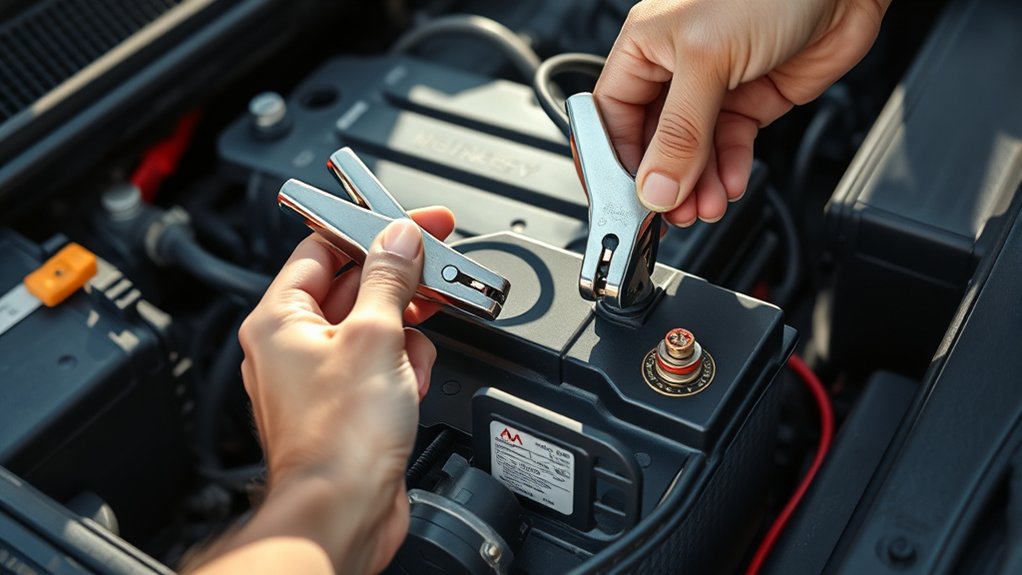
How to Charge a Car Battery Without a Battery Charger
You can charge a car battery without a battery charger by jump-starting with a donor vehicle, using a portable power bank designed for automotive charging, or employing solar panels with a charge controller.
For jump-starting, connect clamps carefully to the correct terminals, ensuring safety by attaching the final negative clamp away from the battery. Portable power banks typically require 30–60 minutes of charging before use. Solar setups need proper wattage and polarity matching to be effective.
Keep following for detailed methods and maintenance tips to ensure your car battery stays charged and reliable.
How to Jump-Start Your Car Battery Safely
To jump-start your car battery safely, you’ll need a second vehicle with a fully charged battery and a set of jumper cables. First, ensure both vehicles are off, and engage parking brakes to prevent movement.
To safely jump-start your car, use a second vehicle with a charged battery and secure both cars with parking brakes.
Connect the jumper cables in this order: attach the positive (red) clamp to the dead battery’s positive terminal, then to the good battery’s positive terminal. Next, connect the negative (black) clamp to the good battery’s negative terminal.
Finally, attach the other negative clamp to an unpainted metal surface on the dead car’s engine block, away from the battery. This connection improves jump start safety by reducing sparking near the battery.
Start the donor car, then the dead car. Remove cables in reverse order. Check battery health after to confirm no damage occurred.
Charge Your Car Battery With a Portable Power Bank
Wondering how to charge your car battery without traditional equipment? A portable power bank can efficiently restore your battery’s charge while preserving battery health. Follow these steps:
| Step | Instruction |
|---|---|
| 1. Preparation | Ensure the power bank is fully charged. |
| 2. Connection | Connect positive (red) clamp to battery’s positive terminal, negative (black) clamp to negative terminal. |
| 3. Charging | Power on the portable power bank and allow charging for 30–60 minutes. |
| 4. Monitoring | Disconnect clamps carefully after charging; check voltage to confirm battery health. |
Using portable power banks designed for automotive use prevents overcharging and safeguards your battery’s longevity. Always follow manufacturer guidelines to maximize safety and effectiveness.
How to Charge Your Car Battery Using Solar Panels
How can you efficiently charge your car battery using solar panels? Harness solar energy by connecting a compatible solar panel system directly to your car battery. Ensure you use a charge controller to regulate voltage and prevent overcharging.
If you have a grid tied solar setup, isolate the battery charging circuit to avoid backfeeding into the grid.
Follow these steps for optimal charging:
- Choose solar panels with adequate wattage (typically 10-50W for car batteries).
- Connect the solar panel’s positive and negative leads to the charge controller inputs.
- Attach the charge controller’s output to the car battery terminals, matching polarity.
- Position panels under direct sunlight for maximum efficiency.
- Monitor voltage and current to ensure safe, controlled charging.
This method provides a reliable, eco-friendly alternative to traditional chargers.
Make a Simple DIY Car Battery Charger at Home
You’ll need a few basic materials like a 12V power source, alligator clips, and a diode to prevent backflow. Start by connecting the power source to the battery terminals using the clips, ensuring correct polarity. Follow the step-by-step assembly to secure connections and test the setup safely before charging.
Basic Materials Needed
Anyone attempting to build a simple DIY car battery charger at home will need a few essential materials to guarantee safety and functionality. Prioritize basic safety by ensuring all spare parts are in good condition and compatible.
The quality of your components directly affects the charger’s performance and your protection against electrical hazards.
Gather the following items before starting:
- A 12V DC power source (such as a compatible adapter or spare power supply)
- Insulated alligator clip cables for secure connections
- A multimeter to monitor voltage and current
- A resistor or voltage regulator to control charging current
- Protective gloves and safety goggles to prevent injury
Having these materials prepared sets the foundation for a safe, effective DIY car battery charger assembly.
Step-by-Step Assembly Process
Before connecting any components, make sure your power source is turned off to prevent accidental shorts or shocks. Begin by securely attaching the alligator clips to each end of your resistor and diode, ensuring firm connections.
Next, connect the positive clip to the positive terminal of the power source and the negative clip to the negative terminal. Incorporate the resistor in series to regulate current flow and prevent overcharging.
Attach the other end of the diode to the battery’s positive terminal to allow current to flow in one direction only. Use insulated wiring to avoid exposure.
Perform a quick safety check to verify all connections are tight and correctly positioned. Once confirmed, switch on the power source. Your DIY charging gear is now assembled and ready for controlled battery charging.
When to Call a Professional for Battery Help
If you notice severe battery damage like cracks or leaks, stop and call a professional immediately to avoid safety hazards. Don’t attempt DIY fixes if you’re unsure or if previous methods haven’t restored the battery’s function. Prioritize your safety and the vehicle’s integrity by seeking expert assistance when risks arise.
Signs of Severe Battery Damage
Recognizing the signs of severe battery damage is essential to avoid further complications or safety hazards. If you notice these indicators, it’s time to call a professional:
- Persistent inability to hold a charge despite repeated attempts
- Visible swelling or deformation of the battery casing, often from heat damage
- Thick, crusty deposits on terminals suggesting severe sulfation buildup
- Corrosion that spreads extensively beyond terminal posts
- Frequent electrical system failures or dimming headlights even after charging
These symptoms indicate internal chemical breakdown or structural compromise that home methods can’t fix. Attempting to charge or repair a battery exhibiting severe sulfation or heat damage risks worsening the condition or causing failure. For safety and reliability, let a certified technician assess and replace the battery when these signs appear.
Safety Concerns and Risks
When you encounter severe battery damage signs, it’s important to understand the safety concerns and risks involved in attempting repairs yourself. Before proceeding, conduct a thorough risk assessment to identify hazards such as acid leaks, corrosion, or cracked casing.
Follow strict safety protocols: wear protective gloves and eyewear, ensure adequate ventilation, and avoid sparks or open flames near the battery. If you detect any structural damage or suspect internal failure, do not attempt charging or repairs.
These conditions increase the risk of acid burns, explosions, or electrical shock. At this point, it’s best to call a professional who has specialized tools and training to handle compromised batteries safely. Prioritize your safety by recognizing when professional intervention is necessary to prevent injury or further damage.
When DIY Methods Fail
Although you might feel confident tackling battery issues yourself, certain situations demand professional expertise to avoid hazards and guarantee proper repair. When DIY methods fail, calling a professional ensures accurate engine diagnostics and safe handling, especially with vehicles using alternative fuels.
You should seek professional help if you encounter:
- Persistent battery drainage despite charging attempts
- Corroded terminals beyond simple cleaning
- Electrical system faults causing erratic behavior
- Difficulty diagnosing complex engine-related battery issues
- Signs of battery swelling or leakage
Professionals use advanced diagnostic tools and have experience with diverse fuel systems. They’ll prevent further damage and ensure your vehicle’s reliability. Don’t risk safety or expensive repairs by ignoring these warning signs.
Battery Maintenance Tips Without a Charger
How can you guarantee your car battery stays in good condition without using a charger? First, avoid irrelevant topic distractions like off-topic ideas unrelated to battery care.
Focus on maintaining proper electrolyte levels by checking and topping off distilled water when necessary. Keep battery terminals clean and free from corrosion using a mixture of baking soda and water.
Ensure tight and secure cable connections to prevent voltage drops. Store your vehicle in a cool, dry place to slow self-discharge and battery degradation.
Regularly start the engine and let it run for at least 15 minutes to allow the alternator to recharge the battery naturally. Lastly, inspect the battery case for cracks or leaks and replace it if damaged to prevent failure.
These steps help preserve battery health without a charger.
Frequently Asked Questions
Can Cold Weather Affect Charging a Car Battery Without a Charger?
Like ice slowing a river, cold weather hinders your battery warming and charging efficiency. You’ll need to gently warm the battery first to improve chemical reactions, ensuring safer, more effective charging without a dedicated charger.
Is It Safe to Use a Phone Charger for a Car Battery?
It’s unsafe charging a car battery with a phone charger because it lacks the required voltage and current control. For phone safety and battery integrity, always use a charger designed specifically for car batteries to prevent damage or hazards.
How Long Does It Take to Charge a Car Battery Without a Charger?
Charging time varies, but without a charger, it can take hours or days depending on your method.
Focus on two-word ideas like solar panel or jumper cables, avoiding unrelated topics to ensure precise, effective charging steps.
Can a Running Engine Charge a Dead Battery Without a Charger?
Yes, a running engine can charge a dead battery without a charger by powering the alternator. Use engine diagnostics to guarantee proper output, and consider camping alternatives like solar panels if extended charging or off-grid power is needed.
What Are the Risks of Overcharging a Car Battery Without a Charger?
You risk overheating, battery swelling, and acid leaks by overcharging. Alternative charging methods without a charger require careful monitoring to avoid these overcharging risks.
Always use a voltmeter and avoid prolonged current exposure to protect your battery.