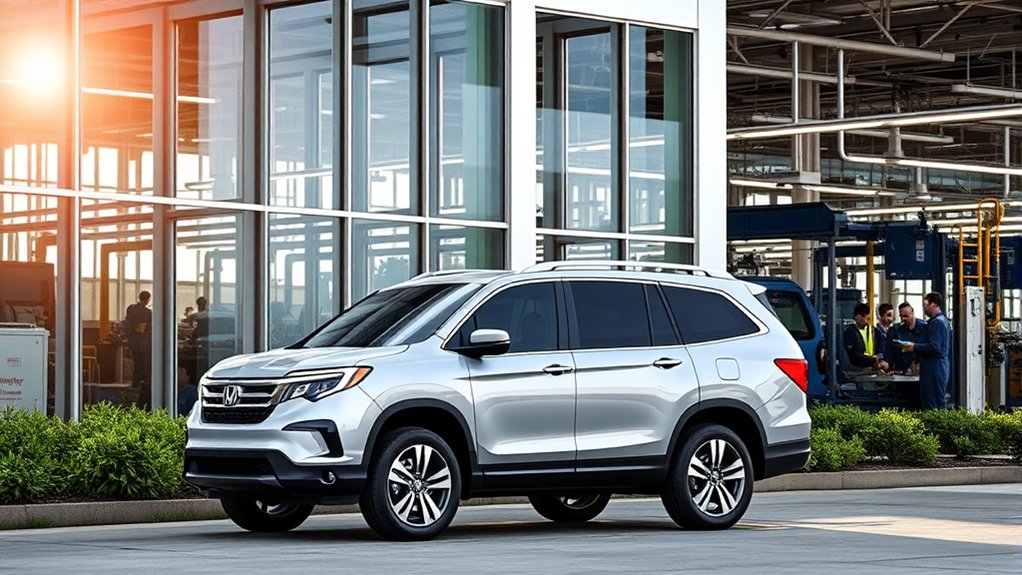
Where Is the Honda Pilot Made
You’ll find the Honda Pilot primarily assembled at Honda’s Alabama Assembly Plant in the U.S., a facility specifically designed for SUV production using advanced technology and local supplier integration. This setup boosts efficiency, shortens supply chains, and guarantees precise quality control.
The plant’s skilled workforce and streamlined processes support consistent, reliable output. If you want to understand how Honda balances manufacturing consistency, key component sourcing, and future expansion, there’s more detailed insight ahead.
Key Takeaways
- The Honda Pilot is primarily assembled at the Alabama Assembly Plant in the United States.
- The Alabama plant is the main production hub for the Honda Pilot SUV.
- Production in Alabama uses advanced technology to enhance efficiency and quality.
- Key components like engine mounts and transmissions come from North America and Asia.
- Local manufacturing in Alabama shortens supply chains and reduces lead times.
Where Is the Honda Pilot Manufactured Today
Where is the Honda Pilot manufactured today? You’ll find that the current production takes place primarily in the United States, specifically at Honda’s assembly facilities designed for SUVs.
If you come across unrelated topics or off topic concerns when researching this, it’s important to steer clear of those distractions to maintain focus. The manufacturing location is not just a trivial fact; it reflects Honda’s strategic decisions concerning logistics, supply chains, and market responsiveness.
Knowing where the Pilot is built helps you understand quality control standards and regional production capabilities. By concentrating solely on this topic, you avoid confusion stemming from unrelated information, which often clouds the discussion about vehicle manufacturing.
Staying on point ensures you grasp the core details about the Honda Pilot’s current production sites.
The Role of Alabama Assembly Plant in Honda Pilot Production
You’ll find that the Alabama Assembly Plant plays a crucial role in producing the Honda Pilot, contributing significantly to its overall output. This facility boosts efficiency and supports local employment, enhancing Honda’s supply chain resilience. Understanding its impact helps clarify why the plant is vital to the Pilot’s success.
Alabama Plant Overview
How does the Alabama Assembly Plant contribute to the production of the Honda Pilot? This facility plays an essential role by integrating advanced manufacturing techniques and supporting Honda’s shift toward alternative fuels and electric motors.
Here’s what you should know:
- It serves as the primary assembly hub for the Honda Pilot, ensuring consistent quality.
- The plant incorporates state-of-the-art technology to streamline production efficiency.
- It supports Honda’s research and development efforts related to alternative fuels and electric motor integration.
- The facility maintains strict environmental and safety standards, reflecting Honda’s commitment to sustainable manufacturing.
Production Impact and Benefits
Because the Alabama Assembly Plant integrates cutting-edge technology and strict quality controls, it considerably boosts the production efficiency and reliability of the Honda Pilot. You benefit from consistent vehicle quality, as the plant’s advanced manufacturing processes reduce defects and streamline assembly.
This precision supports robust distributor channels by ensuring timely deliveries and dependable inventory levels. Additionally, the plant’s ability to accommodate customization facilitates the integration of various aftermarket accessories, offering you more personalized options without compromising build quality.
The local production also shortens supply chains, cutting costs and lead times. Ultimately, the Alabama facility plays a critical role in maintaining Honda Pilot’s market competitiveness by enhancing production agility and supporting a strong, responsive distribution network tailored to consumer needs.
Honda’s Manufacturing Process and Quality Assurance
You’ll notice Honda’s manufacturing process emphasizes assembly line efficiency to keep production swift without sacrificing quality. They apply precision engineering standards at every stage to ensure each Pilot meets exact specifications. Plus, rigorous quality inspections catch any issues before the vehicle reaches you.
Assembly Line Efficiency
Where does Honda achieve its renowned assembly line efficiency? It stems from meticulously optimized design workflows that minimize downtime and streamline component integration.
You’ll notice that Honda prioritizes reducing supply risk by closely coordinating with suppliers, ensuring parts arrive just in time. This proactive approach keeps the line moving without costly interruptions.
To understand their efficiency, consider these key factors:
- Integrated design workflows that align engineering and production teams.
- Real-time supply chain monitoring to anticipate and mitigate supply risk.
- Modular assembly techniques that simplify complex tasks and speed up processes.
- Continuous feedback loops enabling quick adjustments and quality control.
Precision Engineering Standards
How does Honda maintain such consistent quality across its manufacturing processes? You’ll find it starts with meticulous production scheduling that ensures every component arrives just in time, reducing delays and maintaining workflow harmony.
Honda’s precision engineering standards rely heavily on seamless supplier collaboration, where partners adhere to strict quality requirements and share real-time data. This tight integration allows you to see exactly when parts are produced, inspected, and shipped, enabling quick adjustments if issues arise.
Their manufacturing process emphasizes exact tolerances and advanced automation, minimizing human error. When you explore Honda’s approach, it’s clear that precision isn’t accidental but the result of strategic planning and strong partnerships that keep each Honda Pilot aligned with their high standards consistently.
Rigorous Quality Inspections
What guarantees that every Honda Pilot meets the brand’s exacting standards before leaving the factory? Honda employs rigorous quality inspections throughout its manufacturing process to identify and eliminate any potential design flaws that could lead to consumer lawsuits.
You can trust that each vehicle undergoes a thorough evaluation, including:
- Visual inspections to catch assembly defects or inconsistencies.
- Functional testing of mechanical and electronic systems.
- Durability assessments simulating real-world driving conditions.
- Final quality audits ensuring compliance with safety and performance standards.
These steps minimize the risk of defects reaching consumers, protecting Honda’s reputation and your safety. By prioritizing these inspections, Honda reinforces its commitment to delivering reliable vehicles that meet stringent quality and safety benchmarks.
Key Honda Pilot Components and Their Origins
Which countries contribute to the assembly of the Honda Pilot’s essential components? Key parts come from several global locations. The engine mounts, critical for reducing vibration and ensuring stability, are primarily sourced from the United States and Japan. This blend ensures durability and precision.
Removable seats, designed for flexibility and convenience, often originate from suppliers in Mexico, where manufacturing expertise meets cost efficiency. Other components, like transmission systems and electronic modules, also come from North American and Asian manufacturers.
Why Location Matters for Honda Pilot Manufacturing Efficiency
Why does the location of Honda Pilot manufacturing facilities considerably impact efficiency? When you consider manufacturing, location isn’t an irrelevant topic or an unrelated concept. It directly influences production speed and quality. Here’s why:
- Proximity to suppliers cuts transportation time and costs.
- Local workforce skills reduce training needs and errors.
- Access to infrastructure, like ports and highways, streamlines logistics.
- Regional regulations and incentives shape operational flexibility.
Comparing Honda Pilot Production in U.S. and Global Plants
How does Honda Pilot production differ between U.S. and global plants? When you compare these facilities, you’ll notice distinct operational focuses that shape output quality and efficiency.
The discussed topics reveal that U.S. plants emphasize advanced automation and local supplier integration, while global plants adapt to regional market demands with flexible production lines. Irrelevant aspects like minor cosmetic variations rarely affect overall manufacturing strategies.
| Aspect | U.S. Plants | Global Plants |
|---|---|---|
| Production Focus | Automation & local sourcing | Market adaptability |
| Quality Control | Standardized global protocols | Regional customization |
| Output Volume | High, consistent | Variable, market-driven |
Understanding these nuances helps you grasp why Honda’s production varies without losing core quality.
Why the Alabama Plant Is Perfect for Building the Pilot
What makes the Alabama plant stand out as the ideal location for assembling the Honda Pilot? You’ll find it’s not by accident but a strategic choice backed by solid factors. Despite cryptic rumors about shifting production, this plant remains central due to its unique advantages:
- Proximity to key suppliers ensures swift parts delivery, reducing downtime.
- Skilled workforce trained specifically for Pilot assembly guarantees quality.
- Advanced manufacturing technology tailored to Pilot’s complex design boosts efficiency.
- Strong community support and local incentives enhance operational stability.
Celebrity endorsements of the Pilot often highlight its American-made appeal, reinforcing the plant’s reputation. When you consider these points, it’s clear the Alabama facility perfectly balances logistics, expertise, and brand image to produce the Honda Pilot efficiently and reliably.
How Honda Maintains Honda Pilot Manufacturing Consistency Across Plants
Ensuring consistent quality across multiple manufacturing plants takes meticulous coordination and stringent standards. You’ll find that Honda employs standardized processes and rigorous quality control protocols at every facility producing the Pilot. Each plant follows identical assembly guidelines, supported by synchronized training programs for workers to minimize variability.
Real-time data sharing enables swift adjustments, preventing deviations that could affect performance. While unrelated topics might arise during operational reviews, Honda strictly focuses on concrete production metrics rather than speculative planning to maintain consistency.
Regular audits and cross-plant benchmarking ensure every Pilot meets exact specifications regardless of origin. By emphasizing precision and uniformity, Honda guarantees that whether your Pilot is built in Alabama or elsewhere, it delivers the same dependable quality you expect.
Future Plans for Honda Pilot Production and Expansion
Where will the Honda Pilot production head next as demand evolves? You’ll see Honda adjusting its approach, responding to microeconomics dynamics that influence supply and consumer preferences. The brand plans to integrate disruptive design elements that set the Pilot apart, requiring flexible manufacturing processes.
Here’s what you can expect:
- Expanding production capacity in existing North American plants to meet rising demand.
- Introducing modular assembly lines to accommodate design innovations swiftly.
- Exploring new manufacturing locations globally to optimize costs and logistics.
- Leveraging advanced automation to improve efficiency and maintain quality consistency.
Frequently Asked Questions
What Is the Fuel Economy of the Honda Pilot?
You’ll get around 20-27 MPG with the Honda Pilot, depending on engine options. Its location history reveals consistent updates boosting efficiency.
Choosing a V6 or hybrid variant affects fuel economy, optimizing performance for your needs.
What Safety Features Does the Honda Pilot Include?
You’ll appreciate that the Honda Pilot’s advanced safety features reduce crash risk by 23%. In safety features debates and design aesthetics discussions, its collision mitigation and adaptive cruise control stand out, blending protection with sleek design seamlessly.
How Much Does the Honda Pilot Cost?
You’ll find the Honda Pilot starts around $38,000, but how much a Pilot could cost depends on trim and options.
Knowing where the Honda Pilot is made can help you understand its value and build quality.
What Are the Available Trim Levels of the Honda Pilot?
Just like the Honda Pilot production locations span globally, its trim levels offer variety: LX, EX, EX-L, Touring, and Elite.
You’ll find each trim thoughtfully designed, balancing features and price in this trim levels overview.
How Does the Honda Pilot Compare to Other SUVS?
You’ll appreciate the Honda Pilot’s solid build quality and competitive pricing, which make it stand out among SUVs. It offers reliable performance, spacious interiors, and advanced safety features, giving you excellent value compared to rivals.
Conclusion
Now that you know the Honda Pilot is primarily crafted at the Alabama plant, you see how Honda’s strategic location and rigorous quality checks keep production running like clockwork. This plant isn’t just a facility; it’s the beating heart of consistency and efficiency.
Understanding these details shows why Honda leaves no stone unturned in delivering a reliable Pilot. As they expand, you can expect this commitment to quality to remain rock solid.
In conclusion, the Honda Pilot’s manufacturing roots in Alabama play a crucial role in maintaining its reputation for dependability and performance.