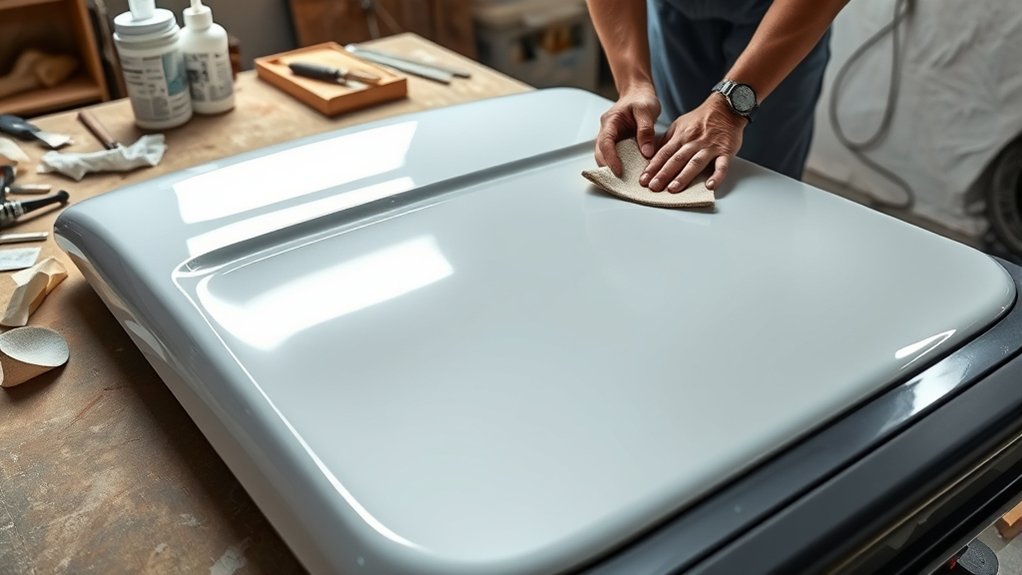
How to Make a Fiberglass Tonneau Cover
To make a fiberglass tonneau cover, start by precisely measuring your truck bed’s length, width, and height at multiple points to capture its shape. Accurate measurements are essential for creating a custom fit that complements your vehicle.
Next, build a durable mold from MDF or foam, sanding it smooth to match your measurements. This mold will serve as the foundation for shaping your fiberglass cover.
Mix resin and hardener accurately, then apply fiberglass cloth with even resin saturation. Shape and sand your cover for a smooth finish, ensuring it fits perfectly.
Securely install hinges and latches to allow easy opening and closing. Finally, protect the surface with multiple paint layers to enhance durability and aesthetics.
Following these steps ensures a custom, durable fit and lasting protection—explore further for detailed techniques.
Measure and Design Your Fiberglass Cover
How do you guarantee your fiberglass tonneau cover fits perfectly? Start by employing precise measurement techniques. Use a tape measure to record the length, width, and height of your truck bed at multiple points to account for any irregularities. Document these dimensions meticulously.
Next, create a detailed design blueprint reflecting these measurements, ensuring the cover contours align with your truck bed’s shape. Accurate measurement techniques minimize material waste and prevent fitting issues.
When moving to material sourcing, select high-quality fiberglass cloth and resin tailored for automotive use. Ensure your supplier provides consistent thickness and strength specifications, crucial for durability and fit.
This methodical approach to measurement and material sourcing lays the foundation for a fiberglass tonneau cover that fits securely and performs reliably.
Build a Fiberglass Tonneau Cover Mold for Your Truck Bed
You’ll start by selecting durable, smooth materials like MDF or high-density foam for your mold to guarantee a clean fiberglass finish. Next, carefully shape the mold to match your truck bed’s exact contours, using precise measurements and sanding for accuracy. This step sets the foundation for a perfect-fitting tonneau cover.
Choosing Mold Materials
Where should you start when selecting materials for your fiberglass tonneau cover mold? Focus on durability, ease of shaping, and cost considerations to ensure a reliable mold. The right mold materials will withstand repeated use and maintain shape precision.
Consider these options:
- Plywood: Affordable, easy to cut and shape, but less durable over time.
- MDF (Medium-Density Fiberboard): Smooth surface, good for fine detail, moderate cost.
- Foam Board: Lightweight and easy to sculpt, ideal for complex curves, but fragile.
- Metal Sheets: Highly durable, excellent for repeated use, higher initial cost.
Choose based on your budget and required mold longevity. Balancing cost considerations with material performance ensures your mold meets both functional and financial demands.
Shaping The Truck Bed
When shaping the truck bed for your fiberglass tonneau cover mold, what’s essential is achieving an exact fit to guarantee proper sealing and durability. Start by thoroughly cleaning the bed surface to remove dirt and debris. Use a tape measure and straight edge to mark precise dimensions.
Carefully apply a release agent to prevent adhesion during molding. Employ sanding blocks and grinders to smooth contours, ensuring consistent angles and edges. While working, always practice safety by wearing gloves, eye protection, and a respirator.
Maintain your tools regularly, sharpen blades, and check power tool cords to ensure accuracy and prevent malfunctions. Continuously verify measurements against the truck bed to refine the shape. This methodical approach ensures your mold matches the bed perfectly, providing a reliable base for your fiberglass tonneau cover.
Mix and Apply Fiberglass Resin and Cloth Safely and Evenly
A essential step in crafting a fiberglass tonneau cover involves mixing the resin and hardener thoroughly to achieve the correct chemical balance. Pay close attention to mixing safety by wearing gloves and working in a well-ventilated area. Follow exact resin ratios specified by the manufacturer to ensure optimal curing and structural integrity.
Once mixed, apply resin evenly over the laid fiberglass cloth to avoid weak spots or air bubbles.
- Measure resin and hardener precisely according to resin ratios.
- Stir mixture slowly for 3–5 minutes for full activation.
- Lay fiberglass cloth smoothly, avoiding wrinkles.
- Use a squeegee or roller to saturate cloth uniformly with resin.
Consistent application guarantees a durable, smooth surface without compromising safety or quality.
Shape and Sand Your Fiberglass Tonneau Cover Smooth
You’ll start by carefully contouring the fiberglass surface to match your desired shape, using a rasp or coarse sandpaper for initial shaping. Next, choose sandpaper grits progressively from coarse to fine to refine the surface without damaging the fiberglass. Finally, sand methodically to achieve a smooth, even finish ready for painting or sealing.
Contouring the Fiberglass Surface
How do you achieve a smooth, aerodynamic contour on your fiberglass tonneau cover? Begin by methodically shaping the edges and curves to match your design specifications. Follow these steps carefully, keeping safety considerations and environmental impact in mind:
- Wear appropriate protective gear, including respirators, gloves, and goggles, to guard against fiberglass dust and fumes.
- Use a sanding block to evenly smooth the surface, avoiding excessive pressure that could distort the shape.
- Continuously check contours with a flexible curve ruler to maintain symmetry and flow.
- Collect dust and debris promptly to prevent environmental contamination and workspace hazards.
Selecting the Right Sandpaper
When selecting the right sandpaper for shaping and smoothing your fiberglass tonneau cover, consider grit size, durability, and flexibility. Start with a coarse grit, around 80-120, to shape and correct toner alignment errors on your cover’s surface.
Then move to medium grits, like 220-320, for refining contours without damaging the fiberglass. Opt for waterproof sandpaper to enhance dust control when wet sanding, minimizing airborne particles and improving surface quality.
Choose flexible backing sandpaper to conform to curved areas, ensuring even abrasion without gouging. Durable, resin-bonded abrasives maintain consistent cutting action, reducing sanding time.
Proper sandpaper selection streamlines your workflow, prevents surface imperfections, and prepares the cover for subsequent finishing steps without compromising structural integrity or alignment precision.
Achieving a Smooth Finish
Why is achieving a smooth finish essential for your fiberglass tonneau cover? A smooth surface ensures optimal aesthetics, structural integrity, and paint adhesion. You’ll start by conducting a roughness comparison between the initial fiberglass layup and your target finish, refining imperfections progressively.
Follow these finishing preps for precision:
- Shape the cover using a coarse grit to remove high spots and uneven contours.
- Transition to medium grit sandpaper to blend the surface uniformly.
- Employ fine grit sandpaper to eliminate visible scratches and prepare for primer.
- Clean thoroughly to remove dust, ensuring no contaminants impair the final coat.
Test Fit and Adjust Your Cover for a Perfect Seal
Before securing your fiberglass tonneau cover, you’ll need to carefully test fit it onto your truck bed to ensure a flawless seal. Position the cover precisely, then inspect all edges for uniform contact with the bed rails.
Conduct seal testing by applying gentle pressure along the perimeter, checking for gaps or uneven areas. Use a thin feeler gauge to detect any inconsistencies in fit.
If you find any misalignment, adjust the cover by slightly sanding or trimming high spots, ensuring that the seal is continuous and tight. Maintain fit maintenance by periodically rechecking the cover’s alignment during the adjustment process.
This methodical approach guarantees that your cover will provide optimal weather protection and durability once installed, preventing leaks and minimizing wind noise.
Install Hinges and Latches Securely
How do you ensure your fiberglass tonneau cover remains securely attached and functions smoothly? Proper installation of hinges and latches is crucial. Focus on precise hinges alignment to avoid binding or gaps, and verify latch security to prevent accidental openings.
- Position hinges evenly along the rear edge; mark drill points carefully.
- Drill pilot holes to prevent fiberglass cracking, then secure hinges with corrosion-resistant screws.
- Align latches with corresponding strike plates; test engagement before final tightening.
- Adjust latch tension to balance ease of operation with firm closure.
This methodical approach guarantees a solid attachment, smooth operation, and long-term durability of your tonneau cover.
Paint and Finish for Long-Lasting Protection
To guarantee your fiberglass tonneau cover is fully protected against weather and wear, you achieve this by applying a high-quality paint protection system designed for outdoor exposure. Begin by sanding the surface with fine-grit sandpaper to create a smooth base.
Next, apply a primer compatible with fiberglass to enhance adhesion. After the primer cures, spray multiple even coats of automotive-grade paint, allowing proper drying time between layers.
Finally, finish with a durable clear topcoat to maximize topcoat durability and shield against UV rays, moisture, and abrasions. This layered approach guarantees long-lasting paint protection, preserving your cover’s integrity and appearance.
Regular inspections and touch-ups will maintain the finish’s effectiveness over time, ensuring your tonneau cover withstands harsh conditions without degrading.
Frequently Asked Questions
What Tools Are Essential for Fiberglass Tonneau Cover Installation?
You’ll need essential installation tools like a drill, clamps, measuring tape, and sanding blocks. For fiberglass prep, use a respirator, gloves, and acetone to clean surfaces, ensuring precise fitting and strong adhesion during installation.
How Do I Maintain and Clean a Fiberglass Tonneau Cover?
You should follow maintenance tips like regularly rinsing with water, using mild soap for cleaning steps, avoiding abrasive materials, and applying a UV protectant to preserve the finish.
Inspect seals often to prevent damage and leaks.
Can a Fiberglass Tonneau Cover Improve Truck Fuel Efficiency?
You’ll notice that fiberglass durability coincides with improved aerodynamics, which in turn can enhance fuel economy impact. By reducing drag, your truck’s fuel efficiency can improve, making fiberglass covers a practical choice for better mileage.
Are There Weight Limits for a Fiberglass Tonneau Cover?
Yes, fiberglass tonneau covers have weight limits typically specified by the manufacturer. You’ll need proper installation tools to ensure secure mounting, which helps maintain structural integrity and prevents exceeding these weight limits during use.
How Weather-Resistant Is a Fiberglass Tonneau Cover?
You’ll find fiberglass tonneau covers provide excellent weather protection due to their superior material durability. They resist moisture, UV rays, and temperature changes effectively, ensuring your truck bed stays dry and protected under various environmental conditions.
Conclusion
By meticulously measuring, molding, and mastering each method, you’ll make a fiberglass tonneau cover that’s both functional and flawless. Remember, shaping smoothly and securing sturdy hinges ensures strength and stability. Testing tightness and tailoring the fit prevents pesky problems.
Finally, painting provides protective perfection, prolonging performance. With patience and precision, your personalized cover will confidently complement your truck.
Combining craftsmanship with consistent durability, your fiberglass tonneau cover offers dependable daily defense.