
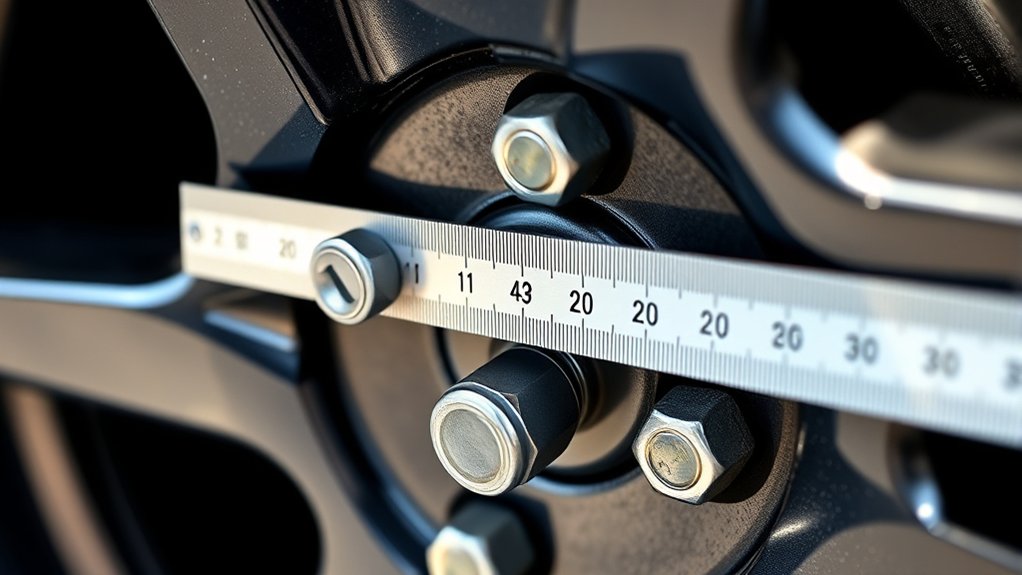
How to Measure Wheel Bolt Pattern
To measure your wheel bolt pattern, first count the number of lug holes on the wheel. Use a caliper or ruler with millimeter markings for accuracy. This ensures you get a precise measurement.
For wheels with an even number of lugs, measure the center-to-center distance between two opposite holes. For wheels with an odd number of lugs, measure from one lug’s center to the midpoint between the two opposite lugs.
Record this measurement as “number of lugs x distance.” Getting this right guarantees safety and fit. There’s more to know about matching and unusual patterns.
Understanding Wheel Bolt Patterns and Why They Matter
Why do wheel bolt patterns matter when selecting or replacing wheels? Because they ensure proper fit and safety. The bolt pattern defines the number of lug holes and their arrangement on the wheel hub.
If you ignore this, you risk installing incompatible wheels, leading to unsafe driving conditions. Avoid confusing this with unrelated topics like tire size or brake specifications; those are irrelevant content for bolt pattern discussions.
Understanding the pattern lets you select wheels that align perfectly with your vehicle’s hub, preventing vibrations and wheel detachment. Precision here matters. Incorrect bolt patterns can cause stress on suspension components.
What Tools You Need to Measure a Wheel Bolt Pattern
You’ll need a reliable measuring tape or caliper to accurately capture the distances between bolt holes. Optional tools like a bolt pattern gauge can simplify the process but aren’t essential. Ensuring your tools are precise is critical to avoid errors in your measurements.
Essential Measurement Tools
What tools do you need to accurately measure a wheel bolt pattern? The essentials include a reliable measuring device like a caliper or a ruler with millimeter markings to ensure precision. A caliper offers the highest accuracy when measuring the distance between bolt holes.
Avoid unrelated tools or off topic ideas such as tape measures designed for fabric or construction, as they lack the necessary precision. You’ll also need a flat surface to place the wheel securely during measurement. Steering clear of unrelated topic tools keeps your process focused and efficient.
Optional Helpful Accessories
How can you enhance accuracy and ease when measuring a wheel bolt pattern? Using optional helpful accessories reduces bolt pattern confusion and ensures precise measurement. These tools complement your essential kit and streamline the process.
- Bolt Pattern Gauge – Specifically designed to measure bolt spacing accurately, minimizing guesswork.
- Torque Wrench – Helps check lug nut torque after measuring, ensuring correct fastening.
- Caliper – Provides exact distance measurements between bolt centers, critical for avoiding errors.
- Marker or Chalk – Marks bolt holes to keep track of measurements and prevent mix-ups during the process.
Incorporating these accessories into your workflow reduces errors, improves consistency, and supports accurate bolt pattern identification with less hassle.
Tool Accuracy Importance
Using the right accessories can simplify measuring your wheel bolt pattern, but the accuracy of your results ultimately depends on the precision of the tools you use. Accurate measurement methods rely on tools that minimize error and provide consistent readings.
A high-quality caliper or ruler ensures precise bolt spacing, while a torque wrench can help verify bolt tightness if needed. Avoid makeshift tools that compromise tool accuracy and lead to incorrect bolt pattern identification.
| Tool Type | Purpose | Accuracy Level |
|---|---|---|
| Vernier Caliper | Measures bolt spacing | High |
| Tape Measure | Quick approximate | Moderate |
| Bolt Gauge | Confirms bolt count | High |
Choosing precise tools improves reliability and prevents costly installation errors.
Measuring Bolt Patterns on Wheels With Even Lug Holes
Where do you start when measuring bolt patterns on wheels with an even number of lug holes? You focus on bolt precision and lug symmetry to ensure an accurate measurement. Begin by identifying pairs of opposite lug holes since even lug holes allow direct line measurements between them.
- Use a caliper or ruler to measure the distance between the centers of two opposite lug holes.
- Confirm lug symmetry by checking that all pairs match in distance.
- Record the number of lug holes to accompany your measurement.
- Express the bolt pattern as “number of lugs” x “distance in millimeters or inches.”
This approach leverages the symmetry of even lug holes for reliable bolt pattern measurement, critical for wheel fitment and safety.
Measuring Bolt Patterns on Wheels With Odd Lug Holes
When measuring wheels with an odd number of lug holes, you’ll first need to identify the exact lug count. Unlike even lug patterns, you can’t measure directly across; instead, measure from the center of one lug hole to the midpoint between two opposite lugs. This technique ensures accurate bolt circle diameter (BCD) readings for odd lug configurations.
Identifying Odd Lug Patterns
Odd lug patterns can challenge standard measurement methods because they lack evenly spaced bolt holes. When identifying odd lug patterns, you need to recognize these measuring oddities early to ensure accuracy.
- Count the total number of lug holes; odd lug patterns often have an uneven distribution.
- Observe the spacing between holes; inconsistent gaps indicate a non-standard pattern.
- Note any asymmetry or unusual hole placements that deviate from typical circular arrangements.
- Compare the pattern against known odd lug configurations to rule out errors.
Measuring Techniques for Odd Holes
How do you accurately measure bolt patterns on wheels with irregular lug holes? When dealing with odd holes, you must account for unique measurement quirks. Start by identifying the number of lug holes, then measure the distance between non-adjacent holes.
For odd lug counts, measure from the center of one hole to the farthest hole across the wheel. Use a caliper or tape measure for precision.
| Lug Count | Measurement Method | Common Quirk |
|---|---|---|
| 5 | Center to farthest hole | Angled spacing complicates |
| 7 | Center to farthest hole | Larger circle, irregular gaps |
| 9 | Center to farthest hole | Non-uniform spacing |
How to Read and Interpret Lug Count and Bolt Circle Diameter
Why does lug count and bolt circle diameter matter? These two factors define the wheel bolt patterns, guaranteeing your wheels fit securely and perform safely. Lug counting involves tallying the number of lug holes on the wheel hub. Bolt circle diameter (BCD) measures the diameter across the center of these lug holes.
To read and interpret:
- Count the lugs accurately; common counts are 4, 5, 6, or 8.
- Measure the bolt circle diameter: for even lug counts, measure center-to-center between two opposite holes.
- For odd lug counts, measure from the center of one lug hole to the outer edge of the opposite hole.
- Express bolt patterns as “Lugs x BCD” (e.g., 5×114.3 mm).
Understanding these details ensures correct wheel fitment and compatibility.
Common Wheel Bolt Pattern Sizes for Popular Vehicles
You’ll encounter common bolt pattern dimensions like 5×114.3 mm and 4×100 mm across many vehicles. Knowing your vehicle-specific bolt pattern guarantees proper wheel fitment and safety. Let’s review the typical sizes used by popular car models.
Popular Bolt Pattern Dimensions
Which bolt pattern dimensions fit your vehicle? Understanding popular bolt pattern sizes helps you select the right wheels efficiently. The bolt pattern combines the number of lug holes and the diameter of the imaginary circle through their centers.
Accurate lug measurement is essential to ensure compatibility.
Common bolt pattern dimensions include:
- 4×100 mm – typical for compact cars and small sedans.
- 5×114.3 mm – widely used on midsize sedans and SUVs.
- 5×120 mm – common among premium vehicles and trucks.
- 6×139.7 mm – found on larger trucks and off-road vehicles.
Knowing these dimensions lets you quickly narrow down suitable wheel options without guesswork. Always verify your vehicle’s specifications before purchasing to avoid mismatched bolt patterns.
Vehicle-Specific Bolt Patterns
Understanding popular bolt pattern dimensions provides a solid foundation for identifying the exact wheel fitment your vehicle requires. Most passenger cars use 4, 5, or 6 lug bolt patterns, with common sizes like 5×114.3 mm (Honda, Toyota) and 5×120 mm (BMW, GM).
Trucks often feature larger bolt patterns such as 6×139.7 mm (Ford F-Series, Chevrolet Silverado). When measuring lug patterns, you’ll either measure center-to-center across opposing lugs for even counts or from the center of one lug to the outer edge of the opposite lug for odd counts.
Knowing your vehicle’s exact bolt pattern and lug measurement ensures compatibility and safety when selecting aftermarket wheels. Consult your vehicle manual or manufacturer specifications to confirm these critical dimensions before purchasing or installing wheels.
How to Match New Wheels to Your Wheel Bolt Pattern
How do you guarantee new wheels fit your vehicle properly? Start by accurately measuring patterns on your current wheels. Correct measurements let you avoid compatibility issues. Next, focus on finding compatibility between the bolt pattern and new wheels.
Ensure new wheels fit by precisely measuring your current wheel patterns to avoid compatibility problems.
Follow these steps:
- Measure your existing wheel bolt pattern precisely, noting the number of lug holes and center-to-center distance.
- Compare these measurements with the specifications provided by the new wheel manufacturer.
- Confirm the wheel’s center bore matches or exceeds your vehicle’s hub diameter for proper fitment.
- Verify the wheel’s offset and load rating align with your vehicle’s requirements to maintain safety and performance.
What to Do When Your Wheel Bolt Pattern Is Unusual
If your current wheel bolt pattern doesn’t match standard sizes, you’ll need to take extra steps to ensure proper fitment. Unusual patterns often cause measurement challenges, so verify each bolt-to-bolt distance meticulously. Use calibrated tools and measure multiple times to avoid errors. Consult manufacturer specs or vehicle forums for uncommon configurations.
| Step | Action | Tip |
|---|---|---|
| 1 | Measure bolt centers | Use digital calipers |
| 2 | Count bolt holes | Confirm hole number |
| 3 | Compare with standard patterns | Identify close matches |
| 4 | Research unusual patterns | Check OEM or aftermarket data |
| 5 | Consult professionals | Seek expert advice if unsure |
Handling unusual bolt patterns requires precision to prevent fitment issues and ensure safety.
Tips to Avoid Mistakes When Measuring Wheel Bolt Patterns
Why do so many measurements go wrong when checking wheel bolt patterns? Often, it’s because people mix unrelated topic details or focus on irrelevant ideas instead of precise measurement steps. To avoid these mistakes, follow these tips:
- Use the correct tools, like a caliper or ruler, ensuring accurate distance readings.
- Measure center-to-center between bolt holes, not edge-to-edge, to prevent errors.
- Avoid distractions or unrelated topic discussions during measurement to maintain focus.
- Double-check your measurements and compare them with manufacturer specs to catch inconsistencies early.
How to Find Your Vehicle’s Wheel Bolt Pattern
Where can you quickly locate your vehicle’s wheel bolt pattern? Start by checking your owner’s manual or the driver’s side door jamb; manufacturers often list bolt pattern specs there. If those sources are unavailable, measure the wheel hub directly using a ruler or caliper.
For a 4- or 5-lug wheel, measure the center-to-center distance between adjacent bolts or opposite bolts, respectively. Avoid confusing this with unrelated topics like tire pressure or brake pad thickness; these are random concepts irrelevant to bolt patterns.
Additionally, many online databases allow you to input your vehicle’s make, model, and year to retrieve bolt pattern data. By focusing on these direct methods, you’ll accurately identify your wheel bolt pattern without risking errors from unrelated or random concepts.
Frequently Asked Questions
Can Wheel Bolt Patterns Affect Tire Pressure Monitoring Systems?
Yes, incorrect wheel bolt patterns can affect tire pressure monitoring systems by causing improper lug engagement and uneven wheel torque. This misalignment may trigger false sensor readings or damage sensor components, compromising system accuracy and safety.
How Do Wheel Bolt Patterns Impact Vehicle Handling and Performance?
Imagine your car gripping the road like a dancer; mismatched wheel bolt patterns disrupt wheel balance and tire alignment, causing vibrations and uneven wear.
You’ll notice compromised handling and performance, so precise bolt patterns keep your drive smooth and controlled.
Are Wheel Bolt Patterns Standardized Internationally?
No, wheel bolt patterns aren’t fully standardized internationally. While some follow common dimensions, nonstandard bolt patterns exist due to regional preferences and manufacturer designs.
This limits universal compatibility despite efforts toward international standardization.
Can Aftermarket Wheels With Different Bolt Patterns Be Safely Adapted?
Different patterns demand deliberate decisions. You can safely select adapter safety solutions, but strict specifications and quality checks are essential to prevent performance problems.
Always assess compatibility carefully before committing to aftermarket wheels with altered bolt patterns.
How Often Should Wheel Bolt Patterns Be Re-Measured or Checked?
You should check wheel patterns whenever you change or rotate wheels, or after any impact.
Regular remeasurement frequency depends on usage, but inspecting every 6,000 miles or during routine maintenance ensures safe fitment and performance.
Conclusion
Now that you’ve mastered measuring your wheel bolt pattern, picture the perfect fit—wheels aligning flawlessly, bolts locking securely, and your ride running smoothly.
Accurate measurement isn’t just a step; it’s the foundation of safety and performance. Whether you’re swapping wheels or upgrading, this precision ensures every turn is confident.
Keep your tools ready, double-check those lug counts and diameters, and drive knowing your wheels are matched perfectly every time. Remember, correctly measuring your wheel bolt pattern is key to a secure and smooth driving experience.