How Do Fuel Gauges Work
Your fuel gauge works by using a float that rides on the fuel’s surface, moving a variable resistor within the sending unit. This resistor changes the electrical current sent to the gauge, which translates the signal into a visual reading on your dashboard. Understanding how fuel gauges work can help you better monitor your vehicle’s fuel level.
Mechanical systems rely on the direct movement of the float to indicate fuel level. In contrast, modern electronic gauges use sensors and microprocessors for higher accuracy and reliability.
By understanding how these signals translate into accurate fuel monitoring, you can manage fuel more efficiently and troubleshoot issues effectively.
What Is a Fuel Gauge and Why It Matters
What exactly does a fuel gauge do, and why should you care about its function? A fuel gauge provides real-time measurement of the fuel level in your vehicle’s tank, allowing you to monitor consumption and avoid running out unexpectedly.
Ignoring this critical instrument isn’t just careless; it risks engine damage and inconvenient breakdowns. You might consider fuel level an irrelevant topic or a random thought while driving, but it directly affects your vehicle’s operation and safety.
The gauge translates physical fuel quantity into an electrical signal, displayed visually on your dashboard. By understanding its role, you ensure accurate fuel management, prevent costly interruptions, and maintain optimal engine performance.
This fundamental device is indispensable for efficient and safe vehicle operation, making it essential for every driver to trust and interpret correctly.
Types of Fuel Gauge Systems: Mechanical vs. Electronic
You’ll encounter two primary types of fuel gauge systems: mechanical and electronic. Mechanical gauges use a float connected to a variable resistor, directly translating fuel level into a gauge reading. In contrast, electronic gauges rely on sensors and microprocessors to provide more accurate and responsive measurements.
Mechanical Fuel Gauge Basics
How exactly do mechanical fuel gauges measure the amount of fuel in a tank? They rely on a float mechanism connected to a variable resistor that changes resistance as the float moves with fuel level. This analog system converts physical position into an electrical signal displayed on your gauge.
However, mechanical limitations restrict accuracy, especially as components wear.
Key factors include:
- Float movement: The float rises and falls with fuel, translating level changes mechanically.
- Variable resistor: Resistance varies with float position, altering gauge reading.
- Linkage system: Mechanical arms transfer float movement to the resistor.
- Float corrosion: Exposure to fuel can degrade the float, causing inaccurate readings.
Understanding these basics clarifies why mechanical gauges, while simple, may suffer from wear and precision issues over time.
Electronic Fuel Gauge Features
Why do electronic fuel gauges offer greater accuracy and reliability compared to mechanical systems? Electronic gauges employ precise sensors and microprocessors to measure fuel levels, minimizing errors caused by mechanical wear or fuel sloshing. You’ll find that these systems use variable resistors or capacitive sensors, translating fuel tank data into digital signals.
This data is processed and displayed with enhanced resolution, ensuring real-time accuracy. Additionally, electronic fuel gauges elevate fuel gauge aesthetics by enabling customizable digital displays, which seamlessly blend into modern dashboard integration.
You can expect smooth animations, clearer readings, and adaptive brightness that mechanical gauges can’t match. Their compact design also reduces dashboard clutter, contributing to a cleaner cockpit environment. Overall, electronic systems deliver superior performance, durability, and design flexibility, making them the preferred choice in contemporary vehicles.
How the Fuel Sending Unit and Float Measure Fuel Levels
You’ll find that the fuel sending unit relies on a float mechanism to track the fuel level inside the tank. As the fuel level changes, the float moves vertically, adjusting the position of a connected variable resistor. This resistance change sends an electrical signal to the gauge, accurately representing the amount of fuel remaining.
Float Mechanism Functionality
Where exactly does the fuel gauge get its information? It relies on the float mechanism inside the tank, which operates based on buoyancy principles. As fuel levels change, the float rises or falls accordingly.
This vertical movement provides real-time data on the fuel quantity.
Here’s how the float mechanism functionality works:
- The float, typically made of a lightweight, corrosion-resistant material, rests on the fuel surface.
- Buoyancy principles keep the float afloat, adjusting its position with fuel level changes.
- The float is mechanically linked to a pivot arm that transmits this movement.
- This movement correlates directly to the fuel level, allowing the sending unit to relay accurate data to the gauge.
Sending Unit Operation
How exactly does the sending unit translate the float’s movement into an electrical signal that the fuel gauge can interpret? Inside the fuel tank, the sending unit connects to the float arm, which moves up and down with the fuel level. This movement adjusts a variable resistor (rheostat) within the sending unit.
As the float rises or falls, the resistance changes, modulating the electrical current flowing through the circuit. The gauge reads this current variation to display the precise fuel level.
For accurate gas measurement, the sending unit materials must resist saltwater corrosion, especially in marine applications. Components are often coated or constructed from corrosion-resistant alloys to maintain functionality and prevent signal distortion caused by degraded contacts.
This precise electrical conversion ensures your fuel gauge provides reliable and consistent readings.
How Electrical Signals Show Your Fuel Level
What happens inside your vehicle’s fuel gauge system when you glance at the dial? Electrical signals from the sending unit translate into a visual display, combining fuel gauge aesthetics with a functional user interface. Here’s how it works:
- The sending unit varies resistance depending on the fuel level.
- This resistance alters the electrical current flowing through the gauge circuit.
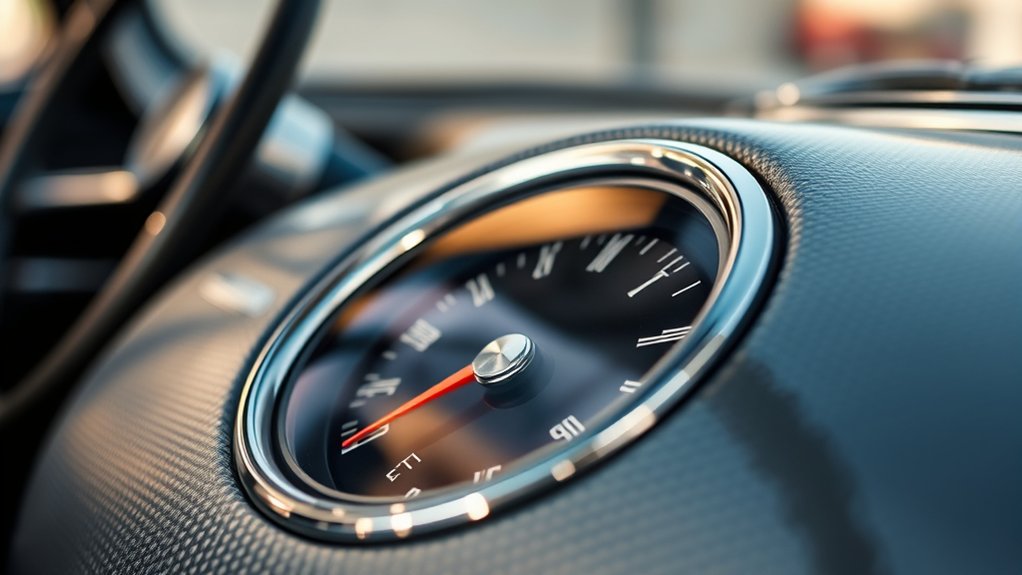
- The fuel gauge’s galvanometer or stepper motor interprets the current, moving the needle or digital indicator.
- The user interface updates in real-time, visually representing the fuel quantity with precision and clarity.
This process ensures that the fuel gauge aesthetics are not just about looks. They provide accurate, timely feedback by converting electrical signals into intuitive readings, helping you monitor fuel status effortlessly.
Common Fuel Gauge Problems and Causes
Although fuel gauges generally provide reliable readings, they can occasionally malfunction due to various mechanical or electrical issues. Understanding the fuel gauge history reveals that early systems relied on simple float mechanisms prone to wear, while modern vehicle dashboards use sophisticated sensors and electrical circuits.
Common problems include a faulty fuel sender unit, where the float arm or resistor track wears out, leading to inaccurate fuel level signals. Wiring faults, such as corroded connectors or broken wires, disrupt signal transmission to the dashboard gauge.
Additionally, gauge instrument failure on the dashboard itself can cause erratic readings. Diagnosing these issues requires testing the sender resistance, inspecting wiring integrity, and verifying the dashboard gauge operation, ensuring accurate fuel level monitoring and preventing unexpected fuel shortages.
Why Fuel Gauges Sometimes Give False Readings
Why do fuel gauges sometimes display inaccurate readings despite functioning components? Several factors can cause this discrepancy, affecting your fuel economics and complicating maintenance budgeting. Understanding these helps you anticipate potential costs and inefficiencies.
- Fuel Sloshing: Movement of fuel inside the tank during driving can cause the float to shift erratically, leading to fluctuating gauge readings.
- Electrical Interference: Corroded connections or faulty wiring can distort the signal between the sending unit and the gauge.
- Sender Unit Wear: Over time, the resistor in the sender unit can degrade, causing false readings without outright failure.
- Tank Shape Variations: Irregular tank designs may cause inconsistent float positions, leading to inaccurate level measurements.
Recognizing these causes helps you maintain fuel economy and allocate your maintenance budget more effectively.
How to Test and Troubleshoot Your Fuel Gauge
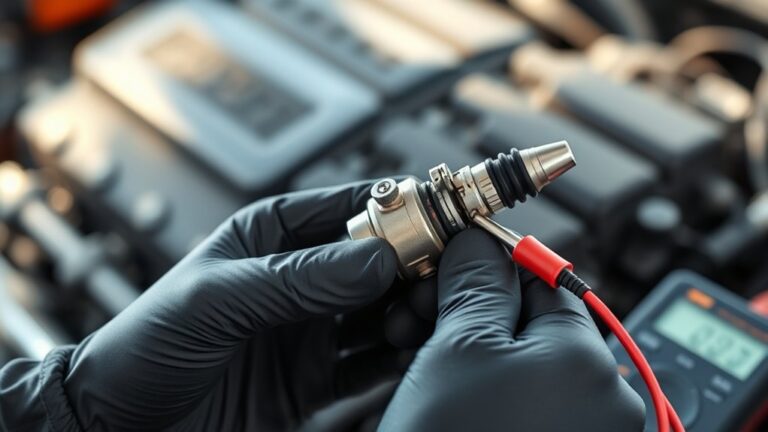
Begin diagnosing your fuel gauge by systematically isolating each component in the fuel level measurement system. Start with the sending unit inside the fuel tank; check its resistance with a multimeter to verify it changes smoothly as the float moves.
Next, inspect the wiring harness for continuity and corrosion, as damaged connections can distort readings. Then, test the gauge itself on the dashboard by grounding the signal line and observing needle movement, accounting for the fuel gauge aesthetics and dashboard design, which may affect accessible testing points.
If the gauge doesn’t respond correctly, it may need replacement. Finally, ensure the instrument cluster’s voltage supply is stable. Troubleshooting in this order helps pinpoint failure sources accurately without compromising fuel gauge aesthetics or dashboard design integrity.
Modern Fuel Gauge Accuracy Improvements
You’ll notice that modern fuel gauges use advanced sensor technology to improve measurement precision and reliability. These sensors provide more accurate fuel level data by minimizing signal noise and environmental interference. Additionally, digital signal processing refines the raw data, ensuring consistent and real-time fuel readings under varied operating conditions.
Sensor Technology Advancements
How have advancements in sensor technology enhanced the accuracy of modern fuel gauges? They’ve revolutionized measurement precision and reliability by integrating innovative components and methods.
You’ll notice improvements such as:
- Capacitive sensors replace traditional resistive float sensors, offering higher sensitivity to fuel level changes.
- Wireless sensor integration eliminates wiring errors and facilitates real-time data transmission, boosting accuracy.
- Temperature-compensated sensors adjust readings dynamically to fuel density variations caused by temperature shifts.
- Future fuel gauge calibration techniques use adaptive algorithms to self-correct sensor drift over time, maintaining long-term accuracy.
Digital Signal Processing
Why does digital signal processing play a pivotal role in enhancing modern fuel gauge accuracy? You rely on digital signal processing theory to filter noise and compensate for sensor nonlinearities in fuel level measurements.
By converting analog signals from fuel sensors into digital signals, you can apply advanced algorithms that correct errors caused by temperature fluctuations, fuel sloshing, and sensor drift. These algorithms use real-time data analysis to smooth out irregularities, ensuring the displayed fuel level truly reflects the tank’s content.
Moreover, digital signal processing enables adaptive calibration, continuously refining accuracy as conditions change. Without this processing, raw sensor data would produce unreliable readings.
Tips to Maintain Your Fuel Gauge for Reliable Performance
When was the last time you checked your fuel gauge’s accuracy? Maintaining it ensures you avoid uncalibrated readings caused by factors like obsolete gas or sensor wear. Follow these precise steps to keep your gauge reliable:
- Regularly Inspect the Sending Unit: Check for corrosion or damage that can distort electrical signals.
- Avoid Using Obsolete Gas: Old fuel can cause sediment buildup, affecting float movement and sensor response.
- Clean Electrical Connections: Dirt or oxidation on connectors leads to erratic gauge behavior.
- Perform Calibration Checks: Cross-verify gauge readings with manual fuel level measurements to detect inconsistencies early.
When to Replace Your Fuel Gauge or Sending Unit
You might notice your fuel gauge acting inconsistently or failing to reflect the actual fuel level accurately. This often signals the need to replace either the fuel gauge or the sending unit.
Don’t fall for common fuel gauge myths suggesting that intermittent issues will resolve without intervention. Instead, diagnose the problem by testing the sending unit’s resistance and the gauge’s response.
Avoid myths—test the sending unit’s resistance and gauge response to accurately diagnose fuel gauge issues.
If readings fluctuate erratically or remain fixed regardless of fuel level, the sending unit is likely faulty. Conversely, if the sending unit tests fine but the gauge malfunctions, replacement of the gauge itself is necessary.
Maintenance myths that recommend frequent replacement without symptoms waste time and money. Replace components only when diagnostic evidence confirms failure to ensure precise fuel level readings and reliable gauge performance.
Frequently Asked Questions
Can Fuel Gauges Be Calibrated for Different Fuel Tank Shapes?
Yes, you can calibrate fuel gauges for different tank geometries, but calibration challenges arise due to irregular shapes affecting sensor readings.
Precise mapping of tank geometry is essential to ensure accurate fuel level measurements and gauge performance.
How Do Temperature Changes Affect Fuel Gauge Readings?
Temperature changes cause fuel volume to expand or contract, affecting readings. You must apply temperature calibration considering fuel tank geometry to guarantee accurate fuel gauge measurements despite thermal variations influencing the sensor’s output.
Are Fuel Gauges Affected by Fuel Type or Additives?
Picture your gauge needle wavering like a compass in fog. Aging fuel and additives can cause sensor drift, subtly skewing readings.
You’ll notice this especially as fuel chemistry changes over time, impacting sensor accuracy and fuel level precision.
Do Hybrid or Electric Vehicles Use Fuel Gauges?
Hybrid vehicles use fuel gauges for their gasoline tanks, while electric vehicles don’t. They rely on battery charge indicators instead. If these systems go wrong, you risk misjudging range, leading to inconvenient or unsafe situations.
Can Fuel Gauges Integrate With Smartphone Apps or Digital Displays?
While your phone glows vividly, your fuel gauge quietly adapts, integrating with smartphones and digital dashboards. It calibrates for tank shapes, accounts for temperature effects, and fuel type impacts. It also includes hybrid and EV gauges for precise, real-time fuel monitoring.
Conclusion
Understanding how your fuel gauge works puts you in the driver’s seat of vehicle maintenance. From mechanical floats to electronic sensors, these systems translate fuel levels into readable signals, keeping surprises at bay.
When problems arise, precise troubleshooting and timely replacements ensure accuracy. Think of your fuel gauge as the heartbeat of your fuel system—regular care keeps it steady, reliable, and ready to guide you safely on every journey.
In summary, knowing how fuel gauges work helps you maintain your vehicle better and avoid unexpected fuel issues.