Is All Wheel Drive the Same as 4 Wheel Drive
All-wheel drive (AWD) and four-wheel drive (4WD) aren’t the same, and understanding the difference between all wheel drive and 4 wheel drive is important for choosing the right vehicle.
AWD automatically distributes torque to all wheels using electronic controls or a center differential, enhancing on-road traction and stability without driver input.
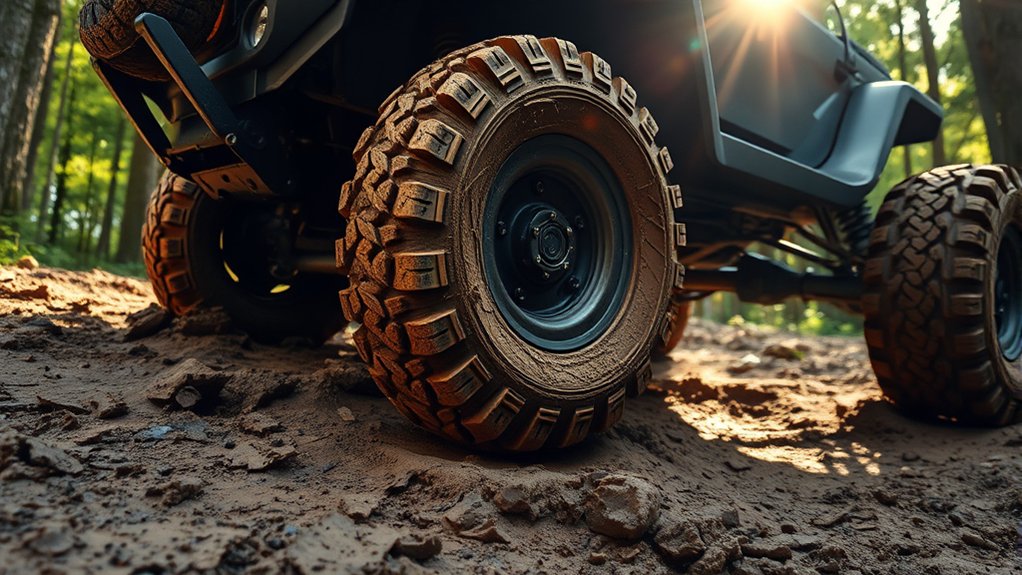
In contrast, 4WD is designed for rugged off-road use, with manual engagement and durable components for maximum traction in tough conditions.
Each system serves different purposes and driving needs.
Knowing these distinctions will help you select the best setup for your environment and driving style.
What Is All Wheel Drive (AWD)?
What exactly is All Wheel Drive (AWD), and how does it function? AWD is a drivetrain system that automatically distributes power to all four wheels simultaneously, optimizing traction on varying road surfaces without driver intervention. It uses a center differential or electronic clutch to vary torque between front and rear axles, enhancing stability and control.
You might encounter AWD myths that claim it guarantees off-road capability or superior towing capacity; however, AWD primarily improves on-road traction rather than heavy-duty performance. Similarly, 4WD myths often conflate AWD’s automatic engagement with 4WD’s manually selectable modes.
Understanding these distinctions helps you recognize AWD’s design focus on everyday driving efficiency and safety rather than specialized off-road or low-traction scenarios.
What Is Four Wheel Drive (4WD)?
You need to understand that Four Wheel Drive (4WD) is a drivetrain system designed to send power to all four wheels simultaneously, typically activated manually. It’s commonly used in trucks and off-road vehicles where traction on uneven or slippery surfaces is critical. Knowing its advantages and limitations will help you determine when 4WD is the most suitable choice for your driving needs.
Definition and Mechanism
How does four wheel drive (4WD) operate to enhance vehicle traction and control? In 4WD systems, power is distributed equally to all four wheels, improving grip on slippery or uneven surfaces.
You engage 4WD manually, often via a lever or switch, locking the front and rear driveshafts together. This mechanism ensures synchronized wheel rotation, reducing wheel slip during off-road or low-traction conditions.
The relevance of this subtopic lies in understanding how mechanical linkages and transfer cases work, which forms the basis for effective traction management. These discussion ideas clarify why 4WD differs from all-wheel drive systems that use automatic power distribution.
Typical Vehicle Applications
Understanding the mechanical foundation of 4WD systems sets the stage for exploring where these drivetrains are most effectively applied. Typically, 4WD is found in vehicles designed for off-road use, such as trucks, SUVs, and utility vehicles.
These systems provide enhanced traction on uneven, slippery, or rugged terrain by mechanically distributing power to all four wheels. When evaluating vehicle options, avoid making an irrelevant comparison to unrelated topics like passenger sedans or urban crossovers, which usually utilize AWD or FWD systems better suited to paved road conditions.
Recognizing the specific applications of 4WD helps you select the appropriate drivetrain based on operational demands rather than unrelated criteria. This focused approach ensures you understand how 4WD aligns with vehicle function, avoiding confusion caused by unrelated topic diversions.
Advantages and Limitations
Why choose four wheel drive (4WD) for your vehicle? 4WD offers superior traction and control in off-road and low-traction conditions, such as snow, mud, or rocky terrain. It allows you to manually engage all four wheels, distributing power evenly for enhanced stability.
However, 4WD systems often add weight and reduce fuel efficiency compared to two-wheel drive, limiting everyday practicality. You might encounter 4WD myths suggesting it’s always better than AWD, but AWD automatically adjusts power distribution and suits varied road conditions without driver input.
Conversely, AWD myths sometimes overstate its off-road capabilities. Understanding these distinctions helps you select the right drivetrain for your needs. Ultimately, 4WD excels in rugged environments but may not be ideal for daily urban driving due to its limitations in efficiency and convenience.
How AWD and 4WD Differ Mechanically
A fundamental mechanical distinction between AWD and 4WD lies in their drivetrain configurations and control systems. AWD employs a center differential or electronic clutch to distribute power automatically between front and rear wheels. It adapts to traction changes without driver input.
In contrast, 4WD uses a transfer case and often requires manual engagement to shift between two-wheel and four-wheel modes. It is designed for rugged off-road conditions.
| Feature | AWD |
|---|---|
| Drivetrain | Full-time, variable power split |
| Control | Automatic |
| Purpose | On-road traction |
| Mechanism | Center differential |
| Engagement | Always active |
| Feature | 4WD |
| Drivetrain | Part-time or full-time |
| Control | Manual or automatic |
| Purpose | Off-road capability |
| Mechanism | Transfer case |
| Engagement | Driver activated |
Which Driving Conditions Suit AWD Best?
Where does all-wheel drive (AWD) perform most effectively? AWD excels in variable on-road conditions like rain, light snow, and mixed pavement where traction fluctuates. Its automatic torque distribution adjusts seamlessly, improving stability without driver input.
This counters several AWD myths suggesting it’s only for extreme off-road use; in reality, AWD is optimized for everyday driving challenges. Unlike 4WD systems with manual engagement and low-range gearing, 4WD quirks complicate operation. AWD requires less driver intervention.
You’ll find AWD particularly beneficial on wet or icy roads, urban environments, and highways with unpredictable traction. By understanding these technical distinctions, you can appreciate that AWD suits moderate conditions demanding consistent traction, while reserving 4WD for more rugged scenarios.
This knowledge helps you select the appropriate drivetrain based on actual driving needs.
When Is 4WD the Better Choice?
When do you need four-wheel drive (4WD) instead of all-wheel drive (AWD)? 4WD is better suited for challenging off-road conditions, steep inclines, deep snow, mud, and rocky terrain where maximum traction and power distribution are critical.
In these environments, 4WD systems provide a mechanical advantage by locking differentials and enabling driver control over torque distribution. If you’re debating 4WD versus AWD, avoid irrelevant discussion or off topic ideas that don’t address specific performance needs.
For routine driving or light off-road use, AWD suffices, making extensive 4WD benefits unnecessary. However, when durability, precise torque control, and robust drivetrain components are essential, 4WD becomes the superior choice.
Understanding these conditions helps you select the appropriate drivetrain without falling into irrelevant discussion or off topic ideas.
How AWD and 4WD Impact Traction, Stability, and Handling
You’ll notice AWD and 4WD systems manage traction differently, affecting how your vehicle grips various surfaces. Each system also influences stability under diverse driving conditions, which impacts your control. Understanding their handling characteristics helps you choose the right drivetrain for your specific needs.
Traction Differences Explained
How do all-wheel drive (AWD) and four-wheel drive (4WD) systems differently influence traction, stability, and handling? AWD continuously distributes power to all four wheels, automatically adjusting torque based on driving conditions. This enhances traction on varied surfaces without driver intervention.
In contrast, 4WD typically operates in selectable driving modes, allowing you to engage or disengage the system as needed. This provides maximum traction in off-road or low-traction scenarios. The selective engagement can improve handling in specific conditions but requires manual input.
AWD systems generally incur lower maintenance costs due to their automated, sealed design. Meanwhile, 4WD systems often demand more frequent maintenance because of additional mechanical components and manual controls. Understanding these traction differences helps you choose a system aligned with your driving needs and maintenance preferences.
Stability in Various Conditions
Why does vehicle stability vary across different driving conditions? Stability metrics such as lateral acceleration, yaw rate, and slip angle fluctuate based on surface type and weather.
AWD systems continuously distribute torque to all wheels, enhancing traction and maintaining stability during variable conditions like wet or icy roads. In contrast, 4WD systems often operate in fixed torque modes, which may reduce adaptability on dry pavement but improve stability on uneven terrain.
Effective braking strategies also influence stability; AWD vehicles can modulate braking force across all wheels dynamically, reducing understeer or oversteer risks. Meanwhile, 4WD systems rely on driver engagement and may require manual brake interventions to correct instability.
Understanding how these systems interact with stability metrics and braking strategies helps you optimize control across diverse environments.
Handling Characteristics Compared
In what ways do AWD and 4WD systems influence a vehicle’s traction, stability, and handling? AWD continuously distributes power to all four wheels, enhancing traction during acceleration and cornering on varied surfaces. This system improves stability by adjusting torque dynamically, making it safe for everyday driving and adverse weather.
Conversely, 4WD engages all wheels primarily for off-road or low-traction scenarios, offering superior traction on rugged terrain but can reduce handling precision on paved roads. Regarding fuel economy, AWD systems generally consume less fuel than 4WD due to lighter components and automatic engagement.
When assessing is it safe for your driving needs, AWD suits urban and mixed conditions better, while 4WD excels in off-road challenges but may compromise fuel efficiency and handling on standard roads.
Choosing Between AWD and 4WD
When deciding between AWD and 4WD, you need to contemplate the specific driving conditions and vehicle capabilities. AWD systems provide seamless traction adjustments, enhancing ride quality on varied paved and moderately slippery surfaces without driver intervention.
They typically occupy less space within the drivetrain, allowing for more efficient use of interior space, which benefits passenger comfort and cargo capacity. Conversely, 4WD systems are designed for rugged off-road or extreme conditions, offering greater torque distribution control but often compromising ride smoothness due to heavier components.
4WD configurations can also reduce interior space because of bulkier transfer cases and additional drivetrain parts. Ultimately, if your primary concern is versatile daily driving with comfort and space, AWD suits you better; if you require serious off-road capability, 4WD is more appropriate.
Fuel Efficiency: AWD vs 4WD
How does drivetrain choice impact your vehicle’s fuel efficiency? When comparing AWD and 4WD, fuel economy is influenced by their mechanical complexity and operational differences. AWD systems distribute power continuously to all wheels, using electronic controls that optimize traction with minimal energy loss.
In contrast, traditional 4WD systems often engage all four wheels mechanically, adding weight and drivetrain drag, which can reduce fuel economy. Shortcut metrics like miles per gallon (MPG) offer a clear way to assess these differences.
Generally, vehicles with AWD show slightly better fuel efficiency compared to 4WD counterparts due to lower drivetrain losses and reduced weight. However, real-world fuel economy depends on usage patterns, terrain, and system design, so relying solely on shortcut metrics may oversimplify the comparison.
Cost Differences Between AWD and 4WD
Fuel efficiency often influences your choice between AWD and 4WD, but cost factors also play a significant role in deciding which system suits your needs. Generally, vehicle pricing for AWD-equipped models tends to be higher due to the complexity of system tuning that enables continuous power distribution to all wheels.
AWD systems require advanced electronics and sensors, which increase initial manufacturing costs. Conversely, 4WD systems are typically found in trucks and SUVs designed for off-road use, with simpler mechanical designs that can reduce upfront costs but may add weight.
However, the ability to switch between two-wheel and four-wheel drive in 4WD systems may affect pricing depending on the sophistication of the transfer case. Understanding these cost components helps you make an informed decision based on your driving requirements and budget.
AWD vs 4WD Maintenance and Repairs
You’ll find that AWD systems generally require less frequent maintenance than 4WD due to their simpler design and continuous operation. However, repairs for AWD can be more costly because of complex components like electronic differentials. Understanding common issues and comparing maintenance schedules will help you manage long-term ownership costs effectively.
Cost Differences Between Systems
When comparing all-wheel drive (AWD) and four-wheel drive (4WD) systems, what stands out most are the differences in maintenance and repair costs. AWD systems, designed for consistent engagement, often require more frequent tire tread balancing and matching due to ride height uniformity. This uniformity affects tire wear.
4WD systems, with adjustable ride height and manual engagement, tend to incur higher costs in drivetrain components but lower tire maintenance expenses.
| Aspect | AWD | 4WD |
|---|---|---|
| Ride Height Impact | Uniform, affects tire wear | Variable, less impact on tires |
| Tire Tread Maintenance | Frequent balancing needed | Less frequent |
| Repair Costs | Moderate, complex electronics | Higher, rugged mechanical parts |
| Maintenance Frequency | Regular due to constant use | Periodic, based on engagement |
Common Repair Issues
How do AWD and 4WD systems differ in their common repair issues? AWD systems generally exhibit higher Awd reliability due to their fully integrated design and continuous power distribution. However, when repairs become necessary, you often face complex issues involving the center differential or electronic control units.
In contrast, 4WD systems prioritize 4wd versatility with selectable modes, but their mechanical components, such as transfer cases and locking hubs, are prone to wear and require more frequent servicing. You’ll find that 4WD repairs often involve drivetrain components exposed to harsher off-road conditions, increasing the likelihood of mechanical failure.
While AWD’s complexity can lead to costly electronic repairs, 4WD’s mechanical nature means you’ll likely deal with physical component replacements. Understanding these distinctions helps you anticipate potential issues based on system design and usage.
Maintenance Frequency Comparison
Typically, AWD systems require less frequent maintenance than 4WD systems due to their sealed, integrated components and continuous operation. You’ll find that 4WD systems demand more regular servicing because of their complex transfer cases and differentials, especially if you use them within off-road limitations.
Understanding this distinction helps prevent mixing unrelated topic concerns, such as general engine maintenance, with drivetrain upkeep.
| Maintenance Task | AWD Frequency | 4WD Frequency |
|---|---|---|
| Fluid Changes | Every 30,000 miles | Every 15,000 miles |
| Differential Service | Every 50,000 miles | Every 20,000 miles |
| Transfer Case Check | N/A | Every 20,000 miles |
| Brake Inspection | Every 20,000 miles | Every 20,000 miles |
| System Diagnostics | Annually | Biannually |
You should tailor maintenance schedules to your vehicle’s drivetrain type.
Popular Vehicles With AWD and 4WD
Which vehicles best showcase the capabilities of AWD and 4WD systems? For AWD, models like the Subaru Outback and Audi Quattro-equipped vehicles demonstrate advanced traction control suited for varied road conditions without driver intervention. These systems represent a shift from old tech to sophisticated, electronically controlled drivetrains.
On the 4WD side, trucks such as the Jeep Wrangler and Toyota Tacoma embody traditional mechanical systems designed for rugged off-road use, emphasizing driver-controlled engagement. While 4WD relies on robust hardware, AWD integrates future trends like predictive torque distribution and sensor-driven adjustments.
Understanding these models helps you appreciate how AWD prioritizes on-road stability, whereas 4WD caters to demanding terrain, reflecting distinct engineering approaches within drivetrain technology.
Frequently Asked Questions
Can AWD or 4WD Be Added to a Vehicle After Purchase?
You can add AWD or 4WD through aftermarket conversion kits, but it’s complex and costly. Such modifications often reduce fuel efficiency and require professional installation to assure proper drivetrain function and safety compliance.
How Do AWD and 4WD Affect Tire Wear?
You might think AWD and 4WD cause equal tire wear, but AWD often leads to more tire noise due to constant engagement, increasing maintenance costs.
4WD, used selectively, typically results in less frequent, uneven tire wear.
Are There Legal Restrictions on Using 4WD on Public Roads?
You’ll find legal definitions vary by region, affecting 4WD use on public roads. Liability implications and insurance coverage nuances depend on vehicle modification legality, so always check local laws to ensure compliance and avoid penalties.
Do AWD and 4WD Systems Require Special Insurance Coverage?
Like a double-edged sword, AWD and 4WD can have insurance implications. You’ll want to inform your insurer, especially after aftermarket upgrades, to ensure coverage matches your vehicle’s enhanced capabilities and avoids potential claim denials.
How Do AWD and 4WD Impact Vehicle Resale Value?
You’ll find AWD vs 4WD impacts resale value differently; AWD often boosts urban appeal, while 4WD attracts off-road buyers. Both systems can increase resale impact by enhancing vehicle versatility and performance, depending on market demand.
Conclusion
When deciding between AWD and 4WD, consider your driving needs carefully. AWD automatically adjusts power to all four wheels, enhancing traction on 75% of paved roads where slippery conditions occur.
In contrast, 4WD offers superior control in rugged, off-road terrain but requires manual activation. Understanding these mechanical differences helps you choose the system that optimizes performance, fuel efficiency, and maintenance for your typical driving environment.
In conclusion, knowing whether all wheel drive is the same as 4 wheel drive is essential to selecting the best system for safer, more reliable handling.