Can Am Spyder Fuel Capacity
Your Can Am Spyder fuel capacity depends on the model you have, ranging from 5.1 gallons on the Ryker to 7.9 gallons on the Spyder RT. Most models hold about 7.1 gallons, giving you varying riding ranges before needing to refuel.
Smaller tanks mean more frequent stops, while larger tanks let you ride longer distances. Understanding these differences helps with trip planning and fuel efficiency.
Explore further to uncover how this impacts your overall riding experience.
How Much Fuel Does a Can-Am Spyder Hold?
How much fuel does a Can-Am Spyder actually hold? Typically, the fuel tank capacity ranges around 7.1 gallons (27 liters). This capacity allows you to enjoy extended rides without frequent stops.
When considering two word ideas like “fuel efficiency” or “tank size,” it’s clear that the Spyder balances capacity and performance effectively. Unlike an unrelated topic such as “engine displacement,” fuel capacity directly impacts how far you can travel before refueling.
You’ll find the fuel gauge conveniently located on the dashboard, giving you real-time information. Understanding this capacity helps you plan trips better, especially when exploring areas with limited fuel stations.
How Fuel Capacities Vary Across Spyder Models
Why do fuel capacities differ among Can-Am Spyder models? It mainly comes down to each model’s design, intended use, and fuel economy. Some models prioritize longer rides, so they feature larger tank capacity. Others focus on agility and weight reduction, resulting in smaller tanks.
Understanding these differences helps you choose the right Spyder for your needs.
| Model | Tank Capacity (gallons) |
|---|---|
| Spyder F3 | 7.1 |
| Spyder RT | 7.9 |
| Spyder RS | 5.4 |
| Spyder Ryker | 5.4 |
| Spyder F3-S | 7.1 |
Each tank capacity impacts your fuel economy and ride planning. Choose accordingly.
How Fuel Capacity Affects How Far You Can Ride
Your Can Am Spyder’s fuel capacity directly influences how far you can ride before needing to refuel. Fuel efficiency plays a key role in determining the average distance you can cover on a full tank. Understanding this helps you plan refueling stops and manage longer trips more effectively.
Fuel Efficiency Impact
Where can you go on a single tank of your Can Am Spyder? While fuel capacity provides a baseline, fuel efficiency plays a vital role in determining your actual range. You’ll find that higher fuel efficiency means you can travel farther before refueling, maximizing the benefit of your tank size.
Keep in mind, insufficient data on specific models or riding conditions can make precise estimates challenging. Avoid relying on unrelated topics like engine power or aesthetics when calculating range. They don’t directly affect fuel consumption.
Instead, focus on factors impacting efficiency, such as riding style, terrain, and maintenance. By understanding how fuel efficiency interacts with capacity, you can better plan rides and manage refueling stops, ensuring your Can Am Spyder meets your travel needs effectively.
Average Riding Distance
How far can you expect to travel on a single tank of your Can Am Spyder? The fuel capacity directly influences your average riding distance, which varies by model and riding conditions. Using quality fuel additives can optimize engine performance, potentially extending your range while maintaining the Spyder aesthetics with minimal impact on weight.
Below is a comparison of typical riding distances based on fuel capacity and average fuel efficiency.
| Model | Fuel Capacity (gallons) | Average Distance per Tank (miles) |
|---|---|---|
| Spyder F3 | 5.4 | 175 |
| Spyder RT | 6.6 | 210 |
| Spyder F3-S | 5.4 | 170 |
| Spyder RS | 5.4 | 165 |
| Spyder Ryker | 5.1 | 160 |
Knowing this helps you plan rides without frequent stops.
Refueling Frequency Considerations
Fuel capacity directly impacts how often you’ll need to stop for refueling during your rides. Understanding the fuel measurement of your Can Am Spyder helps you estimate ride intervals before a refill is necessary.
Larger tank dimensions generally mean longer distances between stops, allowing for extended journeys without interruption. Conversely, smaller tanks require more frequent refueling, which can affect your route planning and overall riding experience.
By considering both fuel measurement and tank dimensions, you can better anticipate refueling frequency based on your typical riding habits and conditions. This insight allows you to plan trips more efficiently, avoid unexpected stops, and maximize your time on the road.
Ultimately, knowing your Spyder’s fuel capacity helps you balance convenience with performance during every ride.
How to Calculate Your Can-Am Spyder’s Driving Range
Wondering how far your Can-Am Spyder can take you on a full tank? To calculate its driving range, start by knowing the fuel capacity, which varies by model but typically hovers around 7.1 to 7.9 gallons.
Next, determine your Spyder’s average fuel consumption, usually measured in miles per gallon (mpg). You can find this in the owner’s manual or by tracking your miles traveled per tank over time.
Multiply the fuel capacity by the average mpg to estimate the driving range. For example, if your Spyder holds 7.5 gallons and averages 35 mpg, your driving range is approximately 262.5 miles.
This calculation helps you plan trips effectively and avoid unexpected refueling stops.
Tips for Getting the Best Fuel Efficiency on Your Can-Am Spyder
To get the best fuel efficiency on your Can-Am Spyder, keep your tire pressure optimized and use smooth throttle control. Regular maintenance checks also play a key role in ensuring your vehicle runs efficiently. Following these steps can help you maximize every gallon of fuel.
Optimize Tire Pressure
How much difference can properly inflated tires make to your Can-Am Spyder’s fuel efficiency? Maintaining the correct tire pressure reduces rolling resistance, directly improving gas mileage. Ignoring this is like discussing an irrelevant topic or making a random pairing—unrelated yet impactful.
Check your tires regularly and adjust to the manufacturer’s recommended PSI for optimal performance.
| Tire Pressure (PSI) | Fuel Efficiency Impact | Safety & Handling |
|---|---|---|
| Below Recommended | Decreases by 5-10% | Poor traction, wear |
| At Recommended | Optimal | Best control |
| Above Recommended | Slight decrease | Harsher ride |
You’ll save fuel and enhance safety by keeping tire pressure within specs, simple but effective.
Smooth Throttle Control
Maintaining proper tire pressure sets a strong foundation for fuel efficiency, but controlling your throttle input plays an equally significant role. When you apply smooth, gradual throttle increases, your Can-Am Spyder consumes fuel more efficiently, avoiding unnecessary spikes in fuel usage.
Abrupt acceleration forces the engine to work harder, reducing miles per gallon. Focus on steady acceleration and deceleration rather than quick bursts. It’s important to avoid side discussion or distractions about unrelated topics that might cause you to accelerate irregularly.
Staying mindful and consistent with your throttle control helps maintain optimal fuel economy. This technique complements other efficiency practices without overlap, ensuring your riding habits directly contribute to better fuel management.
Smooth throttle control is an essential, practical step toward maximizing your Can-Am Spyder’s fuel capacity.
Regular Maintenance Checks
Why should you prioritize regular maintenance checks on your Can-Am Spyder? Proper upkeep ensures your vehicle runs efficiently, directly impacting fuel consumption. Regularly inspect your tires, brakes, and engine to keep everything in optimal condition.
A well-maintained engine burns fuel more efficiently, helping you get the most from every gallon. Pay attention to your fuel gauge and avoid running too close to empty, which can strain the fuel pump.
Additionally, keep your air filter clean to improve air flow and combustion. Before heading to the gas station, check for any leaks or issues that could waste fuel.
How Riding Style Impacts Your Can-Am Spyder’s Fuel Consumption
What effect does your riding style have on the Can-Am Spyder’s fuel consumption? Your acceleration, speed, and braking habits directly influence how much fuel your Spyder uses.
Aggressive acceleration and high speeds increase fuel demand, reducing efficiency. Smooth, steady riding conserves fuel and enhances rider safety by promoting control. Additionally, maintaining consistent speeds reduces strain on the engine, improving mileage.
While fuel additives can optimize combustion and engine performance, they won’t fully compensate for inefficient riding habits. Prioritizing gradual throttle changes and anticipating stops helps lower fuel consumption.
Ultimately, adopting a mindful riding style not only saves fuel but also supports safer rides, making your Can-Am Spyder both economical and reliable on the road.
Where to Find the Fuel Tank and Refuel Your Can-Am Spyder
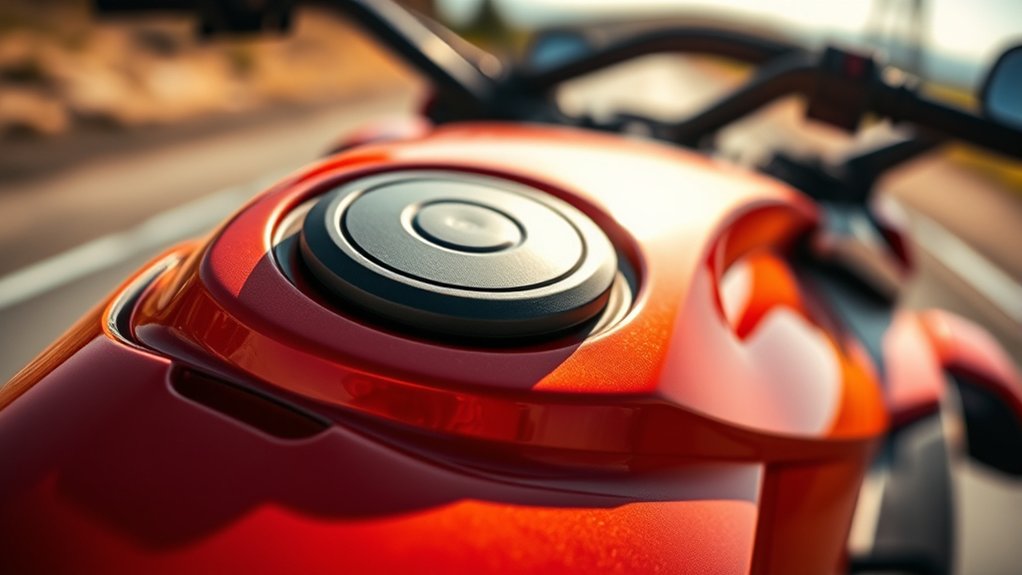
Your riding habits influence how often you’ll need to refuel, so knowing exactly where the fuel tank is located on your Can-Am Spyder is important. The fuel tank is under the seat, accessible by lifting it. Unlike non motorized vehicles or electric charging stations, your Spyder requires traditional gasoline.
Refueling is straightforward once you locate the cap after removing the seat.
| Step | Details |
|---|---|
| Locate Seat | Lift the rider seat |
| Find Fuel Cap | Positioned beneath the seat |
| Use Proper Fuel | Gasoline recommended |
| Refueling Action | Insert nozzle, fill carefully |
| Post-Refuel Check | Secure the cap and seat tightly |
This setup ensures quick refills without confusion, keeping your Spyder ready for the road.
Common Fuel Issues and How to Avoid Them on Your Spyder
When dealing with fuel issues on a Can-Am Spyder, knowing how to identify and prevent common problems can save you time and expense. Avoid using fictional fuels or unapproved fuel additives, as these can harm your engine and reduce performance. Always use high-quality, recommended fuel to maintain optimal operation.
Be cautious of faulty readings; if your Spyder has antique gauges, they may provide inaccurate fuel levels, leading to unexpected shortages. Regularly inspect and calibrate your gauges to avoid this issue.
Also, protect your fuel system from contamination by keeping the tank sealed and clean. By following these steps, you’ll reduce risks like fuel line clogs or engine hesitation, ensuring your Spyder runs smoothly and efficiently on the road.
Fuel Tank Accessories and Upgrades for Your Can-Am Spyder
Maintaining a clean and reliable fuel system sets the stage for exploring accessories and upgrades that can enhance your Can-Am Spyder’s fuel tank performance. You can install fuel additives designed to keep injectors clean, improving fuel efficiency and reducing deposit buildup.
Upgrading to a high-quality fuel cap with better sealing prevents contamination and evaporation. Consider fuel tank liners or coatings to protect against corrosion, especially if you follow strict maintenance scheduling.
Monitoring tire wear may seem unrelated, but balanced tire condition ensures stable handling, which complements fuel system efficiency by maintaining optimal engine load. Additionally, aftermarket fuel gauge upgrades provide more accurate readings, helping you plan refueling stops effectively.
These enhancements collectively support your Spyder’s performance and longevity without complicating routine upkeep.
Frequently Asked Questions
What Type of Fuel Is Recommended for a Can-Am Spyder?
You should use high-quality unleaded gasoline with an octane rating of 87 or higher for your Can-Am Spyder.
Always ensure proper fuel storage to maintain fuel quality and prevent damage to your vehicle’s engine and performance.
How Often Should I Check My Can-Am Spyder’s Fuel Filter?
You should check your Can-Am Spyder’s fuel filter every 12,000 miles or annually, whichever comes first. Maintaining this fuel system component guarantees optimal performance and prevents clogging, fitting well within your regular maintenance cadence.
Can I Use Fuel Additives in My Can-Am Spyder?
You can’t just toss any fuel additive into your Can Am Spyder as if it’s magic potion. Use only recommended fuel additives to avoid engine harm.
Don’t confuse this with tire pressure checks, they’re equally essential but unrelated tasks.
What Are the Environmental Impacts of Can-Am Spyder Fuel Use?
You should know Can-Am Spyder fuel emissions contribute to air pollution, impacting environmental policy goals.
How Does Altitude Affect Can-Am Spyder Fuel Performance?
You’ll notice altitude effects reduce your Can-Am Spyder’s fuel efficiency since thinner air means less oxygen for combustion.
As altitude increases, your engine works harder, consuming more fuel and potentially decreasing overall performance.
Conclusion
Think of your Can-Am Spyder’s fuel tank as the heart of a marathon runner—it powers every mile you conquer. With capacities ranging from about 5 to 7 gallons depending on your model, knowing your tank size helps you plan your rides smartly.
Just like a runner pacing themselves, managing your fuel efficiently ensures you won’t hit empty unexpectedly. Keep your riding style smooth and tank topped up, and your Spyder will take you far with confidence.
Understanding your Can Am Spyder fuel capacity is key to maximizing your adventure and enjoying every journey without worry.