
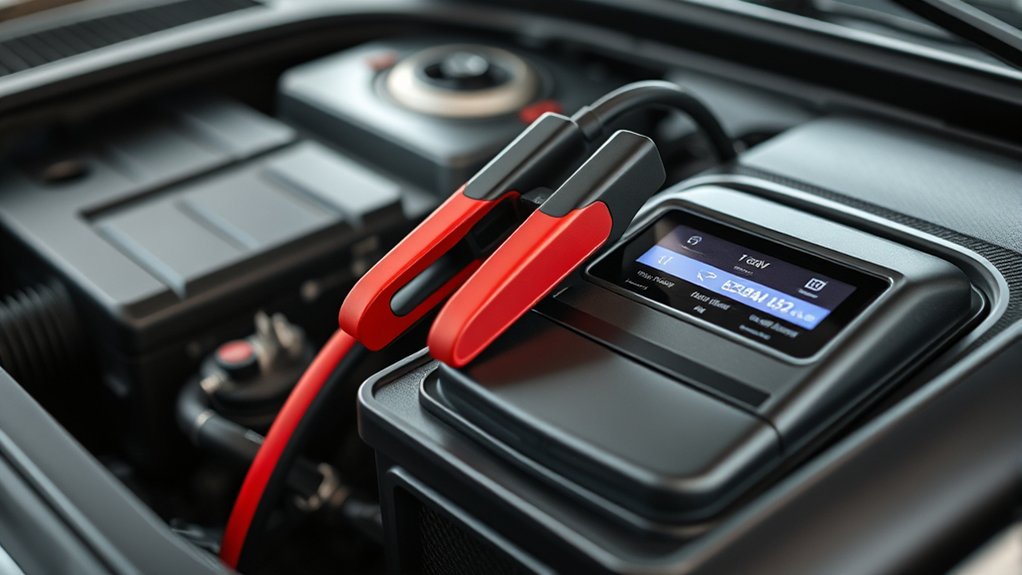
How to Use the Car Battery Charger
To use a car battery charger, first inspect and clean the battery terminals, ensuring all connections are secure and corrosion-free.
Select a charger compatible with your battery type and capacity, prioritizing safety features like reverse polarity protection.
Connect the positive clamp to the positive terminal and the negative clamp to a grounded metal chassis part.
Set the correct charge rate and monitor voltage during charging.
After completion, disconnect safely by removing clamps in reverse order.
Explore further for detailed setup and maintenance tips.
Preparing Your Car Battery for Charger Use
Before you connect the charger, how do you guarantee your car battery is ready? Begin by inspecting the battery terminal connections for tightness and cleanliness. Loose or dirty terminals hinder charging efficiency and can cause electrical resistance.
Use a wire brush to remove any corrosion, which appears as white or bluish powder, from the battery terminal and clamp surfaces. After cleaning, apply a corrosion prevention spray or petroleum jelly to the terminals to inhibit future buildup.
Ensure the battery case is intact without cracks or leaks. Finally, confirm the battery voltage with a multimeter to determine its charge state before charging. Proper preparation minimizes risks and optimizes charger performance, ensuring the battery receives a stable and effective charge.
Choosing the Right Car Battery Charger
With your battery properly prepared, selecting the right charger guarantees efficient and safe recharging. You must consider the battery chemistry, such as lead-acid, AGM, or lithium, since chargers vary in compatibility. Prioritize charging safety features like automatic shutoff and reverse polarity protection to prevent damage and hazards.
Choosing the right charger ensures safe, efficient charging tailored to your battery’s chemistry and safety needs.
Also, choose a charger with an appropriate amperage rating to match your battery’s capacity for optimal performance.
Key factors to evaluate include:
- Compatibility with your battery chemistry
- Charging modes and adjustable current settings
- Built-in charging safety features (e.g., overcharge protection)
- User interface clarity and diagnostic capabilities
How to Connect the Charger Safely
A secure connection between the battery charger and your car battery is essential to guarantee efficient charging and prevent accidents. First, ensure the charger is unplugged before connecting.
Attach the positive (red) clamp to the positive terminal of the battery. Then, connect the negative (black) clamp to a grounded metal part of the car’s chassis, away from the battery, to minimize sparks. Avoid connecting the negative clamp directly to the negative terminal to enhance charging safety.
Check that clamps are firmly attached and free from corrosion. Always work in a well-ventilated area to avoid gas buildup.
After charging, disconnect the negative clamp first, then the positive. Follow local regulations for battery disposal if the battery is damaged or unusable to maintain environmental safety.
Choosing the Right Charger Settings
How do you select the appropriate charger settings for your car battery? Start by understanding your battery’s specifications. Selecting battery type correctly ensures compatibility and safety. Next, focus on choosing charge rate, which affects charging speed and battery health.
Consider these factors:
- Battery chemistry (lead-acid, AGM, gel)
- Battery capacity (Ah rating)
- Recommended charge rate (usually expressed in amps)
- Charger mode (standard, fast, trickle)
Match the charger settings to your battery’s data plate or manual. Using a charge rate too high can overheat the battery, while too low prolongs charging unnecessarily. Selecting battery type properly activates the charger’s internal algorithm for optimal performance.
These steps guarantee efficient, safe charging tailored to your battery’s needs.
Monitoring the Charging Process
After setting the charger to match your battery’s specifications, keep a close eye on the charging process to ensure everything proceeds safely and efficiently. Focus on the monitoring duration to avoid overcharging, which can damage the battery or reduce its lifespan.
Use the charger’s gauge to track voltage and amperage levels, but always verify gauge accuracy before starting. Inaccurate readings may lead to improper charging and potential hazards. Periodically check connections for tightness and signs of overheating.
Maintain a consistent environment free from moisture or extreme temperatures during charging. By diligently monitoring these factors, you ensure an optimal charge cycle tailored to your battery’s needs, preventing damage and promoting longevity.
Stay vigilant throughout the entire process until the charger indicates full charge.
Disconnecting Your Charger Safely
Once the charger signals a full charge, you’ll need to disconnect it carefully to prevent sparks or damage. Start by turning off the charger to cut the power supply before unplugging safely.
When fully charged, turn off the charger before unplugging to ensure safety and prevent sparks.
Follow these steps for proper terminal isolation and to avoid short circuits:
- Switch off the charger and unplug it from the wall outlet first.
- Remove the negative (black) clamp from the battery terminal before the positive (red) clamp.
- Avoid touching clamps together or to metal surfaces during removal.
- Inspect terminals and clamps for corrosion or damage before storing the charger.
Troubleshooting Common Charging Issues
If your charger won’t connect properly, start by checking the clamps and terminals for corrosion or loose contacts. Next, verify the battery’s condition and ensure it accepts the charge without error indicators. Finally, confirm your power supply is stable and delivering the correct voltage for effective charging.
Diagnosing Charger Connection Problems
Several factors can cause charger connection problems when using a car battery charger. To effectively diagnose these issues, follow specific diagnostic steps focused on ensuring charger compatibility and proper connection.
Start by verifying the charger’s voltage matches your battery’s requirements. Next, inspect all cables and clamps for wear or corrosion, as damaged connectors can interrupt current flow. Confirm that the clamps are securely attached to the correct battery terminals, positive to positive, negative to negative.
Lastly, check for any blown fuses in the charging circuit that might prevent power delivery.
- Verify charger voltage and compatibility
- Inspect cables and clamps for damage or corrosion
- Ensure clamps are correctly and securely connected
- Check circuit fuses for continuity
Adhering to these steps helps you isolate and resolve charger connection problems efficiently.
Identifying Battery Charging Errors
How do you quickly pinpoint errors during battery charging? Start by identifying battery charging errors through visual and instrumental checks. Look for abnormal charger indicators, unusual battery heat, or corrosion on terminals.
Use a voltmeter to verify voltage consistency. Below is a quick reference for common errors:
| Error Condition | Likely Cause |
|---|---|
| Charger LED off | Loose connection or dead charger |
| Battery overheating | Overcharging or internal fault |
| Voltage fluctuation | Poor battery health or wiring issue |
If you observe these symptoms, stop charging immediately to prevent damage. Identifying battery charging errors early ensures safety and prolongs battery life.
Regular inspection and adherence to manufacturer guidelines will minimize these issues.
Resolving Power Supply Issues
Recognizing battery charging errors often points to underlying power supply problems that need immediate attention. Flawed power input, such as unstable voltage or poor connections, can cause ineffective charging or silent discharge, where the battery drains without visible signs.
To resolve these issues, you should:
- Inspect and secure all cable connections for corrosion or looseness.
- Verify the charger’s power source for consistent voltage output.
- Check for parasitic loads causing silent discharge when the vehicle is off.
- Test the battery with a multimeter to confirm it holds charge properly.
Maintaining Your Car Battery After Charging
After charging, you should regularly inspect your battery for corrosion, leaks, and secure connections to ensure optimal performance. Store the battery in a cool, dry place and keep it fully charged to prevent capacity loss. These maintenance steps will extend your battery’s lifespan and reliability.
Regular Battery Inspection
When should you inspect your car battery to assure optimal performance? Regular inspection is vital to maximize battery longevity and ensure corrosion prevention. You should check your battery at least once a month and after charging, especially if you notice any performance issues.
During inspection, focus on these key areas:
- Examine terminals and cables for corrosion buildup or looseness.
- Check battery case for cracks, bulges, or leaks.
- Measure voltage with a multimeter to confirm charge status.
- Inspect electrolyte levels if your battery is not maintenance-free.
Consistent inspections help you identify problems early, avoid unexpected failures, and maintain efficient charging cycles. By staying proactive, you extend your battery’s service life and optimize performance with minimal downtime or repair costs.
Proper Storage Techniques
Regular inspections help you catch issues before they escalate, but proper storage after charging plays a significant role in preserving your battery’s health. Once charged, disconnect the battery and store it in a cool, dry place away from direct sunlight and extreme temperatures.
Avoid areas with high humidity to reduce corrosion risks. Use a storage container or battery box for added protection. For seasonal maintenance, recharge the battery every 4-6 weeks to prevent sulfation and capacity loss.
Keep terminals clean and coated with a thin layer of dielectric grease to inhibit oxidation. Following these storage tips ensures your battery maintains optimal performance and longevity, minimizing failures and extending service life during periods of inactivity.
Proper storage is as critical as charging for maintaining your car battery’s reliability.
Avoiding Damage While Charging Your Battery
How can you prevent damage to your car battery during charging? Prioritize safe handling to protect both the battery and environment. Incorrect procedures can cause permanent damage or hazardous leaks, increasing environmental impact. Follow these essential steps:
- Ensure charger voltage and current match your battery specifications.
- Connect clamps correctly: positive to positive, negative to negative, avoiding sparks.
- Charge in a well-ventilated area to dissipate harmful gases safely.
- Disconnect the charger immediately after reaching full charge to prevent overcharging.
Frequently Asked Questions
Can a Car Battery Charger Work on Other Types of Batteries?
You can use a car battery charger on other batteries only if battery compatibility is confirmed. Always check voltage and chemistry to guarantee charging safety, preventing damage or hazards from incompatible battery types or improper charging settings.
How Long Do Car Battery Chargers Typically Last?
You know what they say, “A stitch in time saves nine.” Typically, car battery chargers last 3-5 years, depending on battery life and charging cycles.
Proper care and avoiding overcharging extend their effective lifespan considerably.
Are Car Battery Chargers Safe to Use in Extreme Weather?
You shouldn’t use car battery chargers in extreme weather without checking extreme weather safety ratings. Ensure your charger’s compatibility across battery types to avoid damage.
Always consult the manual for proper operation under harsh conditions.
Can I Leave My Car Battery Charger Unattended Overnight?
Don’t leave unattended chargers overnight without smart features; imagine sparks dancing silently. Overcharge risks rise. For overnight safety, use chargers with auto shut-off or monitor regularly to prevent damage, fire hazards, and ensure reliable battery health.
Do Car Battery Chargers Affect the Car’s Warranty?
Car battery chargers typically don’t void your warranty if you ensure car battery compatibility and follow charging safety considerations.
Always use recommended chargers to avoid electrical damage, preserving both battery health and your vehicle’s warranty coverage.