How to Clean Fuel Filter
You clean your fuel filter by first relieving fuel system pressure, which is essential for safety. Next, safely remove the filter using wrenches and a catch container to avoid fuel spills.
Inspect the filter carefully for cracks, clogs, or any signs of damage. For inline filters, flush or replace the filter element as needed. For cartridge types, soak and clean the media gently without using harsh chemicals.
Reinstall the filter, ensuring the correct flow direction and secure fittings. If engine issues persist after cleaning, replacement of the fuel filter may be necessary. Understanding these steps can help maintain optimal engine performance.
When to Know Your Fuel Filter Needs Cleaning
How do you determine when your fuel filter requires cleaning? Focus on symptoms like engine misfires, reduced acceleration, and difficulty starting. These signs indicate fuel flow restriction caused by a clogged filter.
Avoid relying on irrelevant topics or unverified sources, as misinformation avoidance is crucial for accurate diagnosis. Regularly check your vehicle’s maintenance schedule for recommended fuel filter intervals.
If you notice black smoke from the exhaust or a drop in fuel efficiency, inspect the fuel filter immediately. Use pressure testing equipment to measure fuel line pressure; a significant drop confirms filter blockage.
Staying objective and adhering to manufacturer guidelines ensures you address the issue promptly without confusion from unrelated or inaccurate information. This precision helps maintain engine performance and prevents costly damage.
Tools and Materials Needed to Clean Your Fuel Filter
What tools and materials do you need to effectively clean your fuel filter? You’ll require specific items to minimize security risks and stay within maintenance budgets. Precision in tool selection ensures safety and efficiency.
| Tool/Material | Purpose | Emotion Evoked |
|---|---|---|
| Wrench Set | Loosen filter fittings | Confidence |
| Clean Container | Catch fuel and debris | Control |
| Fuel Filter Cleaner | Remove contaminants | Assurance |
| Safety Gloves | Protect hands | Security |
| Safety Glasses | Shield eyes | Vigilance |
Use these tools carefully to avoid contamination or injury. Proper preparation limits exposure to hazardous fuel, reducing security risks and optimizing maintenance budgets.
How to Remove Your Fuel Filter Safely
Before you begin, guarantee you have all the necessary tools and protective gear at hand to maintain safety throughout the removal process. Start by relieving fuel system pressure to prevent fuel spray, which is crucial for cleaning safety.
Locate the fuel filter, usually along the fuel line or near the fuel tank. Use appropriate wrenches to disconnect fuel lines, catching any residual fuel with a container to avoid spills. Wear gloves and eye protection to safeguard against fuel exposure.
Loosen mounting brackets or clamps securing the filter, then carefully remove it without bending or damaging the fuel lines. Handle the filter gently to preserve its condition for filter inspection later.
Dispose of any fuel-soaked materials properly. Follow these steps precisely to ensure safe removal before proceeding to cleaning and inspection.
How to Inspect Your Fuel Filter for Damage
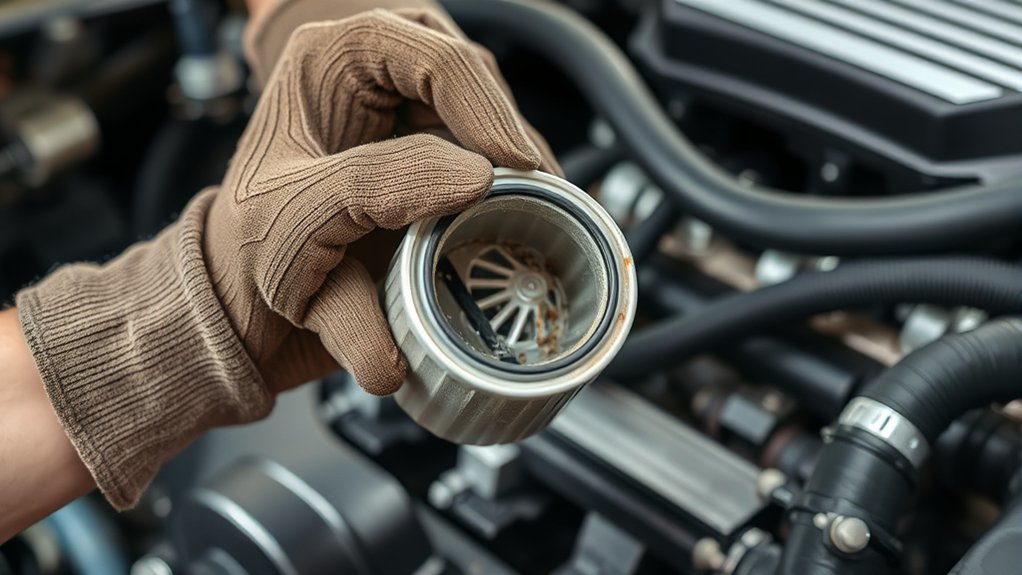
Start by examining your fuel filter for visible signs of wear, such as cracks, rust, or corrosion. Next, check for clogs by assessing fuel flow or inspecting the filter media for debris buildup. Identifying these issues early helps ensure your fuel system functions efficiently.
Visual Signs of Wear
Although fuel filters are designed to trap contaminants effectively, they can show visible signs of wear that indicate the need for replacement. When inspecting your fuel filter, focus on visual wear such as cracks, dents, or corrosion on the casing.
Pay close attention to any color change in the filter media, which may suggest saturation or degradation.
| Visual Sign | Description |
|---|---|
| Cracks | Indicate physical damage |
| Dents | May restrict fuel flow |
| Corrosion | Weakens filter structure |
| Color Change | Shows contamination or aging |
| Loose Connections | Can cause fuel leaks |
Identifying these signs promptly helps maintain fuel system efficiency and prevents potential engine issues. Replace the filter if you observe any of these defects.
Checking for Clogs
How can you determine if your fuel filter is clogged and impairing fuel flow? Start by inspecting signs indicating reduced filtration efficiency caused by fuel contamination.
To check for clogs efficiently:
- Examine fuel pressure; a drop often signals blockage.
- Observe engine performance for hesitation or stalling.
- Visually inspect the filter for dark deposits or sediment buildup.
- Remove the filter and shine a light through it to detect debris accumulation.
- Monitor fuel flow rate during operation to identify restrictions.
How to Clean Different Types of Fuel Filters
You’ll need to approach cleaning inline fuel filters and cartridge fuel filters differently due to their design. For inline filters, you’ll typically flush or replace the filter element, while cartridge filters require disassembly and careful cleaning of the housing and filter media. Let’s go over the exact steps for each type to ensure proper maintenance.
Cleaning Inline Fuel Filters
Where should you start when cleaning an inline fuel filter? Begin by locating the filter along the fuel line and relieving fuel system pressure to ensure safety. Maintaining fuel cleanliness is crucial to prevent contaminants from re-entering the system.
Follow these steps precisely:
- Disconnect the fuel lines carefully to avoid spills.
- Remove the inline filter from its housing.
- Inspect the filter for damage or excessive clogging.
- Use a suitable solvent or compressed air to clean the filter element.
- Reinstall the filter and secure fuel lines properly.
Regular cleaning enhances filter longevity and sustains optimal fuel flow. Avoid using harsh chemicals that could degrade filter components. By following this method, you maintain fuel cleanliness and extend the inline filter’s service life effectively.
Servicing Cartridge Fuel Filters
After ensuring the inline fuel filter is clean and secure, shift your attention to cartridge fuel filters, which require a different approach due to their design. First, relieve system pressure by loosening the fuel cap and draining residual fuel.
Remove the cartridge housing carefully, then extract the cartridge element. Inspect it for clogging or damage. For idle maintenance in diesel engines, clean the cartridge by soaking it in a suitable solvent to dissolve contaminants.
Avoid using high-pressure water, which can damage the filter media. Allow the cartridge to dry completely before reinstalling. Replace the cartridge if it shows signs of wear or persistent blockage.
Finally, reassemble the housing, ensuring all seals are intact to prevent leaks. Proper servicing of cartridge fuel filters ensures optimal fuel flow and engine performance.
How to Reinstall Your Fuel Filter Safely
A secure and proper reconnection of the fuel filter is essential to guarantee peak fuel flow and prevent leaks. Avoid confusing this task with any irrelevant topic or unrelated concept, such as electrical system repairs. Focus solely on the mechanical reconnection steps to ensure safety and efficiency.
To reinstall your fuel filter safely, follow these key steps:
- Align the filter according to the directional flow arrow.
- Securely attach fuel lines using the correct clamps or fittings.
- Double-check that all connections are tight but avoid overtightening.
- Reconnect any mounting brackets or clips to stabilize the filter.
- Inspect for leaks by pressurizing the system before full engine start.
These precise actions will ensure your fuel filter functions correctly without compromising vehicle safety.
When to Replace Instead of Clean Your Fuel Filter
If you notice severe clogging that cleaning can’t fix, it’s time to replace your fuel filter. The filter’s material has limits and won’t perform effectively after repeated use. Ignoring replacement can lead to poor engine performance and potential damage.
Signs of Severe Clogging
Recognize when your fuel filter shows signs of severe clogging to avoid further damage to your engine. Severe clogging reduces fuel flow, causing performance issues that cleaning can’t fix. You should replace the filter if you notice:
- Persistent engine misfires despite cleaning efforts
- Significant drop in fuel pressure measured with a gauge
- Engine stalling under load or at idle
- Difficulty starting the engine after multiple attempts
- Visible contamination or damage inside the filter housing
These signs indicate the filter’s media has deteriorated or is saturated beyond cleaning effectiveness. Addressing severe clogging promptly prevents fuel pump strain and potential engine damage.
Fuel Filter Material Limits
How do you determine when cleaning your fuel filter no longer suffices? Fuel filter materials have inherent limits; they’re designed to trap contaminants but degrade over time. If you notice persistent clogging despite thorough cleaning, it’s a clear sign the filter media has deteriorated.
Filter materials like paper or synthetic fibers lose their structural integrity, reducing filtration efficiency and risking damage to the fuel system. Additionally, physical damage such as tears or deformation means the filter can’t perform as intended.
Always inspect the filter’s condition closely. If the material appears brittle, clogged beyond cleaning, or compromised, replace it. Maintaining a functional fuel filter protects your fuel system from contaminants that can cause costly repairs, so prioritize replacement over cleaning when material limits are reached.
Impact on Engine Performance
When does a clogged fuel filter start to noticeably degrade your engine’s performance? You’ll see reduced engine efficiency and poorer fuel economy as contaminants restrict fuel flow.
Cleaning works only if the filter isn’t damaged or overly clogged. Replace it instead when symptoms worsen or persist despite cleaning.
Watch for these signs:
- Engine hesitation or stalling during acceleration
- Difficulty starting the engine or frequent misfires
- Noticeable drop in fuel economy
- Engine running roughly or uneven idle
- Check engine light related to fuel delivery faults
If these occur, the filter’s internal media may be compromised, limiting flow and damaging fuel injectors. Replace the fuel filter promptly to restore optimal engine efficiency and fuel economy.
Cleaning suits minor clogs, but replacement ensures reliable fuel delivery and engine performance.
How Often to Clean or Replace Your Fuel Filter
Why should you pay close attention to your fuel filter’s maintenance schedule? Proper maintenance scheduling ensures consistent filtration efficiency, preventing contaminants from reaching the engine.
Typically, you should clean or replace the fuel filter every 20,000 to 30,000 miles, but this interval can vary based on driving conditions and fuel quality. If you operate in dusty environments or use lower-grade fuel, shorten the interval accordingly.
Always consult your vehicle’s manual for manufacturer recommendations. Neglecting timely maintenance reduces filtration efficiency, leading to clogged filters and potential fuel flow restrictions.
Use precise inspection methods to assess filter condition, and adhere strictly to the maintenance schedule to maintain optimal engine performance. Regular replacement or cleaning preserves fuel system integrity and prevents costly repairs.
How to Recognize Fuel System Problems After Cleaning
Maintaining your fuel filter on schedule helps prevent many fuel system issues, but cleaning alone doesn’t guarantee problem-free operation. After cleaning, you need to recognize signs indicating potential problems requiring immediate attention or professional maintenance to avoid costly damage and ensure burnout prevention.
Watch for these key indicators:
- Engine hesitation or sputtering during acceleration
- Reduced fuel efficiency despite a clean filter
- Difficulty starting the engine or frequent stalling
- Unusual noises from the fuel pump or injectors
- Check engine light illumination related to fuel system faults
If you notice any of these symptoms, schedule a thorough diagnostic promptly. Proper diagnosis and professional maintenance will safeguard your fuel system’s integrity and extend your vehicle’s lifespan.
How Fuel Filter Care Boosts Engine Performance
How exactly does caring for your fuel filter enhance engine performance? A clean fuel filter ensures efficient fuel flow, preventing contaminants from reaching the engine. This optimizes combustion, improves fuel efficiency, and reduces engine strain.
Neglecting this can cause clogs, leading to poor acceleration and increased emissions. Avoiding an unrelated topic or random tangent, focus on these direct benefits.
| Benefit | Effect on Engine | Maintenance Tip |
|---|---|---|
| Improved Fuel Flow | Smoother acceleration | Replace filter regularly |
| Enhanced Combustion | Better power output | Clean filter during service |
| Reduced Engine Wear | Longer engine life | Inspect for debris buildup |
Frequently Asked Questions
Can I Use Any Type of Fuel in My Vehicle?
You shouldn’t use any type of fuel in your vehicle; only the recommended grade works correctly. Discussing unrelated topics like fuel filter cleaning is irrelevant here.
Using incorrect fuel causes engine damage and reduces performance. Always follow specs.
What Are the Symptoms of a Clogged Fuel Injector?
Symptoms of a clogged fuel injector hit your engine like a thunderstorm: rough idling, poor acceleration, misfires, and increased fuel consumption.
Don’t let irrelevant topic or unrelated discussion distract you from these essential performance issues.
How Does a Fuel Filter Differ From a Fuel Pump?
You’ll find the fuel filter traps contaminants, while the fuel pump moves fuel through the system. For two word discussion ideas, consider “pressure regulation” or “flow control.” Avoid unrelated topic chatter to stay precise and clear.
Are There Eco-Friendly Fuel Filters Available?
Yes, you can find eco-friendly filters made from recycled materials. These filters reduce waste and maintain efficiency.
When selecting, ensure compatibility with your system’s specifications to optimize performance and environmental benefits simultaneously.
Can Dirty Fuel Filters Affect Fuel Economy?
Yes, dirty fuel filters reduce fuel flow, lowering fuel economy. Avoid generalization risk by not assuming all performance drops relate to filters. Unrelated topics like engine tuning also impact efficiency. Regular inspection ensures optimal fuel use.
Conclusion
Regular fuel filter maintenance is essential because a clogged filter can reduce fuel flow by up to 30%, severely impacting engine performance. By cleaning or replacing your fuel filter on schedule, you guarantee optimal fuel efficiency and prevent costly repairs. Always inspect the filter carefully for damage and know when replacement is necessary.
Staying proactive with fuel filter care not only extends your engine’s life but also maintains smooth, reliable vehicle operation. Proper cleaning of the fuel filter ensures your engine runs efficiently and avoids unnecessary breakdowns.
By prioritizing how to clean fuel filter, you protect your vehicle’s performance and save money in the long run.